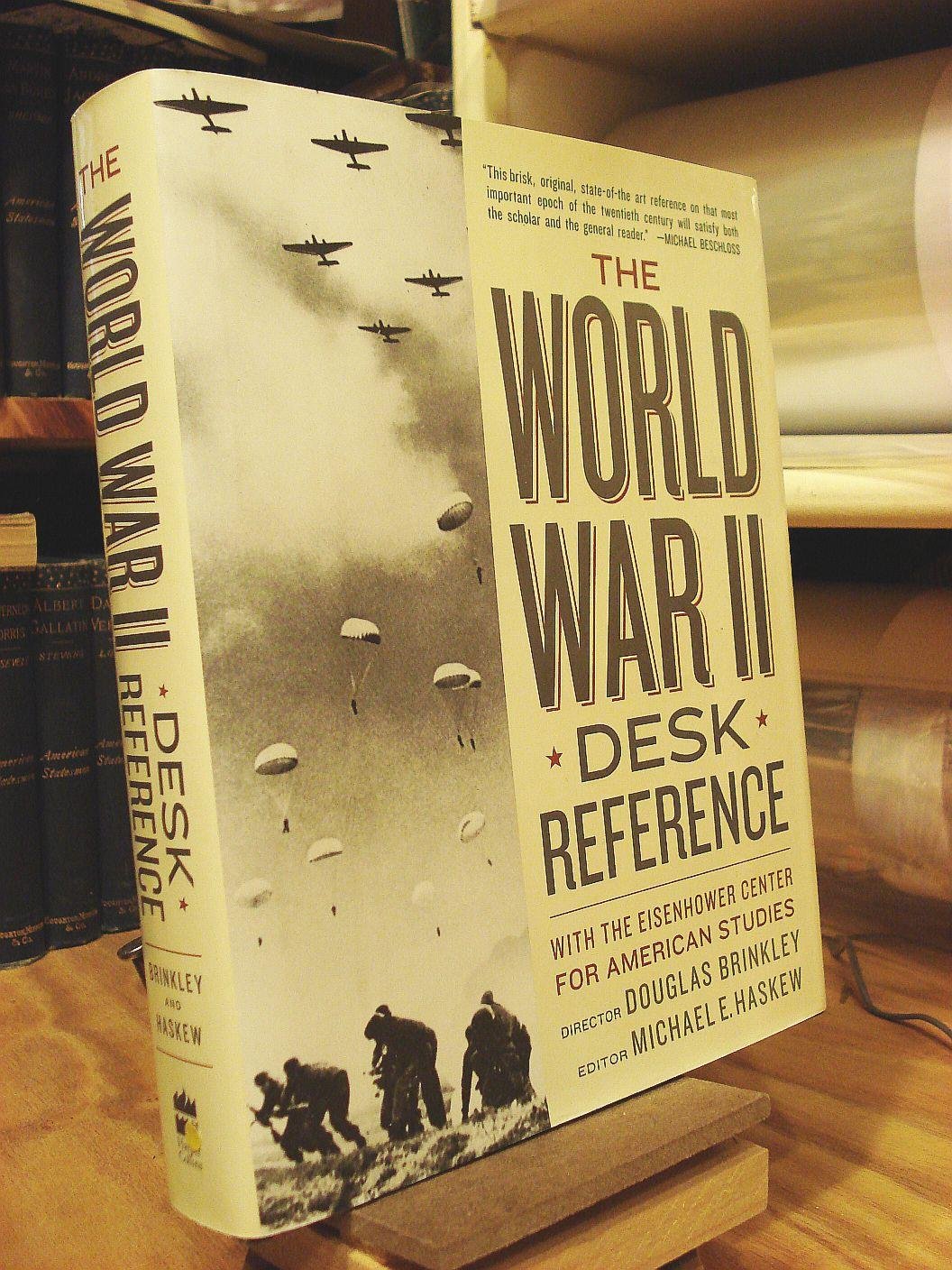



More than 12 million American men and women entered the U.S. armed forces during World War II, and millions more worked and sacrificed at home to help the Allied cause to defeat the Axis powers. At the close of the war, America had become the leading nation on the global stage, and its veterans returned home to forge a vibrant postwar society. Written under the direction of two distinguished historians, The World War II Desk Reference explains in clear prose, backed by rosters of statistics, time lines, and maps, the global cataclysm that was World War II. But this volume is not a typical almanac. With material ranging from battlefronts to important military commanders to armaments, among the backdrop of all the necessary political, social, and economic factors, Douglas Brinkley and Michael E. Haskew's reference will prove invaluable to readers. Photographs, lists, time lines, tables, glossaries, and maps encapsulate many pieces of complicated information, making The World War II Desk Reference immensely browsable. The book also includes a helpful resource on national World War II monuments, organizations, and museums. Throughout the book, you'll find oral histories culled from several sources, including the Eisenhower Center for American Studies at the University of New Orleans, which holds the world's largest repository of valuable letters, journals, and other war-related records. Excerpted from those who fought on both sides, these accounts add a deeply touching, profoundly personal dimension seldom found in other books on World War II. In a modern world plagued by terrorism, dictators, and weapons of mass destruction, Brinkley and Haskew's seminal work reminds us that America's role in World War II led to a truly monumental victory. For World War II enthusiasts, history buffs, and anyone interested in our nation's history, this is the one book to own. More than 12 million American men and women entered the U.S. armed forces during World War II, and millions more worked and sacrificed at home to help the Allied cause to defeat the Axis powers. At the close of the war, America had become the leading nation on the global stage, and its veterans returned home to forge a vibrant postwar society. Written under the direction of two distinguished historians, The World War II Desk Reference explains in clear prose, backed by rosters of statistics, time lines, and maps, the global cataclysm that was World War II. But this volume is not a typical almanac. With material ranging from battlefronts to important military commanders to armaments, among the backdrop of all the necessary political, social, and economic factors, Douglas Brinkley and Michael E. Haskew's reference will prove invaluable to readers. Photographs, lists, time lines, tables, glossaries, and maps encapsulate many pieces of complicated information, making The World War II Desk Reference immensely browsable. The book also includes a helpful resource on national World War II monuments, organizations, and museums. Throughout the book, you'll find oral histories culled from several sources, including the Eisenhower Center for American Studies at the University of New Orleans, which holds the world's largest repository of valuable letters, journals, and other war-related records. Excerpted from those who fought on both sides, these accounts add a deeply touching, profoundly personal dimension seldom found in other books on World War II. In a modern world plagued by terrorism, dictators, and weapons of mass destruction, Brinkley and Haskew's seminal work reminds us that America's role in World War II led to a truly monumental victory. For World War II enthusiasts, history buffs, and anyone interested in our nation's history, this is the one book to own. Douglas Brinkley is the Katherine Tsanoff Brown Chair in Humanities and Professor of History at Rice University, presidential historian for the New-York Historical Society, trustee of the Franklin D. Roosevelt Presidential Library, and a contributing editor at Vanity Fair . The Chicago Tribune dubbed him “America’s New Past Master.” He is the recipient of such distinguished environmental leadership prizes as the Frances K. Hutchison Medal (Garden Club of America), the Robin W. Winks Award for Enhancing Public Understanding of National Parks (National Parks Conservation Association), and the U.S. Fish and Wildlife Service’s Lifetime Heritage Award. His book The Great Deluge: Hurricane Katrina, New Orleans, and the Mississippi Gulf Coast received the Robert F. Kennedy Book Award. He was awarded a Grammy for Presidential Suite and is the recipient of seven honorary doctorates in American studies. His two-volume, annotated Nixon Tapes won the Arthur S. Link–Warren F. Kuehl Prize. He lives in Austin, Texas, with his wife and three children.