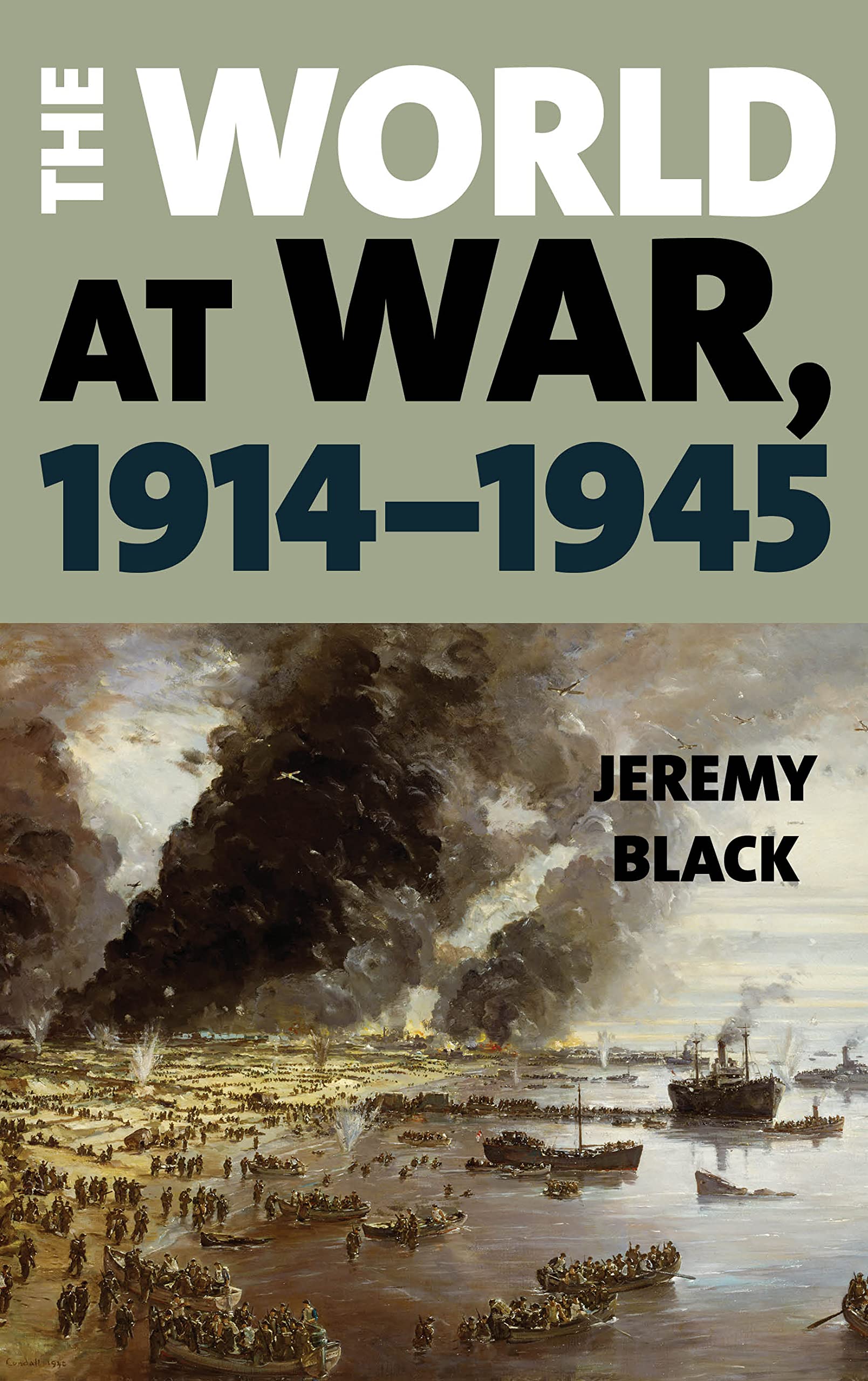



This text provides an innovative global military history that joins three periods―World War I, the interwar years, and World War II. Jeremy Black offers a comprehensive survey of both wars, comparing continuities and differences. He traces the causes of each war and assesses land, sea, and air warfare as separate dimensions. He argues that the unprecedented nature of the two wars owed much to the demographic and industrial strength of the states involved and their ability and determination to mobilize vast resources. Yet the demands of the world wars also posed major difficulties, not simply in sustaining the struggle but also in conceiving of practical strategies and operational methods in the heat and competition of ever-evolving conflict. In this process, resources, skills, leadership, morale, and alliance cohesion all proved significant. In addition to his military focus, Black considers other key dimensions of the conflicts, especially political and social influences and impacts. He thoroughly integrates the interwar years, tracing the significant continuities between the two world wars. He emphasizes how essential American financial, industrial, agricultural, and energy resources were to the Allies―both before and after the United States entered each war. Bringing the two world wars to life, Black sheds light not only on both as individual conflicts but also on the interwoven relationships between the two. “While reading _The World at War, 1914-1945_, by the British academic Jeremy Black, readers will get a strong impression of what British universities are trying to achieve with their history courses. Certainly, there are specific events of the 1914-45 period that are named, of which more later, but what stands out is the author's willingness to foreground the methods British universities use to study history. This book explains the different levels on which war operates: strategic, operational, and tactical. Also, Black explains how history itself is influenced by national, geographic, economic, governmental, and individual views.” ― H-War “This book provides the reader with an innovative global military history that joins three periods―World War I, the interwar years, and World War II. Professor Black offers a comprehensive survey of both wars, comparing continuities and differences. He traces the causes of each war and assesses land, sea, and air warfare as separate dimension in each period. A must read for anyone interested in this time period of military and indeed global history.” ― New Books Network “Jeremy Black’s latest book, The World at War, 1914–1945, engages with recent formulations that treat the two World Wars as part of one unified historical dynamic. . . . The strength of the book lies in its challenge to see the period 1914–45 in ways different from how scholars and popular culture normally present it. . . . Whether or not the men of 1942 understood themselves as finishing the work of their fathers in 1915 may, as The World at War, 1914–1945 challenges us to consider, be the wrong question to ask. Instead readers might ask whether they understood the irony that their imperial service represented, in the wider scheme of history, a critical element in bringing about the end of empires.” ― Parameters: Us Army War College Quarterly “Jeremy Black is at his best in The World at War, 1914–1945. He skillfully synthesizes the premier scholarship of recent years with the seminal works from earlier decades. The resulting survey paints history’s two bloodiest conflicts not merely in broad strokes but also in fine details.” ―David J. Ulbrich, co-author of Race and Gender in Modern Western Warfare “Jeremy Black has provided another masterful work for the understanding of modern war and history. In examining the twentieth-century world wars from the aspects of strategy, logistics and resources, operational planning, effective leadership, economics, alliance relations, and peoples and societies in conflict, he highlights the commonalities of the two wars but also challenges the long-held notion of a linear interpretation of world war from 1914 to1945.” ―Stan Carpenter, US Naval War College “What happened in the world of warfare between the opening guns of ‘The Great War’ and the end of a second world war? Jeremy Blackshows that attempts to tie the conflicts too closely ignore the strategic dimensions that are at least as important as battle in understanding them. His narrative spans both wars and the years between, but Black chooses land, sea, and air warfare as his organizing principles, guiding the reader smoothly through each period’s biggest lessons learned or ignored by contemporaries. His clarity and logic will be very helpful to students new to the complexity of the literature on this vital era. Black’s postscript is a reminder to historians and educators overly willing to succumb to the convenient notion of ‘The Long War’ that so easily links 1914–1918 and 1939–1945. He calls that