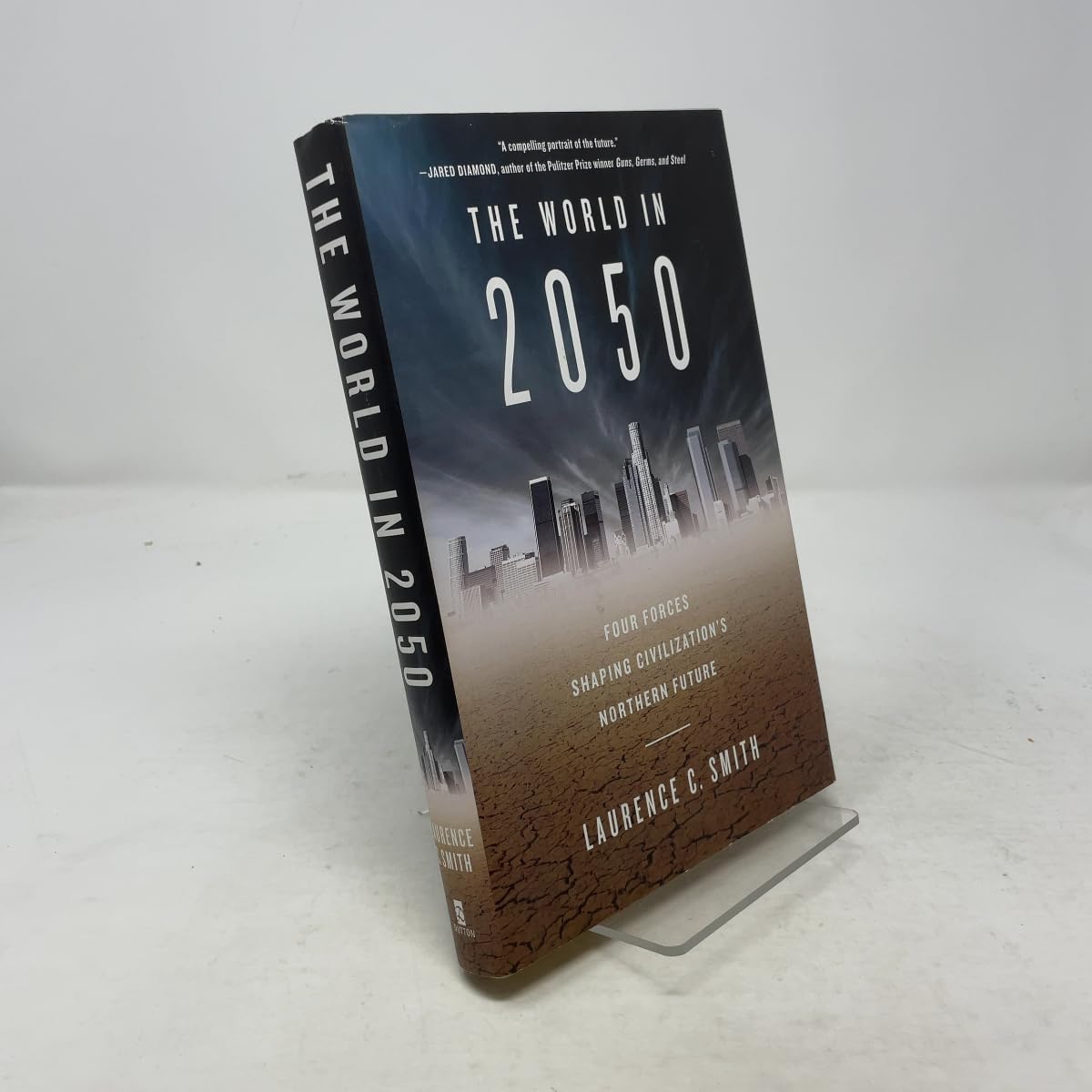
The World in 2050: Four Forces Shaping Civilization's Northern Future
$16.14
by Laurence C. Smith



A vivid forecast of our planet in the year 2050 by a rising star in geoscience, distilling cutting-edge research into four global forces: demographic trends, natural resource demand, climate change, and globalization. The world's population is exploding, wild species are vanishing, our environment is degrading, and the costs of resources from oil to water are going nowhere but up. So what kind of world are we leaving for our children and grandchildren? Geoscientist and Guggenheim fellow Laurence Smith draws on the latest global modeling research to construct a sweeping thought experiment on what our world will be like in 2050. The result is both good news and bad: Eight nations of the Arctic Rim (including the United States) will become increasingly prosperous, powerful, and politically stable, while those closer to the equator will face water shortages, aging populations, and crowded megacities sapped by the rising costs of energy and coastal flooding. The World in 2050 combines the lessons of geography and history with state-of-the-art model projections and analytical data-everything from climate dynamics and resource stocks to age distributions and economic growth projections. But Smith offers more than a compendium of statistics and studies- he spent fifteen months traveling the Arctic Rim, collecting stories and insights that resonate throughout the book. It is an approach much like Jared Diamond took in Guns, Germs, and Steel and Collapse , a work of geoscientific investigation rich in the appreciation of human diversity. Packed with stunning photographs, original maps, and informative tables, this is the most authoritative, balanced, and compelling account available of the world of challenges and opportunities that we will leave for our children. How will civilization change over the next 40 years if humanity balloons to nine billion, sea level rises by a foot and atmospheric temperature by several degrees, and globalization continues apace? From those assumptions, Smith, a university-employed geophysicist, posits answers with a focus on the Arctic Ocean and its coastline. Familiar with the Far North through scientific field trips, Smith embeds personal observations into his predictions about the effects of boreal warming. Becoming more accessible to ships, Arctic regions in Russia, Alaska, and Canada will experience a raw-materials bonanza, with oil, natural gas, minerals, and water resources likely to be exploited as permafrost melts and summer sea ice recedes. Festooned with data, his discussions of such prospects valuably avoid either environmental or industrial advocacy and lay a factual foundation for his readers to learn how demographic and economic trends in the world’s southerly population belts might influence development of the Arctic. Concluding with a half-dozen events that could upset his forecast, Smith exhibits trend-spotting skill in this readable account of the Arctic frontier. --Gilbert Taylor "[The World in 2050] is a lively and impressive book, among the first in what promises to be an important publishing category, the explication of how the human landscape will be altered by artificially triggered climate change." - Wall Street Journal "Smith's planetary palm-reading would be impressive enough, but he also managed to pull it off with literary gusto. He combines a wide-angle-lens analysis reminiscent of Jared Diamond with a knack for narrative, including tales of numerous visits to the Arctic." - New Scientist "Cleverly executed." - Mother Jones "One of the most head-turning books I've ever come across recently." -Thomas PM Barnett, World Politics Review "A charismatic rising star vividly relates the big challenges facing the world." -Jared Diamond, author of the Pulitzer Prize winner Guns, Germs, and Steel and Collapse "This is a blockbuster of clear argument, sophisticated use of multiple empirical sources, and cogent writing that makes a convincing case for the emergence of the deep Global North as the main beneficiary of emerging climatic and economic trends. Intelligently discussing the future requires exactly the balance of discerning empirical analysis and wise interpretive judgment to be found here." -John Agnew, Professor of Geography UC, Los Angeles Laurence C. Smith is vice chairman and professor of geography and professor of earth and space sciences at UCLA. In 2006, he briefed Congress on the likely impacts of northern climate change, and in 2007 his work appeared prominently in the Fourth Assessment Report of the United Nations' Intergovernmental Panel on Climate Change. He lives in Los Angeles with his wife, drinking water imported from hundreds of miles away. Laurence C. Smith is vice chairman and professor of geography, and professor of earth and space sciences at UCLA. He has briefed Congress on the likely impacts of northern climate change, and his work appeared prominently in the Fourth Assessment Report of the Unit