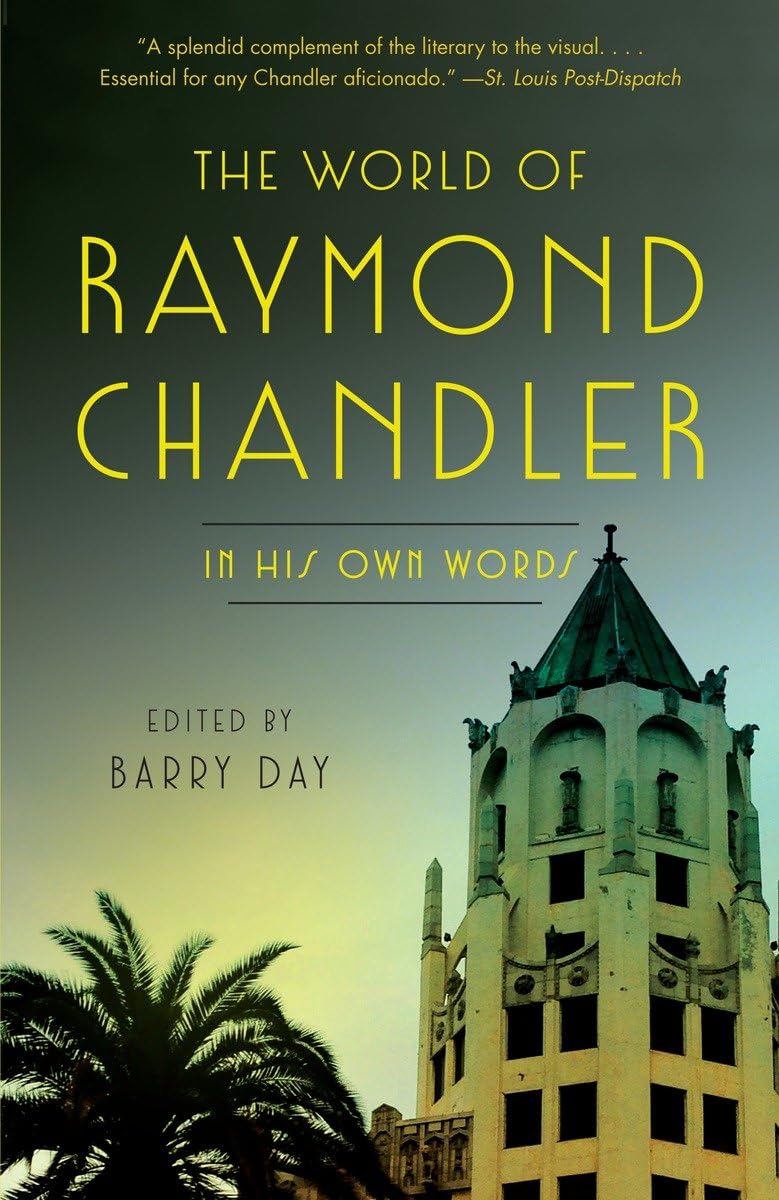
The World of Raymond Chandler: In His Own Words (Vintage Crime/Black Lizard)
$16.24
by Raymond Chandler



The World of Raymond Chandler shows how Chandler precariously balanced the values of a classical English education against those of a fast-evolving America during the years before the Great War; how he adopted Los Angeles as his home after WWI, with Hollywood in turn adopting him (and adapting his works); how his detective hero and alter ego Philip Marlowe evolved over the years; and, above all, what it is to be a writer, and in particular one writing in the “other language” of hardboiled fiction. Acclaimed biographer and historian Barry Day deftly interweaves images and text, using quotations from Chandler’s novels, short stories, letters, and interviews, to craft a unique portrait of the mystery writer’s life and times. “Terrific . . . Day allows Chandler to elucidate [his] vision himself. He was a penetrating, thwarted, breathtakingly intelligent person.”— The New York Times Book Review “A fresh new opportunity to savor the melancholy magic of a private eye so often found sitting alone in his small Hollywood office.” — The Wall Street Journal “Barry Day stretches Chandler’s limber language like a skein across the skeleton of his life, knitting in the spaces in between with his own editorial commentary. . . . Even the greenest Chandler novice may find much here that tantalizes.” — The New York Times “A tour of Chandler’s sinister, neon-lit world. . . . A splendid complement of the literary to the visual. . . . Essential for any Chandler aficionado.” — St. Louis Post-Dispatch “A remarkable book. . . . A fascinating and convincing portrait of a writer who, using the material of his own life and his convictions, refined pulp into literature. More than any biography I’ve read, this book stirred in me a new sympathy for Chandler to match the admiration I’ve always felt.” —Dean Koontz, bestselling author of What the Night Knows “A solid introduction to Chandler’s work. It includes some fine stuff you won’t find in other bios and illuminates Chandler’s life and times ‘like a swung curtain of crystal beads’.” — The Boston Globe “Will equally satisfy his fans and readers unfamiliar with the noir master.” — Shelf Awareness “I enjoyed every page. I’ve had a collection of Chandler stories waiting unread on my shelf for years and years ( The Simple Art of Murder ). Barry Day’s The World of Raymond Chandler has prompted me to pull it down and place it at the top of my queue. I can’t think of any higher praise.” —Scott Smith, author of A Simple Plan “Barry Day’s book is a welcome reminder of just what a great writer Raymond Chandler was, and also illuminates his life—Who knew he went to an English public school?—and the whole phenomenon of Los Angeles, and the way then and now the sleazy and the corrupt live cheek by jowl with the rich and glamorous. A pleasure to read!” —Michael Korda, author of Hero and Clouds of Glory Barry Day was born in England and received his M.A. from Balliol College, Oxford. Day has written about Dorothy Parker, Oscar Wilde, Johnny Mercer, P. G. Wodehouse, and Rodgers and Hart. He has written and produced plays and musical revues showcasing the work of Noël Coward, the Lunts, Oscar Wilde, and others. Day is a Fellow of the Royal Society of Arts and a Trustee of the Noël Coward Foundation and was awarded by Queen Elizabeth the Order of the British Empire for services to British culture in the U.S. He lives in New York, London, and Palm Beach. Five The City of the angels Scattered diamond points at first, the lights drew together and became a jeweled wristlet laid out in the show window of the night. —“The Man Who Liked Dogs” “Everything’s for sale in California.” — The Lady in the Lake “We make the finest packages in the world, Mr. Marlowe. The stuff inside it is mostly junk.” —Harlan Potter in The Long Goodbye “a big hard-boiled city with no more personality than a paper cup.” “It is the same in all big cities, amigo.” — The Little Sister I smelled Los Angeles before I got to it. It smelled stale and old like a living room that had been closed too long. But the colored light fooled you. — The Little Sister Crime writer Ross Macdonald—considered by many to be the leading neo-Chandler—wrote that Chandler “invested the sun-blinded streets of Los Angeles with a romantic presence.” But the romance was strictly of the film noir variety. It was a time when the city was trying to carve out an identity for itself. There are those who will tell you it still is. Hollywood was not the whole of Los Angeles; but in a very unreal sense, all of Los Angeles was Hollywood. Architectural imagination ran riot. French châteaux sat cheek by jowl with Tudor castles and Italian villas. You might go to a restaurant like the Brown Derby, built to resemble a hat, or a bank that resembled an animal. A bottling plant a block long might have the exterior of an ocean liner with portholes for windows; a cinema posed as a Chinese pagoda—and still does. Ever