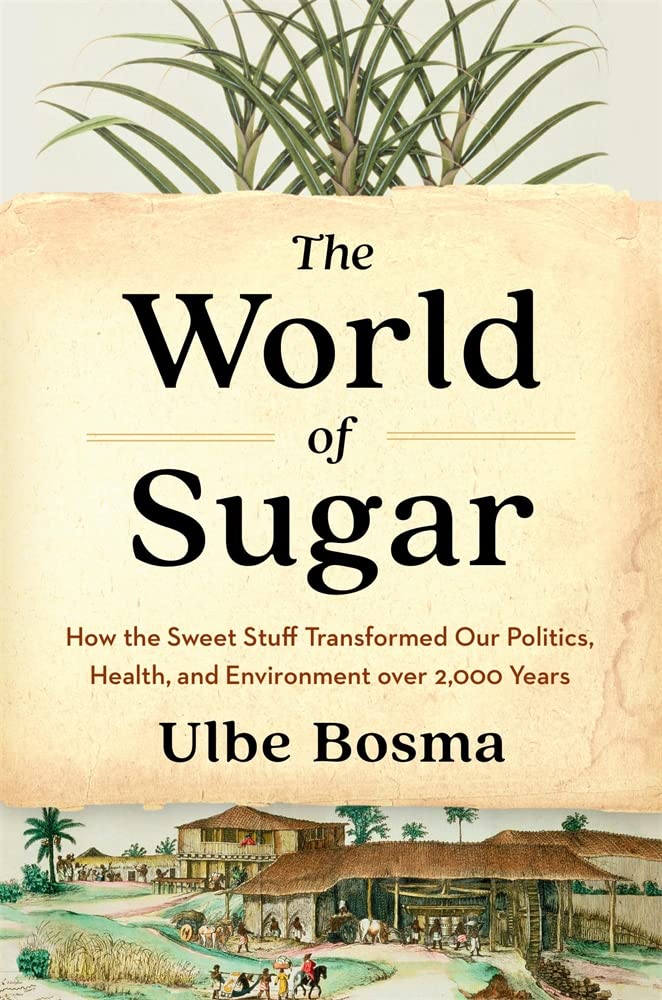
The World of Sugar: How the Sweet Stuff Transformed Our Politics, Health, and Environment over 2,000 Years
$32.62
by Ulbe Bosma



“[A] tour de force of global history…Bosma has turned the humble sugar crystal into a mighty prism for understanding aspects of global history and the world in which we live.”― Los Angeles Review of Books The definitive 2,500-year history of sugar and its human costs, from its little-known origins as a luxury good in Asia to worldwide environmental devastation and the obesity pandemic. For most of history, humans did without refined sugar. After all, it serves no necessary purpose in our diets, and extracting it from plants takes hard work and ingenuity. Granulated sugar was first produced in India around the sixth century BC, yet for almost 2,500 years afterward sugar remained marginal in the diets of most people. Then, suddenly, it was everywhere. How did sugar find its way into almost all the food we eat, fostering illness and ecological crisis along the way? The World of Sugar begins with the earliest evidence of sugar production. Through the Middle Ages, traders brought small quantities of the precious white crystals to rajahs, emperors, and caliphs. But after sugar crossed the Mediterranean to Europe, where cane could not be cultivated, demand spawned a brutal quest for supply. European cravings were satisfied by enslaved labor; two-thirds of the 12.5 million Africans taken across the Atlantic were destined for sugar plantations. By the twentieth century, sugar was a major source of calories in diets across Europe and North America. Sugar transformed life on every continent, creating and destroying whole cultures through industrialization, labor migration, and changes in diet. Sugar made fortunes, corrupted governments, and shaped the policies of technocrats. And it provoked freedom cries that rang with world-changing consequences. In Ulbe Bosma’s definitive telling, to understand sugar’s past is to glimpse the origins of our own world of corn syrup and ethanol and begin to see the threat that a not-so-simple commodity poses to our bodies, our environment, and our communities. “A tour de force of global history…Bosma has turned the humble sugar crystal into a mighty prism for understanding aspects of global history and the world in which we live.” ― Dinyar Patel , Los Angeles Review of Books “ The World of Sugar shows the globalized tangle of interests that capitalism creates among consumers, producers, investors, labor, national governments, and transnational organizations…Sugar offers a bitter reminder of the enduring tensions between the complexity of national interests and the interests of capital.” ― Bronwen Everill , Foreign Policy “One of the most accomplished longue durée case studies in the history of capitalism that we have, concerned not just with trade and consumption but with production also. At every turn it subverts both critiques and celebrations of capitalism, and our understanding of much else besides. It is an extraordinary achievement.” ― David Edgerton , Literary Review “Sugar’s societal dominance is a recent development…Its history is both a story of progress and a bittersweet tale of ‘exploitation, racism, obesity, and environmental destruction’…[An] authoritative, highly readable study―the first to be truly global.” ― Andrew Robinson , Nature “Bosma lucidly depicts how a commodity that is challenging to cultivate and devoid of nutritional value was central to the development of European imperialism, transatlantic slavery, the Industrial Revolution, economic protectionism, and the postcolonial politics and environmental degradation of the Global South. Bosma’s wide-ranging accounting is full of eye-opening insights…This is a comprehensive and alarming look at how one commodity changed the world.” ― Publishers Weekly “Bosma revisits the technical innovations, economic arrangements, and pains of a world submitting to the joy and addictiveness of sugar. His insights into the present are all the more resounding.” ― Julien Damon , L'Express “Bosma traces how sugar has fundamentally ‘changed how we feed ourselves’…The ubiquity of sugar, writes Bosma, tells us about progress but also reveals a darker story of human exploitation.” ― Sudipta Datta , The Hindu “Takes you on a journey of discovery―the journey of sugar itself, which has gone from relative obscurity to becoming an indispensable part of modern diet, causing untold harm in the process.” ― BooksFirst “Covers the history of the sweet stuff, first produced in granulated form in the 6th century BC, but not a huge commodity until more than two millennia later. This is…a reckoning with sugar.” ― Sophie Roell , Five Books “A comprehensive 2,500-year examination of sugar’s history and its profound impact on society and the environment. Ulbe Bosma traces sugar’s journey from a luxury good in ancient India to a ubiquitous ingredient in our diets today, underscoring its role in fostering health issues and environmental crises. Bosma highlights how sugar has altered cultures and shaped political polici