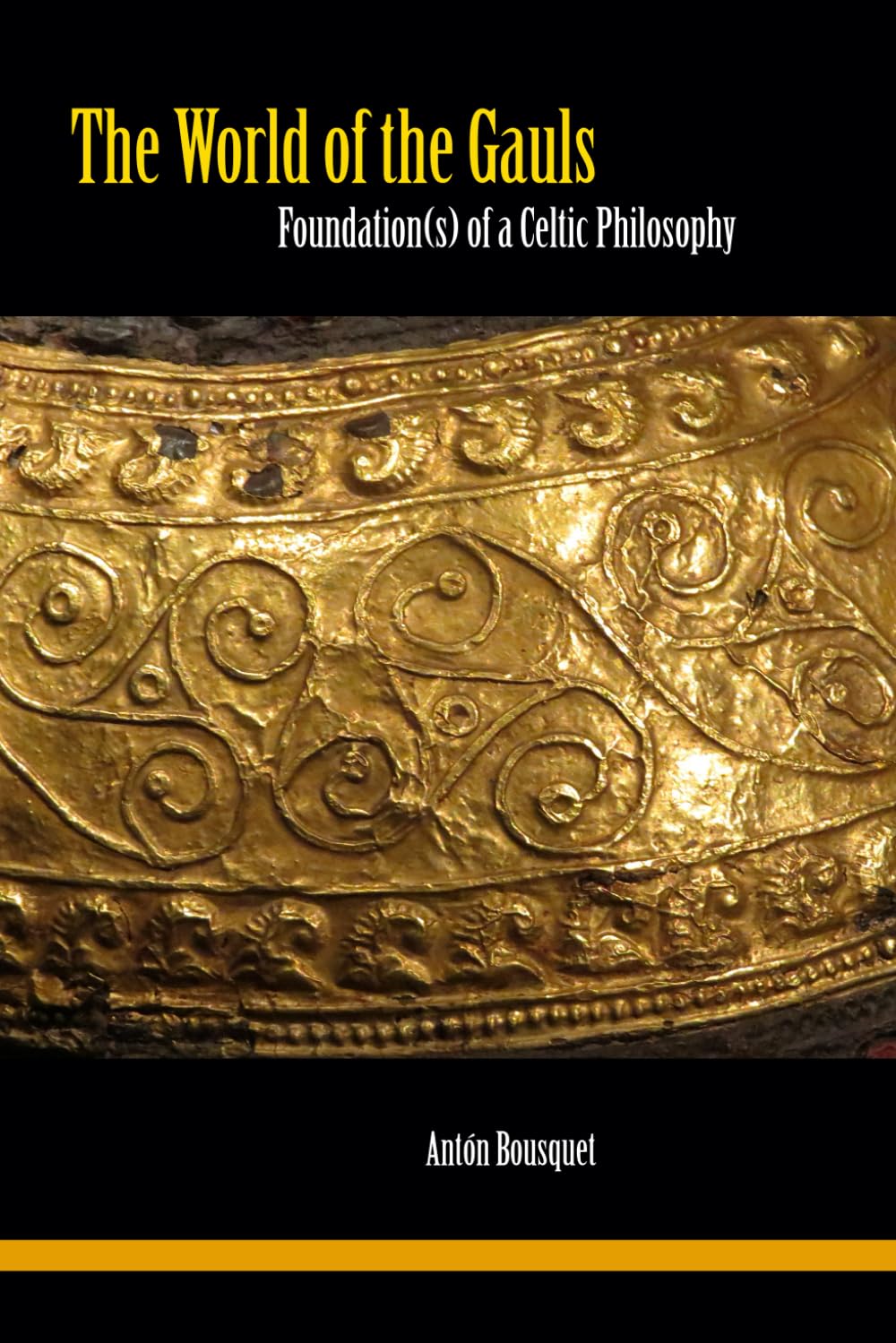



(Last Revised: February 2026) More than two millennia after the Roman conquest that marked the beginning of the decline of the Gaulish tongue and culture, traces of the world of the Gauls still pervade their land. The Gauls deliberately refused to put their worldview into writing, but they nonetheless left a foundation, buried in the soil in the form of artifacts or written in the manuscripts of their neighbors. The artworks of the Gauls, in particular, represent an invaluable source concerning the way the early Celts viewed the creation. More than mere folklore, it is a genuine philosophy that may be seen in the images that they carved on rocks, stamped on coins, or cast in bronze. The world of the Gauls is definitely gone, but faint traces of its foundations remain, and these scattered remnants can become the basis for the construction of something new, a philosophy that will not be a faithful reconstruction of the philosophy of the ancient Celts, now irretrievably gone, but one sharing common roots with it. The present work examines these remnants and uses them as the starting point of a modern Celtic philosophy. The core of the old worldview is the tripartition of the creation into three realms: the first is the Dubnos, which is the Dark and the Deep, the earth, the waters, and the shadows of the night. The “middle realm” is Bitu, Life and Being, which is characterized by the color of blood, of dawn, and of dusk. Finally, the last one is the Albios, which is the Bright, the light of the skies that illuminates the day, and the immaterial world. The three realms of nature, to which the Gauls associated different gods, were portrayed as being at war with one another, as reflected in their central myth, and it is through this harmonious strife that the world can flourish and man accomplish his destiny. Because of the total absence of philosophical writings by the Gauls themselves, this book heavily relies on the thought of philosophers whose worldview resonates particularly well with the shards of the Gaulish world, especially that of Martin Heidegger and Heraclitus, to create a new vision of what the ancient worldview of the Gauls may have looked like. About the author: Antón Bousquet is an independent researcher specializing in the philosophy of language, the philosophy of religion, and comparative cultural studies. He holds a Master’s degree in Linguistics from the University of Grenoble III in France and a Ph.D. in Comparative Literature and Intercultural Studies from Fu Jen Catholic University in Taiwan. A former teacher of French as a foreign language, he has worked in different parts of Europe, the Middle East, and Asia.