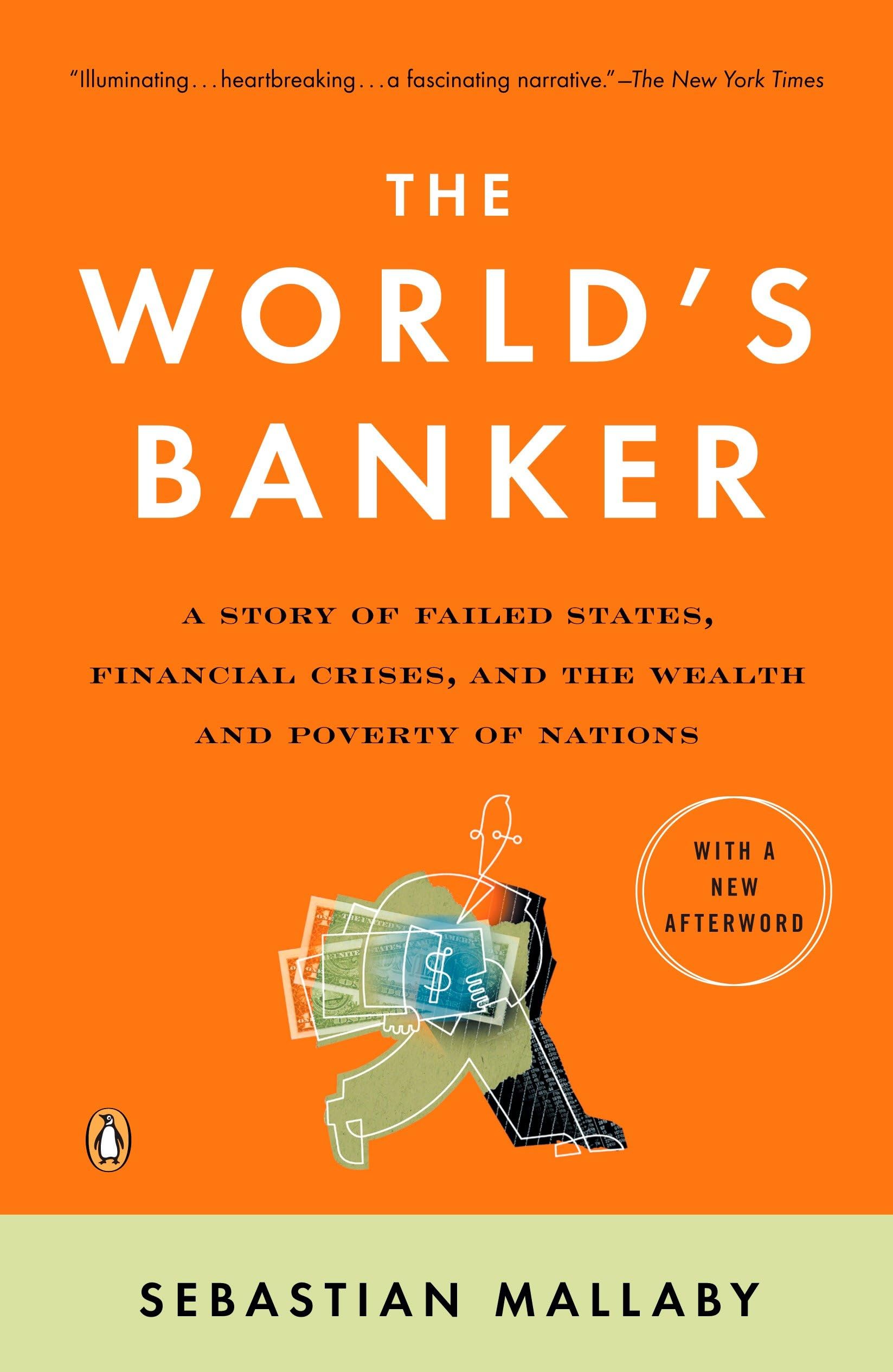
The World's Banker: A Story of Failed States, Financial Crises, and the Wealth and Poverty of Nations (Council on Foreign Relations Books (Penguin
$22.00
by Sebastian Mallaby



Never has the World Bank's relief work been more important than in the last nine years, when crises as huge as AIDS and the emergence of terrorist sanctuaries have threatened the prosperity of billions. This journalistic masterpiece by Washington Post columnist Sebastian Mallaby charts those controversial years at the Bank under the leadership of James Wolfensohn—the unstoppable power broker whose daring efforts to enlarge the planet's wealth in an age of globalization and terror were matched only by the force of his polarizing personality. Based on unprecedented access to its subject, this captivating tour through the messy reality of global development is that rare triumph—an emblematic story through which a gifted author has channeled the spirit of the age. This edition features a new afterword by the author that analyzes the appointment of Paul Wolfowitz as Wolfensohn's successor at the World bank "A sophisticated, evenhanded take on the [World Bank's] last decade of development efforts... Illuminating... heartbreaking... a fascinating narrative." — The New York Times "An excellent read... [Mallaby] has a talent for brilliant writing and penetrating analysis." — Financial Times Sebastian Mallaby is the author of several books, including The Power Law , More Money Than God, The Man Who Knew, and The World's Banker . A former Financial Times contributing editor and two-time Pulitzer Prize finalist, Mallaby is the Paul A. Volcker Senior Fellow for International Economics at the Council on Foreign Relations. Chapter One A TALE OF TWO AMBITIONS On Friday, September 14, 2001, President George W. Bush led a televised prayer service in Washington's National Cathedral. He invoked the heroes of three days before: inside the World Trade Center, a man who could have saved himself had stayed and died beside his quadriplegic friend; a priest died giving the last rites to a firefighter; two office workers, finding a disabled stranger, carried her down sixty-eight floors to safety. We feel, said the president, what Franklin Roosevelt called the "warm courage of national unity." And he spelled out the next steps. "Our responsibility to history is already clear: to answer these attacks and rid the world of evil." Meanwhile another memorial service was under way in another part of Washington. In what passes for the capital's business district, two blocks west of the White House, two thousand people gathered in the glass-fronted atrium of the World Bank's headquarters. In an institution with employees from more than a hundred countries, including a large number of Muslims, the attacks of September 11 had induced a trauma of a special kind. Along with the fear felt by everyone in Washington-that more and nastier attacks might follow soon-there was the fear that life in the United States would become less secure for people with Pakistani or Saudi or Afghan passports. And there was the fear-which only grew as the president's rhetoric evolved-that friends and family abroad could somehow find themselves on the wrong side of a new global divide-the side that President Bush now classified as "evil." The World Bankers gathered in the atrium, where the walls rise, cathedral-like, thirteen stories above the marble floor to a roof composed of glass; and where, in place of the baptismal basin and Christian inscription, there is an internal lake fed by an internal waterfall, and a sign proclaiming, OUR DREAM IS A WORLD FREE OF POVERTY. The staff packed into this atrium, displacing the kiosk displays on work stress and business communication that often furnish its vast space, and watched their president face them from a stage: a silver-haired, barrel-chested, twinkly eyed man-a sort of Santa Claus without the beard and costume. "I am not a preacher and I surely don't represent all the religions here," the president began, "but in this room we have a microcosm of the world. We have one hundred forty nations. We have Christians and Muslims and Jews and Buddhists and Sikhs.... We as a family can be a light for each other and for our community and for the world, because we are charged with the most significant challenge of all: to relieve poverty, and to improve the lives of our fellow men, and give our children a chance for peace and hope.... Ours is a noble task," he added. To relieve poverty and so create a space for peace: Over the next few weeks James Wolfensohn, who is more of a preacher than he allows, built upon this theme, offering a response to 9/11 that contrasted markedly with President Bush's promise to "rid the world of evil." In Wolfensohn's view, an understanding of the terrorist attacks began with the big picture: In a world of 6 billion people, half lived on less than $2 per day, and a fifth subsisted with not even a dollar. In the next twenty-five years, moreover, the world's population would swell by a further 2 billion, and all but 50 million of these would live in poverty-afflicted countries. Even if no simpl