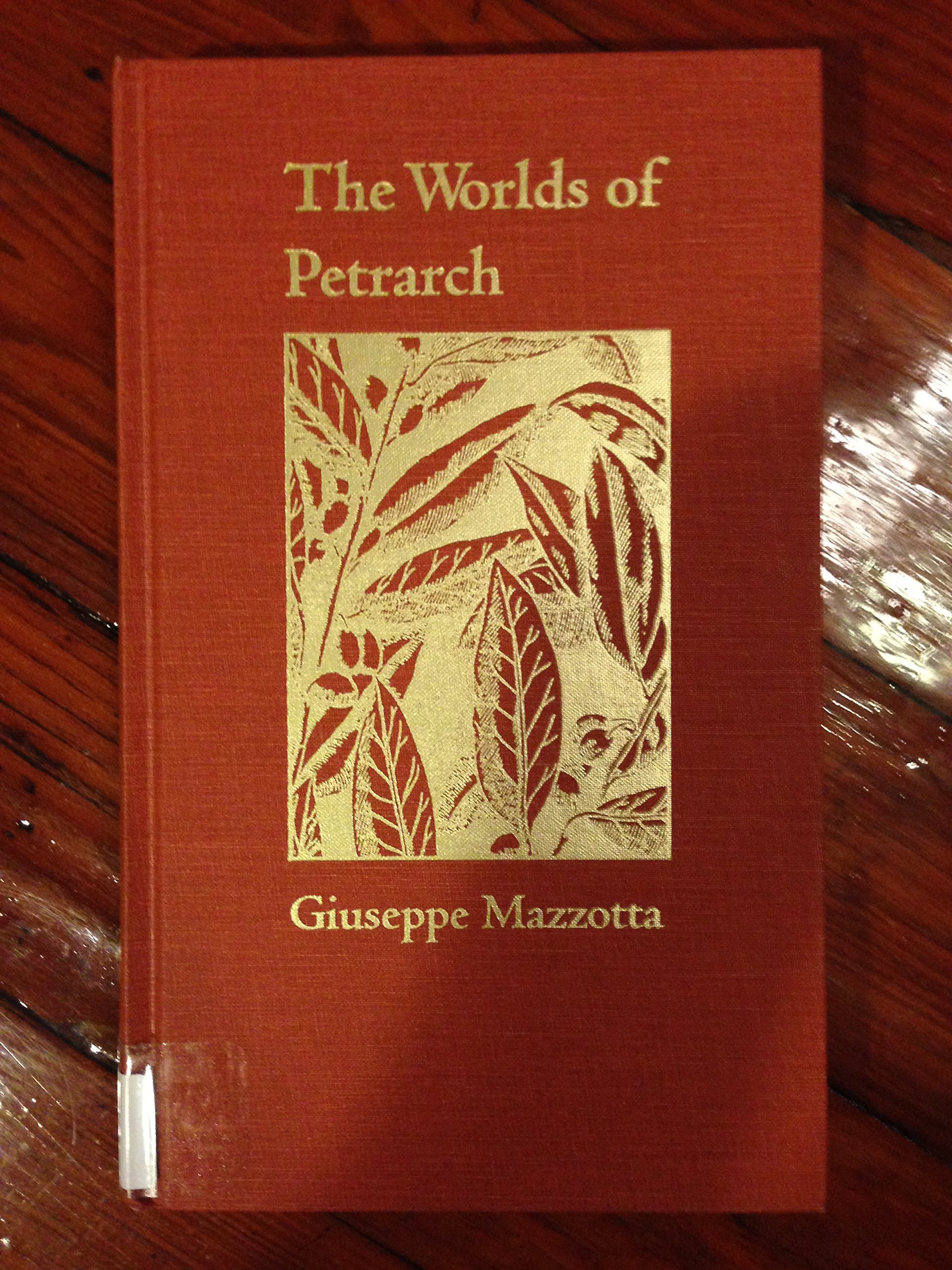
The Worlds of Petrarch (Duke Monographs in Medieval and Renaissance Studies)
$127.95
by Giuseppe Mazzotta



At the center of Petrarch's vision, announcing a new way of seeing the world, was the individual, a sense of the self that would one day become the center of modernity as well. This self, however, seemed to be fragmented in Petrarch's work, divided among the worlds of philosophy, faith, and love of the classics, politics, art, and religion, of Italy, France, Greece, and Rome. In recent decades scholars have explored each of these worlds in depth. In this work, Giuseppe Mazzotta shows for the first time how all these fragmentary explorations relate to each other, how these separate worlds are part of a common vision. Written in a clear and passionate style, The Worlds of Petrarch takes us into the politics of culture, the poetic imagination, into history and ethics, art and music, rhetoric and theology. With this encyclopedic strategy, Mazzotta is able to demonstrate that the self for Petrarch is not a unified whole but a unity of parts, and, at the same time, that culture emerges not from a consensus but from a conflict of ideas produced by opposition and dark passion. These conflicts, intrinsic to Petrarch's style of thought, lead Mazzotta to a powerful rethinking of the concepts of "fragments" and "unity" and, finally, to a new understanding of the relationship between them. "A very important study. Mazzotta not only gives us a dense and rich new portrait of a much-studied and absolutely major figure, but he also brings to the fore the abiding force and value of Petrarch's 'worlds' of discourse and thought to many of today's debates regarding, for example, the relation of aesthetics and rhetoric to the politico-historical realm, or the epistemological validity of poetry, or the constructedness of the self."—Rebecca West, University of Chicago "A richly textured, deeply learned, and broadly inclusive study of Petrarch's writing, his historical situation, and his contribution to our own cultural formation."—William Kennedy, Cornell University "A richly textured, deeply learned, and broadly inclusive study of Petrarch's writing, his historical situation, and his contribution to our own cultural formation."--William Kennedy, Cornell University Giuseppe Mazzotta is Professor and Chair, Italian Language and Literature Department, Yale University. His is the author of Dante, Poet of the Desert, The World at Play , and Dante's Vision and the Circle of Knowledge. The Worlds of Petrarch By Giuseppe Mazzotta Duke University Press Copyright © 1993 Duke University Press All rights reserved. ISBN: 978-0-8223-1363-2 Contents Acknowledgments, Note on Petrarch's Texts, Petrarch's Works, Translations, Introduction, Chapter I: Antiquity and the New Arts, Chapter II: The Thought of Love, Chapter III: The Canzoniere and the Language of the Self, Chapter IV: Ethics of Self, Chapter V: The World of History, Chapter VI: Orpheus: Rhetoric and Music, Chapter VII: Humanism and Monastic Spirituality, Appendix 1: Petrarch's Song 126, Appendix 2: Ambivalences of Power, Notes, About the Author, CHAPTER 1 Antiquity and the New Arts * * * The convention of partitioning history according to distinguishable and discrete intellectual periods has not gone unchallenged in recent times. Historiographic categories such as "Renaissance," "modernity," and "Middle Ages" continue to retain at least a nominal validity as terms of chronological demarcation (certainly useful for primers of literary history), but the historical specificity of each epoch, which in the nineteenth century could be defined with ease, is now hard to pinpoint. In 1870 Francesco De Sanctis published his Storia della letteratura italiana, which is shaped by the Hegelian belief in the organic, teleological process of history. The security of the Hegelian historiographic model, wherein contradictory individual phenomena can be manipulated into an overarching totality or significant unity, is in question from a variety of perspectives. Paradoxically, two radically contrasting premises about history usually end up agreeing in their dismissal of historical boundaries. These boundaries are arbitrary, it is said, because "human nature tends to remain much the same in all times." The judgment is underwritten by those who believe in the irreducible individuality of each spiritual and artistic experience. But the major doubts about the legitimacy of traditional historical periodizations occur to scholars who, engaged as they are in interpretive practices, inevitably come to discover that data cannot be rigidly classified or epistemological breaks identified and to recognize the crudeness of the notion of originality and foundation in literary history. They discover, in short, that textual details do not always fit the generality of formulas established a priori and that canons of a culture repress or exclude what may contradict the myths of that culture. These doubts have been recently reinforced by deconstructive modes of analysi