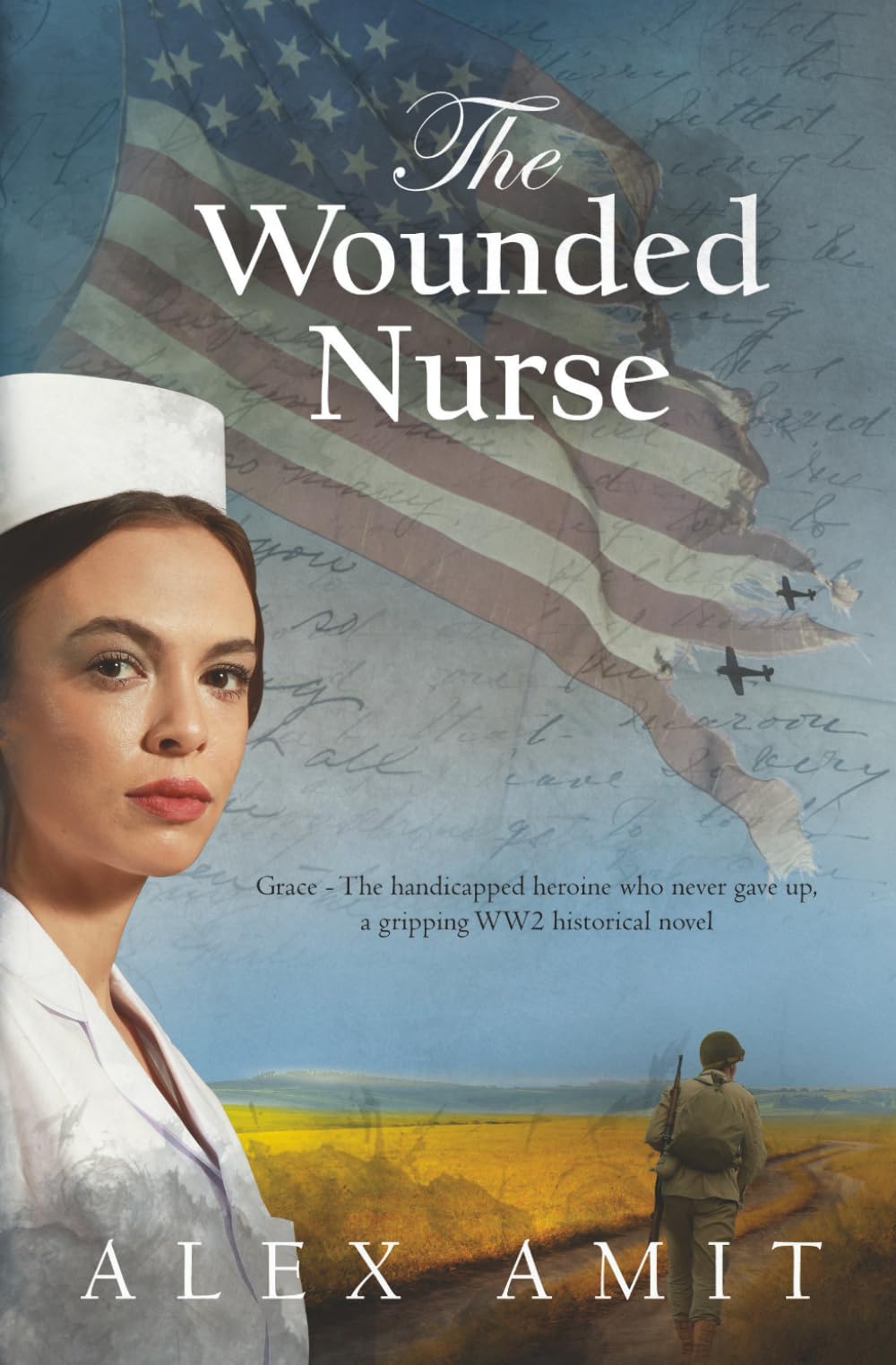



"I wanted to save lives, but I discovered that war wounds everyone. I also discovered the power of willpower and love." World War II, Italy 1944. Grace, a new nurse, arrives at the front. She dreams of saving the lives of soldiers, but a few days later she gets badly injured, and her dreams are shattered among explosions and bullets whistling. Lying in her hospital bed, Grace refuses to face reality and is unwilling to return home to the US. She wants to recover and become a nurse again, even though her body will never be as it was before her injury. But her journey of recovery will be a long one, and at night Grace starts reading letters to John, a wounded soldier lying on the bed beside her. She must do something to distract her pain. Step by step, in the chaos of the war around her, Grace tries to find the one who will love her. Step by step, Grace struggles to recover and love herself again. "It's definitely an unforgettable story and it just gets more beautiful and moving as it goes on until it reaches its conclusion which is a perfect ending. I absolutely loved it." - Net Galley Reviews "A triumph of two people learning to deal with their disabilities after tragic circumstances. If anyone wants to learn what it's like trying to cope with a new disability or trying to see through the eyes of a disabled person, this is the book to read.. " - Net Galley Reviews "You're no longer a nurse, you're a cripple who should have been sitting on the deck of a U.S. Army hospital ship on your way to New York Harbour, drinking hot American Army milk and being excited to see the Statue of Liberty appear on the horizon."- Net Galley Reviews " I truly felt like it was my finger in the soldier's wound attempting to stop the bleeding!"- Net Galley Reviews ⭐⭐⭐⭐⭐ "Few authors imbue their tales of individual valor in wartime with the degree of honoring the feminine victims in the manner that he relates this sensitive and empowering novel." - Amazon Hall of Fame Top 50 Reviewer ⭐⭐⭐⭐⭐ Excerpt. © Reprinted by permission. All rights reserved. Italy, front line south of Rome, field hospital, April 1944. "Are you the new nurse? Put your finger here," the doctor instructs me, and I press my fingers to the open wound in the chest of the wounded soldier as he lies on a stretcher placed in front of us on the simple wooden operating table. "My name is Grace," I answer, ignoring my blood-soaked fingers as I try to stop the wounded man's bleeding as best I can. "Vascular Scissors." He speaks quietly, and I collect them from the metal tray next to me, placing them in his hand. The tray is full of surgeons' chisels, sewing materials, and syringes. I must not make mistakes. Even though it was bright outside, it was was dark inside the tent, except for a dim yellow light from a lamp hanging from the tarp roof. It sways from side to side in the wind that shakes the tent sheets. In the weak light, I struggle to find the right spot to tack my fingers while the wounded soldier continues to bleed. I must succeed. The faint sound of raindrops that have been hitting the tarpaulin for three days interferes with my concentration. It is only disturbed by the sound of the scalpel blades or scissors I throw onto the stainless steel tray with sharp rings of metal. I can also hear the constant growl of cannon batteries firing in the distance, their muffled voices continuing unabated. "Now try to take your finger off," the doctor instructs me after finding the point of injury and blocking it. I move my fingers away as he quickly stitches the exposed skin. "Cut another strip off his uniform and disinfect immediately afterwards." I take my hands off the wound, hold the scissors, and quickly cut his torn uniform. It's soiled with mud and blood that have mixed together, until it's impossible to tell what's what. I throw the strips of cut cloth onto the muddy ground, then grab the bottle of alcohol and some cotton wool. I start cleaning the wounded soldier's skin, feeling his body shivering at the sting of disinfectant. I have to hurry, soon they'll be bringing in another wounded soldier. This one was also waiting to one side, lying in his stretcher, until we were finished taking care of the one before him. I've lost count of the number of wounded soldiers I've treated in the last few days. "How long have you been with us?" the doctor asks me. "This is my fourth day." I stand proudly. I've hardly slept for the last three nights, working in this tent since I arrived at this hospital and the attack on the German lines began. "The wound has reopened. Put your fingers on it again," the doctor speaks a little louder, and I toss the alcohol-soaked cotton swab and the scissors onto the metal tray, ignoring the jarring sound of metal hitting metal. My fingers are tucked into the open wound again, trying to stop the flow of blood staining the soldier's pale skin crimson. "Where's another nurse?" He looks to the sides. "I need anothe