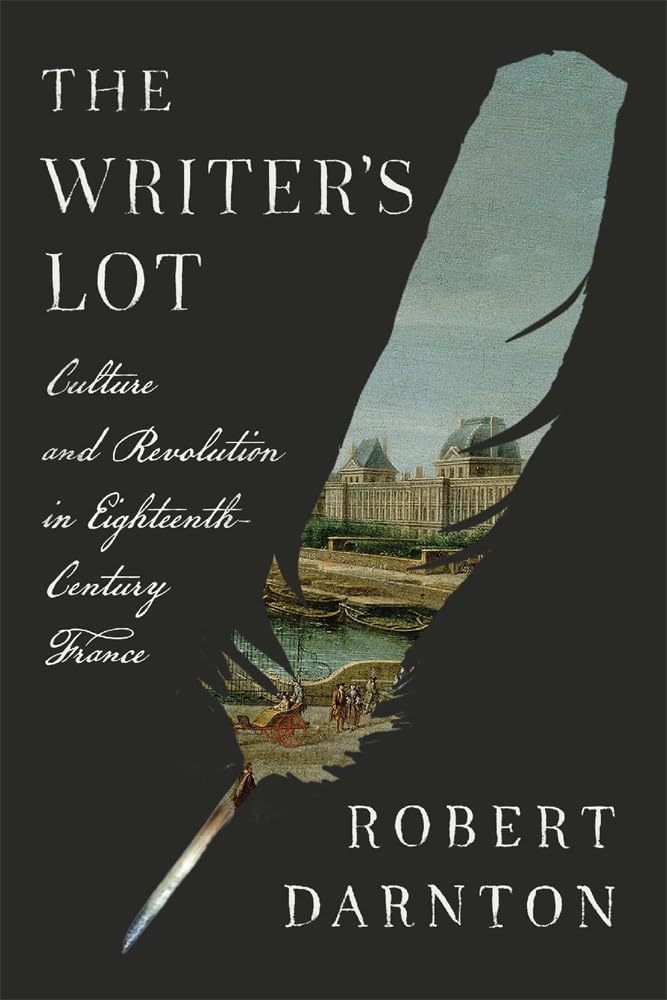
The Writer's Lot: Culture and Revolution in Eighteenth-Century France
$25.08
by Robert Darnton



A pioneering social history of French writers during the Age of Revolution, from a world-renowned scholar and National Book Critics Circle Award winner. In eighteenth-century France, writers emerged as a new kind of power. They stirred passions, shaped public opinion, and helped topple the Bourbon monarchy. Whether scribbling in dreary garrets or philosophizing in salons, they exerted so much influence that the state kept them under constant surveillance. A few became celebrities, but most were hacks, and none could survive without patrons or second jobs. The Writer’s Lot is the first book to move beyond individual biography to take the measure of “literary France” as a whole. Historian Robert Darnton parses forgotten letters, manuscripts, police reports, private diaries, and newspapers to show how writers made careers and how they fit into the social order―or didn’t. Reassessing long-standing narratives of the French Revolution, Darnton shows that to be a reject was not necessarily to be a Jacobin: the toilers of the Parisian Grub Street sold their words to revolutionary publishers and government ministers alike. And while literary France contributed to the downfall of the ancien régime, it did so through its example more than its ideals: the contradiction inherent in the Republic of Letters―in theory, open to all; in practice, dominated by a well-connected clique―dramatized the oppressiveness of the French social system. Darnton brings his trademark rigor and investigative eye to the character of literary France, from the culture war that pitted the “decadent” Voltaire against the “radical” Rousseau to struggling scribblers, booksellers, censors, printers, and royal spies. Their lives, little understood until now, afford rare insight into the ferment of French society during the Age of Revolution. “[A] meticulous and engrossing study… The Writer’s Lot is replete with…vivid and arresting details, but Darnton’s biographies aim to explore not only the social reality of the ‘poor devils’, but the extent to which their writing contributed to the Revolution.” ― Lisa Hilton , Times Literary Supplement “Does a great deal to shed illusions that the budding fourth estate of the prerevolutionary era was made up entirely of radical revolutionaries…convincingly doubles down on the claim that the cutthroat, competitive milieu in which this reserve army of hacks and scribblers moved made them uniquely placed to take advantage of the disorder and uncertainty that the French Revolution produced.” ― Bartolomeo Sala , Jacobin “How has Darnton revised his arguments fifty-four years later? Partly, by examining in detail the pre-revolutionary careers of selected writers who succeeded or failed before 1789, and their fortunes during the revolution. This allows him to display once more his marvellous eye for colour and apposite anecdotes…Darnton’s achievement is to refine his original argument while retaining his essential insights, and presenting them, as always, in superb prose.” ― Munro Price , Literary Review “Over the course of his long and distinguished career, Darnton has brought 18th-century France to life for generations of readers…the debates pursued here remain enduringly lively ones, in which Darnton’s contributions will continue to echo, entertain and enlighten.” ― Simon Macdonald , History Today “Darnton began his brilliant career by insisting on the part the French Grub Street writers played in the ideological origins of the French Revolution. He remains unpersuaded 'by historians who argue that some form of Enlightenment discourse brought down the ancien régime and determined the course of the Revolution.' After dedicating decades to studying 'printing, pirating, censorship, book-selling and the politics of publishing', Darnton has finally come full circle back to the writers.” ― Ruth Scurr , The Spectator “Darnton is one of the reasons that we have book studies. His work is a textbook example of what history can be. He uses language that anyone can understand, backed by rigorous historical methods and time spent in the archives, and founded on answering serious historical questions. This book is no departure from his strengths. It is tight, engaging, and worth the read for a number of audiences.” ― Elizabeth Stice , Orange Blossom Ordinary “A fresh and vital history, as well as an appealing romanticization of the freelancer’s lot.” ― Publishers Weekly “In this gorgeously written and original study, one of our greatest historians returns to one of his greatest themes: the passage of French authors from the literary world of the Old Regime into the French Revolution. Robert Darnton also offers precious reflections on his own previous work.” ― David Bell, author of Men on Horseback and coeditor of French Revolutionary Lives “The writer’s life has never been more brilliantly portrayed than in this vivid book by Robert Darnton, our leading historian of all things literary in eighteenth