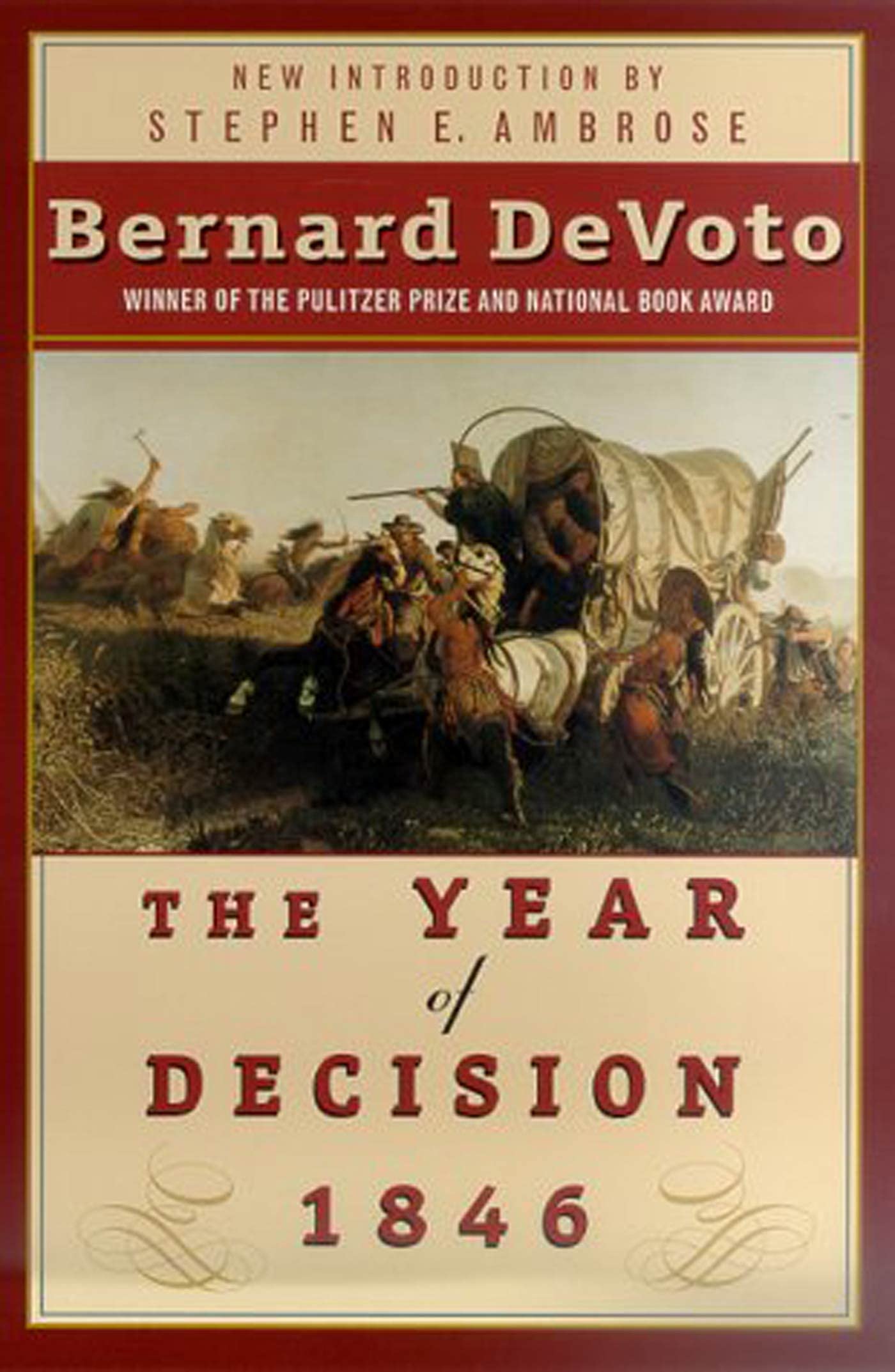



Year of Decision 1846 tells many fascinating stories of the U.S. explorers who began the western march from the Mississippi to the Pacific, from Canada to the annexation of Texas, California, and the southwest lands from Mexico. It is the penultimate book of a trilogy which includes Across the Wide Missouri (for which DeVoto won both the Pulitzer and Bancroft prizes) and The Course of Empire . DeVoto's narrative covers the expanding Western frontier, the Mormons, the Donner party, Fremont's exploration, the Army of the West, and takes readers into Native American tribal life. “In the first volume of the trilogy, Devoto made 1846 the 'year of the decision.' The reason was that it was in 1846 that America began a war with Mexico that would lead to the annexation of New Mexico, Arizona, and California; and that America settled a long-smoldering dispute with Great Britain and became sovereign in Oregon, thus beginning the process of making the Southwest and West Coast into a part of the American Republic. It was also a peak year in the emigration across the plains and mountains.” ― Stephen E. Ambrose, from the Introduction “Bernard DeVoto has woven a pattern of history more meaningful than any of its strands... This rare combination of the scholar's accuracy, the novelist's creative vision, and the historian's insight has won him a distinguished place among American historians.” ― Garrett Mattingly, author of The Armada Bernard DeVoto (1897-1955), winner of the Pulitzer Prize and the National Book Award, was a renowned scholar-historian. Stephen E. Ambrose is the author of Undaunted Courage and D-Day June, 1944 both critically-acclaimed bestsellers. The Year Of Decision: 1846 By Bernard DeVoto St. Martin's Press Copyright © 1943 Bernard DeVoto All rights reserved. ISBN: 978-0-312-26794-0 Contents Title Page, Copyright Notice, Dedication, Acknowledgments, Preface, New Preface to the Year 2000 Edition, Calendar, Map, Invocation, I: Build Thee More Stately Mansions, II: The Mountain Man, III: Pillar of Cloud, IV: Equinox, V: Spring Freshet, Interlude: Doo-Dah Day, VI: Oh Susanna!, VII: "Cain, Where Are Thy Brothers?", Interlude: World of Tomorrow, VIII: Solstice, IX: The Image on the Sun, X: Sonorous Metal, XI: Continental Divide, Interlude: Friday, October 16, XII: Atomization, XIII: Trail's End, XIV: Anabasis in Homespun, XV: Down from the Sierra, XVI: Whether It Be Fat or Lean: Canaan, XVII: Bill of Review — Dismissed, Statement of Bibliography, Index, Books by Bernard DeVoto, Copyright, CHAPTER 1 Build Thee More Stately Mansions THE First Missouri Mounted Volunteers played an honorable part in the year of decision, and looking back, a private of Company C determined to write his regiment's history. He was John T. Hughes, an A.B. and a schoolmaster. Familiarity with the classics had taught him that great events are heralded by portents. So when he sat down to write his history he recalled a story which, he cautions us, was "doubtless more beautiful than true." Early in that spring of 1846, the story ran, a prairie thunderstorm overtook a party of traders who were returning to Independence, Missouri, from Santa Fe. When it passed over, the red sun had sunk to the prairie's edge, and the traders cried out with one voice. For the image of an eagle was spread across the sun. They knew then that "in less than twelve months the eagle of liberty would spread his broad pinions over the plains of the west, and that the flag of our country would wave over the cities of New Mexico and Chihuahua." Thus neatly John T. Hughes joined Manifest Destiny and the fires that flamed in the midnight sky when Caesar was assassinated. But he missed a sterner omen. The period of Biela's comet was seven years. When it came back in 1832 many people were terrified for it was calculated to pass within twenty thousand miles of the earth's orbit. The earth rolled by that rendezvous a month before the comet reached it, however, and the dread passed. In 1839 when the visitor returned again it was too near the sun to be seen, but its next perihelion passage was calculated for February 11, 1846. True to the assignment, it traveled earthward toward the end of 1845. Rome identified it on November 28 and Berlin saw it two days later. By mid-December all watchers of the skies had reported it. The new year began, the year of decision, and on January 13 at Washington, our foremost scientist, Matthew Maury, found matter for a new report. Maury was a universal genius but his deepest passion was the movement of tides. In that January of '46 he was continuing his labor to perfect the basis for the scientific study of winds and current. Out of that labor came the science of oceanography, and methods of reporting the tides not only of the sea but of the air also that have been permanent, and a revolution in the art of navigation. But he had further duties as Superintendent of the Naval