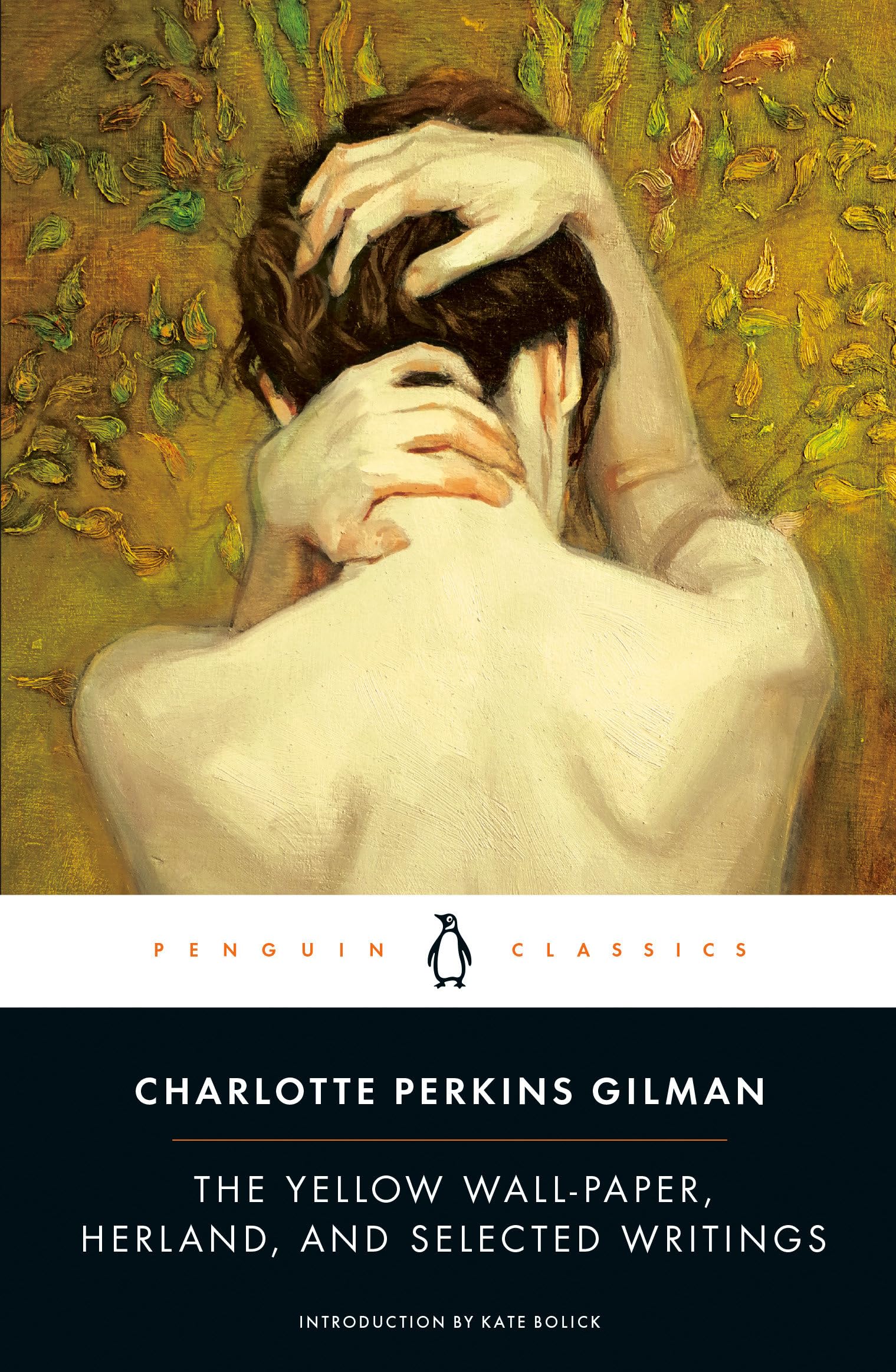
The Yellow Wall-Paper, Herland, and Selected Writings (Penguin Classics)
$13.33
by Charlotte Perkins Gilman



A collection of the groundbreaking feminist writer's most famous works, with a thought-provoking introduction by bestselling author Kate Bolick Wonderfully sardonic and slyly humorous, the writings of landmark American feminist and socialist thinker Charlotte Perkins Gilman were penned in response to her frustrations with the gender-based double standard that prevailed in America as the twentieth century began. Perhaps best known for her chilling depiction of a woman's mental breakdown in her unforgettable 1892 short story 'The Yellow Wall-Paper', Gilman also wrote Herland, a wry novel that imagines a peaceful, progressive country from which men have been absent for two thousand years. Both are included in this volume, along with a selection of Gilman's major short stories and her poems. New York Times bestselling author Kate Bolick contributes an illuminating introduction that explores Gilman's fascinating yet complicated life. For more than seventy years, Penguin has been the leading publisher of classic literature in the English-speaking world. With more than 1,700 titles, Penguin Classics represents a global bookshelf of the best works throughout history and across genres and disciplines. Readers trust the series to provide authoritative texts enhanced by introductions and notes by distinguished scholars and contemporary authors, as well as up-to-date translations by award-winning translators. Charlotte Perkins Gilman (1860-1935) was born in New England, a descendant of the prominent and influential Beecher family. In 1884 she married Charles Water Stetson. After giving birth, Charlotte sank into a deep depression. She entered a sanitarium in Philadelphia to undergo the 'rest cure', a controversial treatment, which forbade any type of physical activity or intellectual stimulation. In 1892, she published the now-famous story “The Yellow Wall-Paper.” In 1898, her most famous nonfiction book, Women and Economics , was published. With its publication, and subsequent translation into seven languages, Gilman earned international acclaim. In 1900, she married her first cousin, George Houghton Gilman. Over the next thirty-five years, she wrote and published hundreds of stories and poems and more than a dozen books. Kate Bolick ’s first book, the best-selling Spinster: Making a Life of One’s Own , was named a New York Times Notable Book of 2015. A contributing editor for The Atlantic , Bolick is also host of “Touchstones at The Mount,” an annual interview series at Edith Wharton’s country estate, in Lenox, Massachusetts. Previously, she was executive editor of Domino magazine, and a columnist for The Boston Globe ’s Ideas section. She teaches writing at New York University, in both the Cultural Reporting and Criticism MA program and the Gallatin School of Individualized Study. Bolick speaks frequently at colleges and conferences, and has appeared on the Today s how, CBS Sunday Morning , CNN, MSNBC, and numerous NPR programs across the country. HERLAND Chapter I A Not Unnatural Enterprise This is written from memory, unfortunately. If I could have brought with me the material I so carefully prepared, this would be a very different story. Whole books full of notes, carefully copied records, first-hand descriptions, and the pictures—that’s the worst loss. We had so me bird’s‑eyes of thecities and parks; a lot of lovely views of streets, of buildings, outside and in, and some of those gorgeous gardens, and, most important of all, of the women themselves. Nobody will ever believe how they looked. Descriptions aren’t any good when it comes to women, and I never was good at descriptions anyhow. But it’s got to be done somehow;the rest of the world needs to know about that country. I haven’t said where it was for fear some self-appointed missionaries, or traders, or land-greedy expansionists, will take it upon themselves to push in. They will not be wanted, I can tell them that, and will fare worse than we did if they do find it. It began this way. There were three of us, classmates and friends—Terry O. Nicholson (we used to call him the Old Nick, with good reason), Jeff Margrave, and I, Vandyck Jennings. We had known each other years and years, and in spite of our differences we had a good deal in common. All of us were interested in science. Terry was rich enough to do as he pleased. His great aim was exploration. He used to make all kinds of a row because there was nothing left to explore now, only patchwork and filling in, he said. He filled in well enough—he had a lot of talents—great on mechanics and electricity. Had all kinds of boats and motor cars, and was one of the best of our airmen. We never could have done the thing at all without Terry. Jeff Margrave was born to be a poet, a botanist—or both—but his folks persuaded him to be a doctor instead. He was agood one, for his age, but his real interest was in what he loved to call “the wonders of science." As for me, Sociology’s