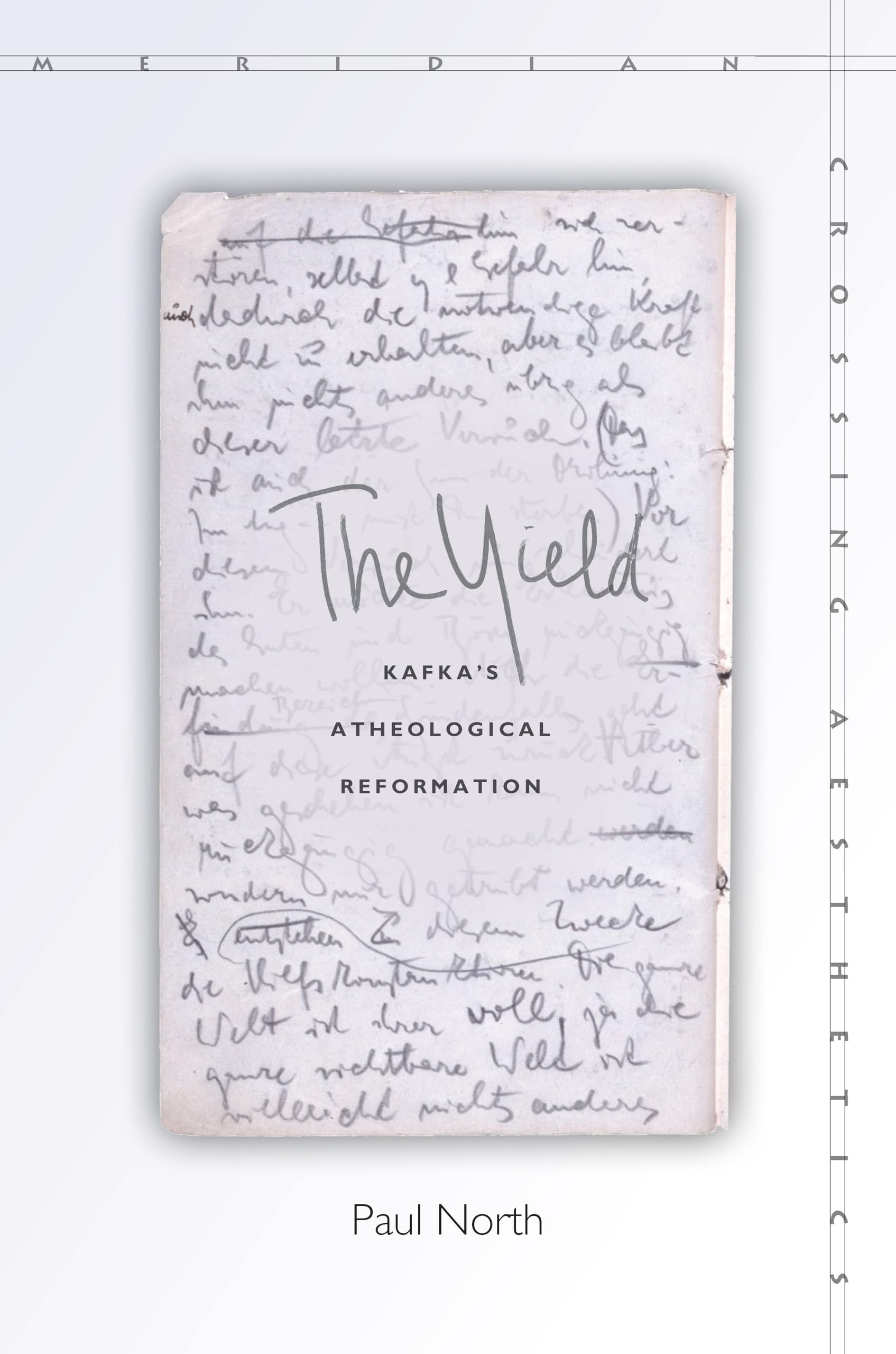
The Yield: Kafka's Atheological Reformation (Meridian: Crossing Aesthetics)
$28.80
by Paul North



The Yield is a once-in-a-generation reinterpretation of the oeuvre of Franz Kafka. At the same time, it is a powerful new entry in the debates about the supposed secularity of the modern age. Kafka is one of the most admired writers of the last century, but this book presents us with a Kafka few will recognize. It does so through a fine-grained analysis of the three hundred "thoughts" the writer penned near the end of World War I, when he had just been diagnosed with tuberculosis. Since they were discovered after Kafka's death, the meaning of the so-called "Zürau aphorisms" has been open to debate. Paul North's elucidation of what amounts to Kafka's only theoretical work shows them to contain solutions to problems Europe has faced throughout modernity. Kafka offers responses to phenomena of violence, discrimination, political repression, misunderstanding, ethnic hatred, fantasies of technological progress, and the subjugation of the worker, among other problems. Reflecting on secular modernity and the theological ideas that continue to determine it, he critiques the ideas of sin, suffering, the messiah, paradise, truth, the power of art, good will, and knowledge. Kafka's controversial alternative to the bad state of affairs in his day? Rather than fight it, give in. Developing some of Kafka's arguments, The Yield describes the ways that Kafka envisions we can be good by "yielding" to our situation instead of striving for something better. "Paul North's very rich meditation on Kafka's 'atheological' thought is epoch-making, a fully satisfying rebuttal of the vulgar claim that "we" do not understand Kafka. With an extraordinary lightness of touch, made possible by a wealth of philosophical and literary erudition, North takes us far more deeply into the heart of Kafka's thought than any scholar before him. He demonstrates that Kafka overturns every supposition on which traditional theologies have been built―a demolition that implicates the leading concepts of secular modernity, founded as they are on (the original confusions of!) theology. This book is a marvel of originality, the product of a gaia scienza of thought, as pleasurable to read as it is rewarding to understand."―Stanley Corngold, Princeton University "This is an excellent book and a true gem. It has accomplished what no Kafka critic has ever managed to do completely: to provide a clear, intelligent, and systematic account of the convoluted, contradictory, and counter-intuitive fragments written by Kafka during his Zürau retreat."―Jean-Michel Rabaté, University of Pennsylvania Paul North is Professor of German at Yale University and author of The Problem of Distraction (Stanford, 2012). The Yield Kafka's Atheological Reformation By Paul North STANFORD UNIVERSITY PRESS Copyright © 2015 Board of Trustees of the Leland Stanford Junior University All rights reserved. ISBN: 978-0-8047-9659-0 Contents Conversations, Preface, A Note on References, Abbreviations, § Introduction, 1. Atheology, 2. Thoughts, 3. Four Circles, 4. The Fourfold Atheological Analysis, PART I: KAFKA'S BEING AND TIME, § Refutation of What Being Never Was, 5. Toward a General Echontology, 6. Language for Other Purposes, 7. Possession, the Possessed, 8. Against Having, 9. Thing Being, 10. What "Am" Does, 11. Foreign That You Are, § Better Weapons than Faith and Hope, 12. Two-Sided Faith, 13. Faith and World, 14. Faith and Life, 15. The Progress Idea, 16. Letting Fall and Yielding, 17. A Twofold Truth, 18. The Garden Antinomy, 19. The Messianic Share, 20. Kierkegaard Codicil, § Excursus: For a Kafkan Logic, 21. Two Logoi, 22. The Logic of Sense, 23. The Logic of Speech, PART II: DEATH AND THE WILL, § The Problem of Our Art, 24. Death Knowledge, 25. Death Image, 26. Schein zum Tode, 27. The Illuminated Corpse, 28. Nietzsche's Doubt, 29. The Problem with Our Art, 30. The Return of the Snake, § The Yield: On Forgoing Power, 31. The Way and the Wall, 32. No More Than, 33. What You Are, 34. Yielding, 35. Pressure to Act, 36. Subservience, 37. Ontological Freedom, 38. Struggle, Will, Power, Strength, 39. Heidegger, Letting and Leaving, 40. Childish Measures, Notes, Select Bibliography, Index, CHAPTER 1 § Introduction 1. Atheology When a historical category loses its meaning and threatens to disappear, an opportunity arises that has a strange consequence. The category "Jew" in middle Europe during the first quarter of the twentieth century is an example of such a threatened category with its strange consequence. While the term "Jew" certainly continued to refer to a group of living individuals and was used by lovers and haters of them alike, its meaning, for many complex reasons, had for some time — since the Jewish Enlightenment at least — been becoming too diverse to signify one thing. All sides clung to the category with renewed force, however, despite or perhaps because of its splintering meaning.