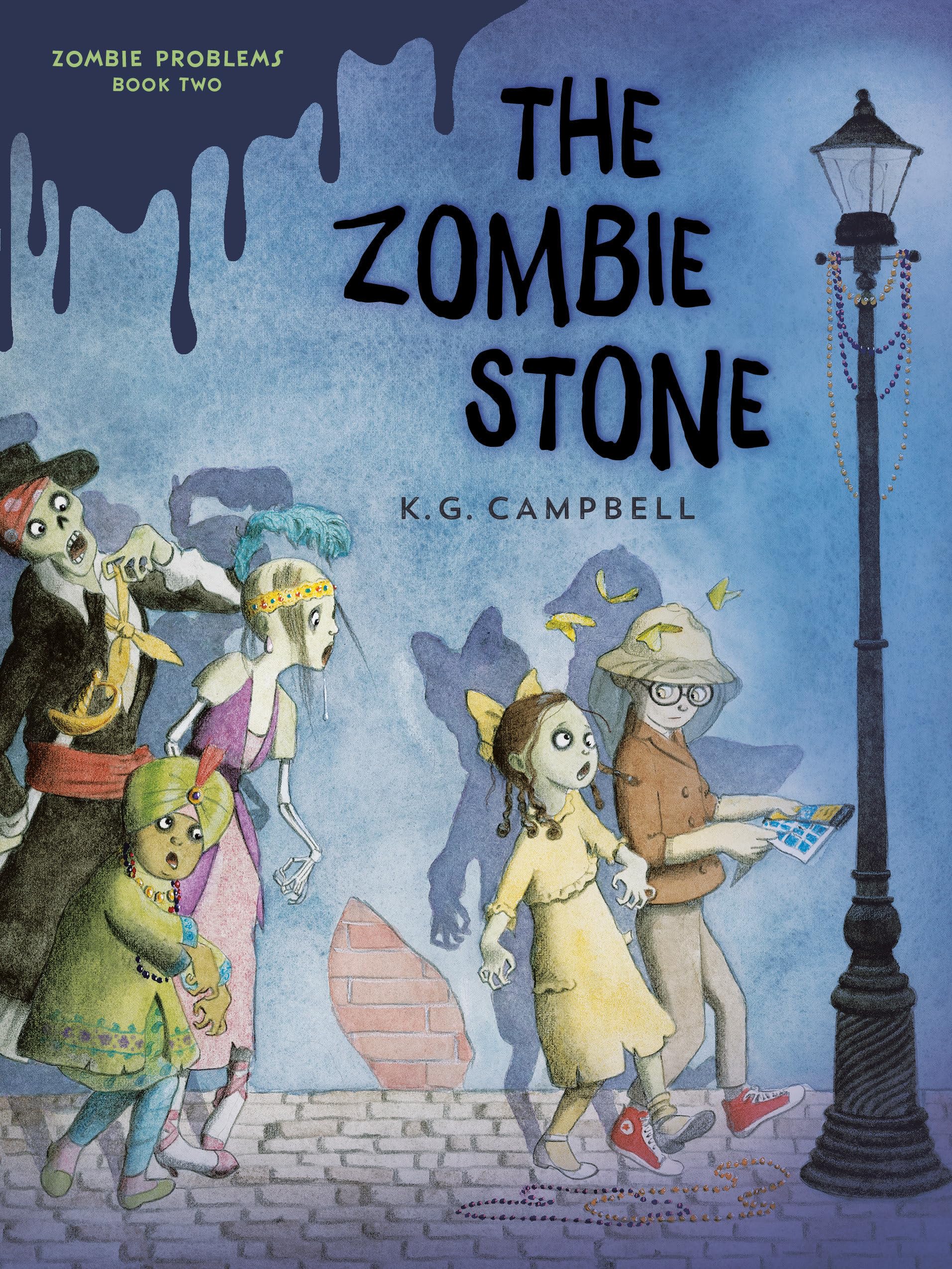



What's worse than discovering you have a zombie problem? Imagine acquiring four more undead tag-alongs. . . . From the acclaimed illustrator of Flora & Ulysses comes the second book in the Zombie Problems trilogy, heralded as "reminiscent of Roald Dahl in uniting the macabre with realism." August DuPont has a small problem. When a zombie followed him home one day, he didn't expect her to stick around. But his very dead great-great-aunt Claudette is in no hurry to leave August's side. In order to rid himself of his clammy sidekick, August must hunt down the elusive Zombie Stone. His frantic search leads him through a bizarre carnival and back to his dour cousins, the Malveaus. Throw in a necromancer, a pop star with attitude, some armadillo people, and four new zombies (that's right, four!),and you'd better believe that August's small zombie problem is only going to get bigger. Gr 4-7-After the adventures of the first book, August is still a lonely boy with an unfortunate habit of attracting zombies. His attempt to retrieve the zombie stone leads him to adventures in a thinly disguised fictional New Orleans. There he encounters many fantastical characters, and of course more zombies. Despite the zombie premise, this book is more goofy than macabre with wacky shenanigans and over-the-top characters to appeal to fans of stories that mix reality and fantasy like Trenton Lee Stewart's "The Mysterious Benedict Society" or Tom Angleberger's "Origami Yoda." The main character is genuinely likable, but he shows less character growth than in the first volume. All of the main and most of the secondary characters appear to be white. The plot is fairly fast paced, with a few points where it drags. This may not be worth adding at smaller libraries if the first didn't circulate, but would be a good choice for medium or large libraries. VERDICT For those readers who have already enjoyed the first installment, this is a solid sequel that mixes fun, horror elements, and incredible adventures.-Elizabeth Nicolai, Anchorage Public Library, AKα(c) Copyright 2011. Library Journals LLC, a wholly owned subsidiary of Media Source, Inc. No redistribution permitted. Keith G. Campbell was born in Kenya, but raised and educated in Scotland. He graduated with a master's degree in art history from the University of Edinburgh. After trying on several careers, Keith eventually returned to his early passion of writing and illustrating stories. He is the author-illustrator of several picture books and the winner of two Ezra Jack Keats Awards. A Small Zombie Problem is his first work for older readers. Keith lives in Malibu, California. Learn more at kgcampbell.com and follow him at @artbykgcampbell. Chapter One It had become apparent that the canoe was sinking. The opaque brown water, which had moments before been sloshing around the boy’s shoes, had now reached his ankles. “Claudette!” cried the boy urgently, pointing toward the largest of several spouting holes. “Stop that up with your finger!” The girl named Claudette, however, must surely have been stronger than she realized. For while attempting to plug the gushing water, she promptly forced her entire fist through the vessel’s hull, dramatically worsening the situation, as you might imagine. The boy scrambled across the canoe to stuff the jagged gash with a plaid blanket. But within moments the wool was a saturated lump, the “repair” worthless, and, in the meantime, the other leaks were worsening. Indeed, with every second, there was more and more water, and less and less canoe. As wet coldness reached his knees, the boy finally came to understand that the boat was doomed. Yet even then, he did not fully appreciate the dire nature of his predicament. There was, however, someone who did. One hundred feet above the foundering vessel, an osprey was headed back to its nest and family with a freshly caught bass. The bird observed the splashy drama far below with a detached curiosity, as you or I might observe some feathery misadventure in the sky above. The male human, just visible through a cloud of tasty-looking butterflies, had removed his oddly netted helmet and, for some reason, was using it to toss around water. The female human—who moved like a thing living, but to the bird above smelled like a thing dead—was with cupped hands awkwardly attempting to do the same. Humans, the osprey mused, were an odd bunch. What the frantic pair were trying to achieve he could hardly imagine. But what he spied next, the osprey understood only too well; for every creature of the swamp is hardwired to recognize the most dangerous of predators. Through the watery channel, just beneath the surface, moved the pale shadow of a white beast. So enormous was it, that the osprey dropped its family’s dinner in shock. The thing was wider than the vessel was long, and its powerful, snaking tail created a wake like that of a shrimping boat. And the white, enormous, snaking beast with a pow