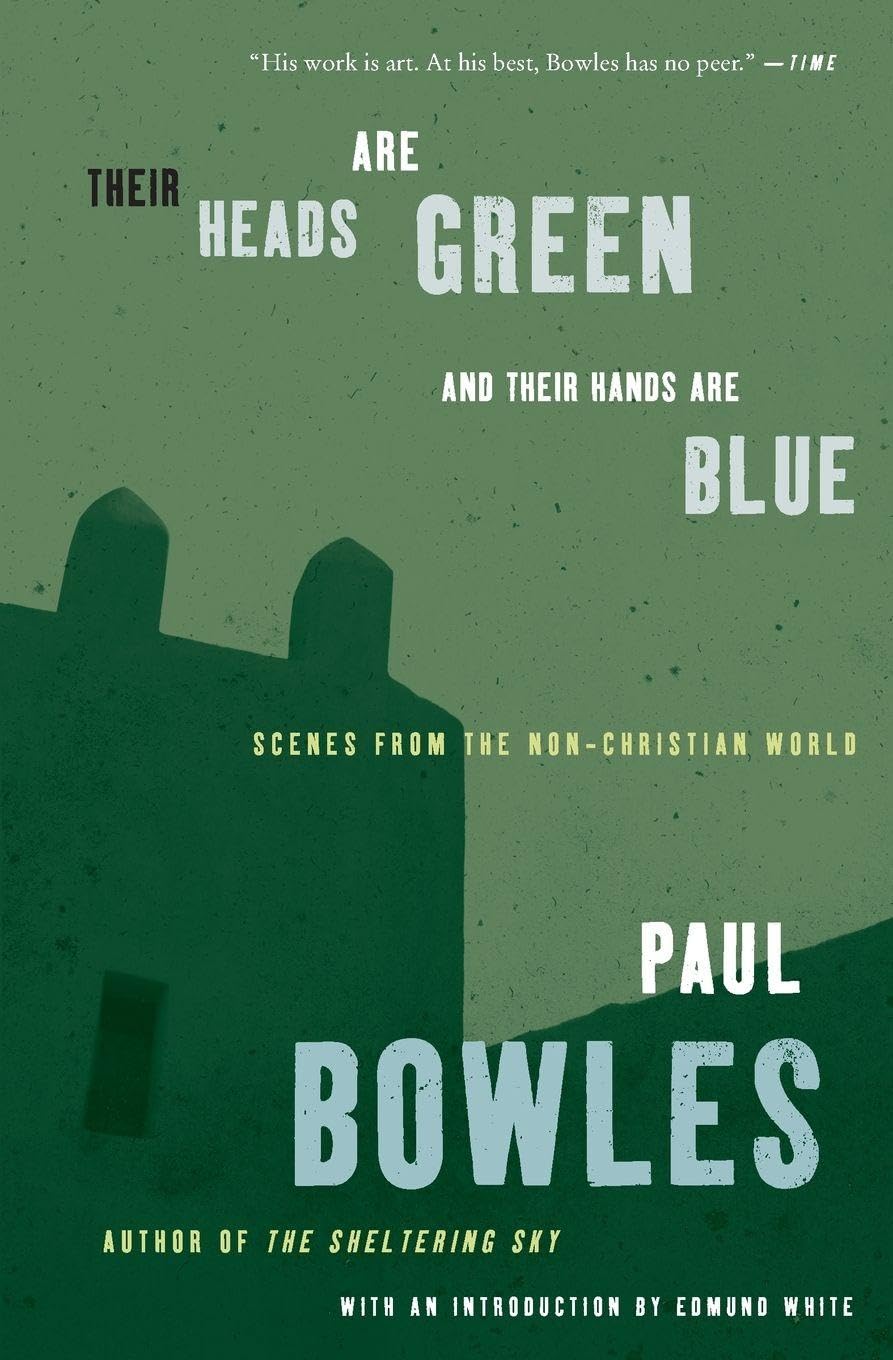
Their Heads Are Green and Their Hands Are Blue: Scenes from the Non-Christian World – Travel Essays from a Born Wanderer with Insight and Humor
$15.19
by Paul Bowles



An engaging collection of travel essays by the author of The Sheltering Sky Their Heads are Green, Their Hands are Blue deals largely with places in the world that few Westerners have ever heard of, much less seen―places as yet unencumbered by the trappings, luxuries, and corruptions of modern civilization. Bowles is a sympathetic and discerning observer of these alien cultures, and his eyes and ears are especially alert both to what is bizarre and what is wise in the civilizations in which he settles. Above all, Bowles is a superb and observant traveler―a born wanderer who finds pleasure in the inaccessible and who cheerfully endures the concomitant hardships with resourcefulness, insight, and humor. Their Heads are Green and their Hands are Blue is an engaging collection of eight travel essays. Except for one essay on Central America, all of these pieces are concerned with locations in the Hindu, Buddhist, or Islamic worlds. A superb and observant traveler, Paul Bowles was a born wanderer who found pleasure in the inaccessible and who cheerfully endures the concomitant hardships with a matter-of-fact humor. These essays provide us with Paul Bowles' characteristic insightfulness and bring us closer to a world we frequently hear about, but often find difficult to understand. Paul Bowles was born in 1910 and studied music with composer Aaron Copland before moving to Tangier, Morocco. A devastatingly imaginative observer of the West's encounter with the East, he is the author of four highly acclaimed novels: The Sheltering Sky , Let It Come Down , The Spider's House , and Up Above the World . In addition to being one of the most powerful postwar American novelists, Bowles was an acclaimed composer, a travel writer, a poet, a translator, and a short story writer. He died in Morocco in 1999. Their Heads Are Green and Their Hands Are Blue Scenes from the Non-Christian World By Paul Bowles HarperCollins Publishers, Inc. Copyright © 2006 Paul Bowles All right reserved. ISBN: 0061137375 Chapter One Fish Traps and Private Business Welideniya Estate, Ceylon may, 1950 The landscape is restless -- a sea of disorderly hills rising steeply. In all directions it looks the same. The hills are sharp bumps with a thin, hairy vegetation that scarcely covers them. Most of this is rubber, and the rubber is wintering. Mr. Murrow, the planter, says that in another week or two the present brownish-yellow leaves will be replaced by new ones. Where the rubber stops the tea begins. There the earth looks raw. The rocks show between the low bushes; here and there a mulberry tree with lopped branches, planted for shade. On top of one of these steep humps is the bungalow, spread out all along the crest. Directly below to the southwest, almost straight down, is the river with its sandy banks. But in between, the steep declivity is terraced with tea, and by day the voices of the Tamil pickers are constantly audible. At night there are fires outside the huts on the opposite bank of the river. The air is hot and breathless, the only respite coming in the middle of the afternoon, when it rains. And afterward, when it has stopped, one has very little energy until night falls. However, by then it is too late to do anything but talk or read. The lights work on the tea-factory circuit. When everyone is in bed, Mr. Murrow calls from under his mosquito net through the open door of his bedroom to a Tamil waiting outside on the lawn. Five minutes later all the lights slowly die, and the house is in complete darkness save for the small oil lamps on the shelves in the bathrooms. Nothing is locked. The bedrooms have swinging shutters, like old-fashioned barroom doors, that reach to within two feet of the floor. The windows have no glass -- only curtains of very thin silk. All night long a barefoot watchman shouldering a military rifle pads round and round the bungalow. Sometimes, when it is too hot to sleep, I get up and sit out on the verandah. Once there was no air even there, and I moved a chair to the lawn. On his first trip around, the watchman saw me, and made a grunting sound which I interpreted as one of disapproval. It may not have been; I don't know. The nights seem endless, perhaps because I lie awake listening to the unfamiliar sounds made by the insects, birds and reptiles. By now I can tell more or less how late it is by the section of the nocturnal symphony that has been reached. In the early evening there are things that sound like cicadas. Later the geckos begin. (There is a whole science of divination based on the smallest details of the behavior of these little lizards; while the household is still up they scurry silently along the walls and ceiling catching insects, and it is only well on into the night that they begin to call out, from one side of the room to the other.) Still later there is a noise like a rather rasping katydid. By three in the morning everything has stopped but a small bird whose cr