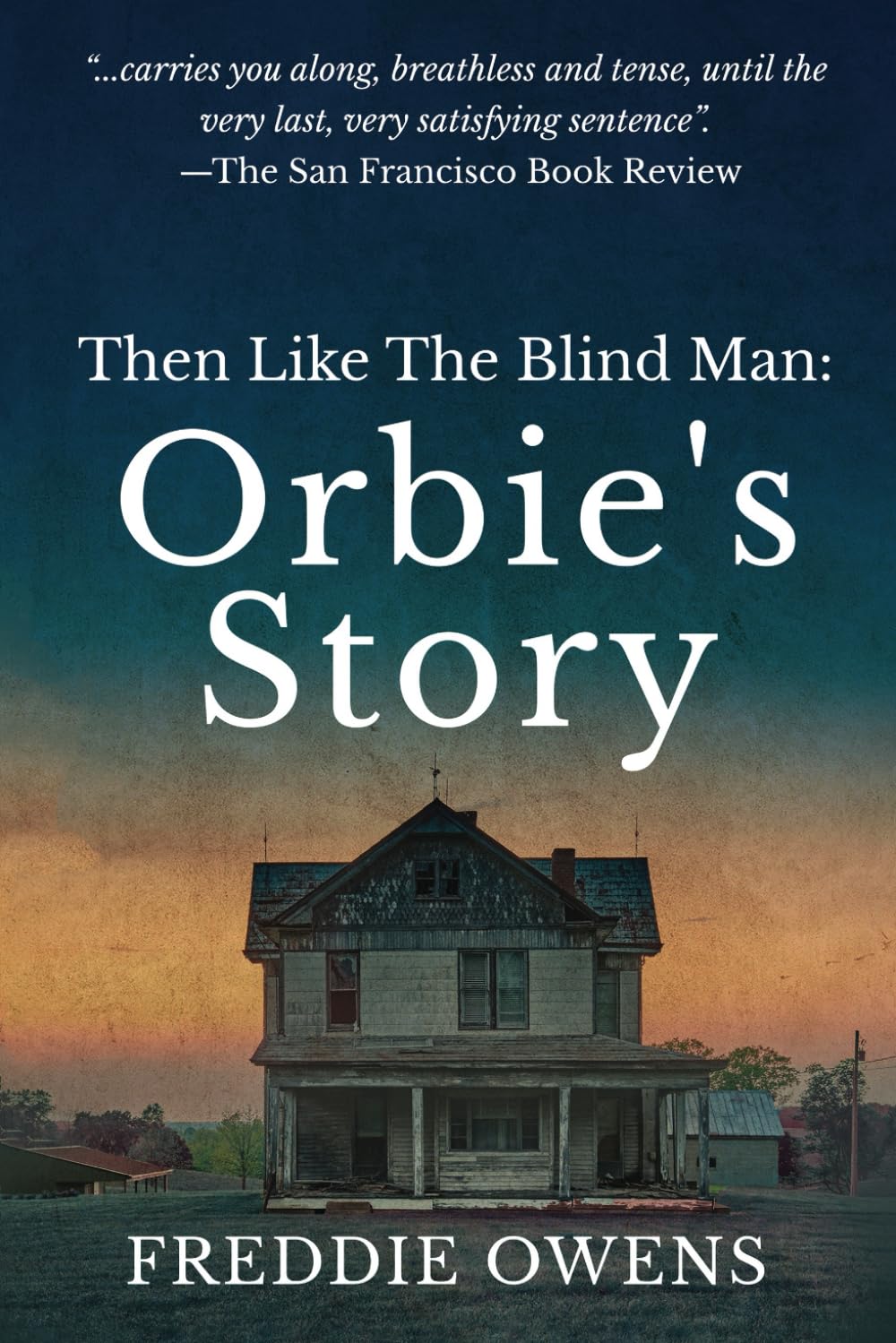



"In an American coming-of-age novel, the author presents a stunning story with clarity and historical accuracy, rich in illuminating the Appalachian culture of the time period..." ---Publisher's Weekly "A psychologically astute, skillful, engrossing and satisfying novel. ---Starred Kirkus Review A storm is brewing in the all-but-forgotten back country of Kentucky. And for young Orbie Ray, the swirling heavens may just have the power to tear open his family's darkest secrets. Then Like The Blind Man: Orbie's Story , a rural-American version of Hamlet, tells the story of an extraordinary little boy in the segregated south of the 1950s, and the forces he must overcome to restore order in his world. Feisty nine-year-old Orbie Ray hates his stepfather even more than he does kids whose skin color he doesn't trust—a fact that lands him at Harlan's Crossroads, there to spend a drought summer on his grandparent's dirt farm while his family travels on to Florida's sunny climes. Resentful, fearing for his naively religious mother, Orbie pines for the return of his dead father. To make matters worse, he must now deal with his maverick 'n-word loving' grandparents and the black Pentecostal congregation of snake handlers to which they belong. We follow the boy as he struggles at making friends among the colored kids of Kingdom Church—as he then wanders the hills and hollers of Kentucky tormented by visions of his father's murderer, encountering soothsayers, bizarre electrical phenomena, and denizens of the forest along the way. A black Choctaw preacher-man introduces him to a power potent enough to destroy his enemies if only it could be used for revenge. Thus, when his family returns and the crimes of the stepfather come to light, the boy finds himself walking straight way into a storm of unusual meteorological and psychological magnitude, compelling him to face his own hatreds and the riddle of the power. "Reminiscent of To Kill A Mockingbird...a 'special' novel worthy of joining the ranks of an illustrious Southern literary tradition." ---Kindle Nation ABNA Quarter Finalist - Received IRDiscovery Award for Best in Literary Fiction - Finalist for Kindle Book Review's Literary Fiction Award - Received Kirkus Review's STAR for exceptional Merit - Featured in Kirkus Review's Trade Magazine - Honorable Mention: Writer's Digest Self-Published Book Awards - Retailers, Libraries and Educators can get the book through Ingram Wholesale - Now available in Bookstores Nationwide! - An Amazon Bestseller! Scroll Up To Look Inside; Down To Read Reviews In his debut novel, Owens captures his characters' folksy Appalachian diction without overdoing it. He also renders a child's viewpoint with great psychological sensitivity: "I didn't like the way [Victor] was all the time trying to be on my mind. It was too close together somehow--like when Momma started talking about Jesus and wouldn't shut up." A psychologically astute, skillful, engrossing and satisfying novel. * Starred Kirkus Review * Every once in awhile, you read a book in which every element fits together so perfectly that you just sit back in awe at the skill of the storyteller. Then Like the Blind Man is one of these books. ...[It] grabs you from the very first page and carries you along, breathless and tense, until the very last, very satisfying sentence. Freddie Owens has created something special. * The San Francisco Book Review * In an American coming-of-age novel, the author presents a stunning story with clarity and historical accuracy, rich in illuminating the Appalachian culture of the time period. ...[It] brings history alive, depicting American union labor practices and the racial prejudices that were so prevalent in the 1950's. * Publisher's Weekly * Orbie's sharecropping grandparents, by defying convention with unnerving grace, become founts of colloquial wisdom whose appeal is impossible to resist, and the Orbie they nurture -- the best version of a boy who may otherwise have been lost -- is someone the reader comes to love. * Michelle Schingler / ForeWord Book Review * The magical undercurrent that runs through the story adds to its feeling of other-worldliness, and the symbolism is both omnipresent and beautifully handled... * Catherine Langrehr / The Indie Reader * Dead Chicken Memories North-South Structures Composite Personae I was born in Kentucky but grew up around Detroit. I would sometimes spend a week or two, once I spent six weeks, in Kentucky, staying with cousins or with my grandparents. It was an entirely different world for me, providing some of the best and worst times of my growing up years. I had a great time on a dairy farm with several of my cousins, milking cows, hoeing tobacco, running over the hills and up and down a creek that surrounded the big farm. I remember too, periods of abject boredom, sitting around my grandparent's old farm house with nothing to do but wander about the red clay yard or kill flies