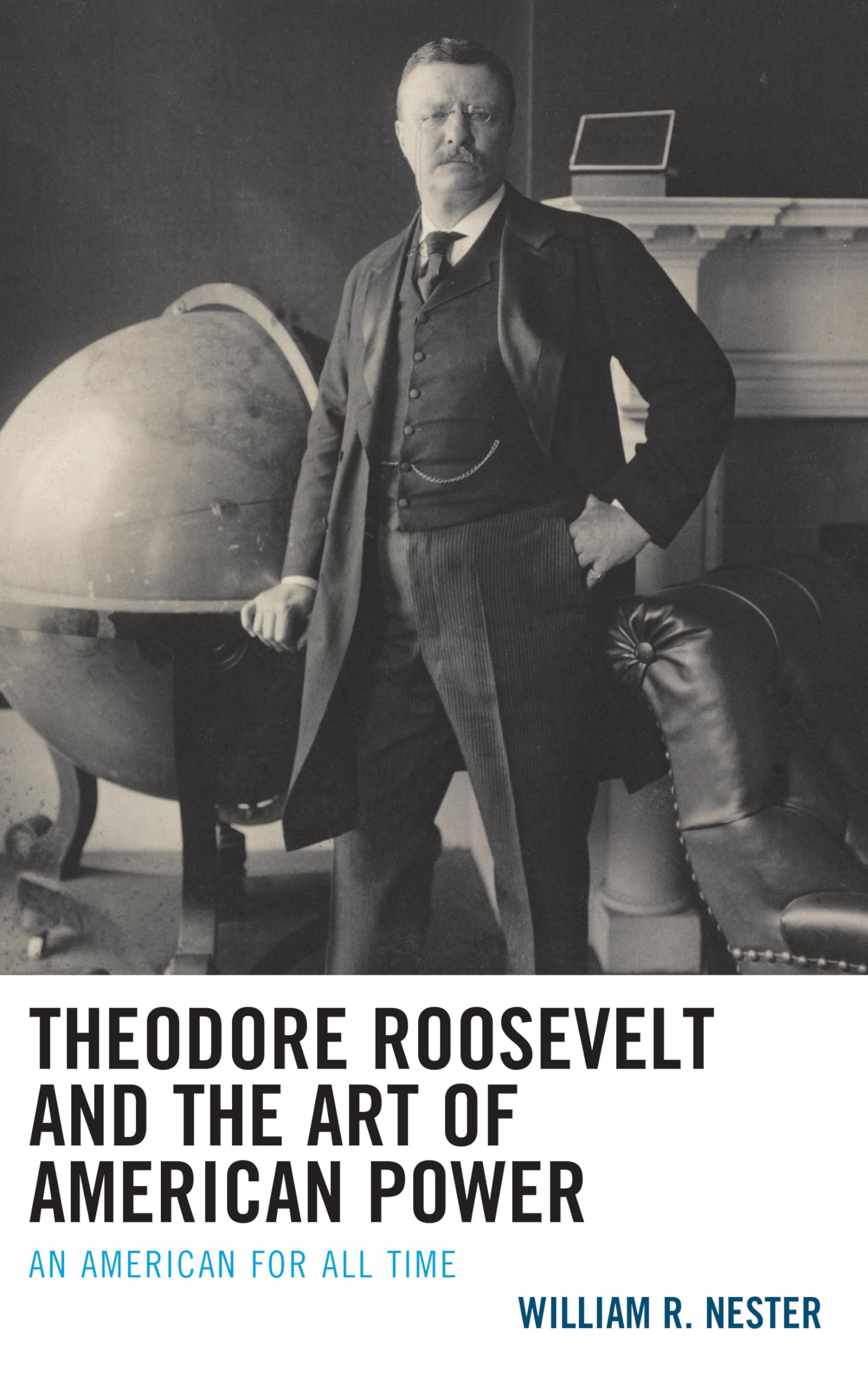
Theodore Roosevelt and the Art of American Power: An American for All Time
$42.36
by Deborah Geis



Theodore Roosevelt is an American icon, his face carved in granite alongside those of Washington, Jefferson, and Lincoln on Mt. Rushmore. He is the only American awarded both the Medal of Honor and Nobel Peace Prize. As president, he pushed through a stubborn Congress to breakup corporate monopolies strangling the economy, impose health standards on the food and drug industries, and conserve America’s natural heritage, including the Grand Canyon and Redwood forest. He was a brilliant diplomat who ended a war between Japan and Russia, and prevented a war between Germany and France. He engineered independence for the province of Panama from Columbia, then signed a treaty with the new country that entitled the United States to build, run, and defend a Panama canal. He crusaded for progressive reforms as a New York assemblyman, U.S. civil service commissioner, New York City police commissioner, and New York governor. He led scientific expeditions across East Africa’s savanna and Brazil’s rainforest. During the war with Spain, he raised a cavalry regiment and led his Rough Riders to a decisive victory at San Juan Heights. As a Dakota rancher during the frontier’s twilight, he squared off with outlaws and renegade Indians. He was a prolific writer, authoring 38 books and hundreds of essays. Roosevelt was among the most charismatic presidents. Yet, although most Americans adored him, most Wall Street moguls and political bosses hated him for his reforms. He was complex, simultaneously peacemaker and warmonger, progressive and conservative, Machiavellian and Kantian, avid hunter and nature lover. Roosevelt accomplished all that he did because he mastered the art of American power. His motto “speak softly and carry a big stick” exemplified how he asserted power to defend or enhance American interests. Time after time he bested such titans as J.P. Morgan or Kaiser Wilhelm at the game of power. Although he is the subject of dozens of books, this is the first to comprehensively explore just how Roosevelt understood, massed, and wielded power to pursue his vision for an America as the world’s most prosperous, just, and influential nation. “Nester (St. John's) offers new insight into the concept of power as defined by early-20th-century American culture. Situated at the epicenter of this “American Power” is Theodore Roosevelt, whom Nester refers to as “An American for All Time.” According to Nester, Roosevelt saw life as a constant struggle, and believed that the Gilded Age notion of the survival of the fittest could be applied to the individual American and the country as a whole. To Roosevelt, power came in two forms, soft and hard, and was exemplified by his famous axiom to “speak softly and carry a big stick.” But unlike many counterparts at the turn of the century, Roosevelt did not believe in the winner-take-all mentality, as it related to political power and material resources. Through his detailed analysis of Roosevelt’s life, Nester effectively demonstrates how Roosevelt defined and used power to lead the US to the forefront of world power. In showcasing the rise of American power in the early 20th century, Nester’s coverage of Roosevelt offers a mirror to the challenges of today. Summing Up: Recommended. Upper-division undergraduates through faculty.” ― Choice Reviews William R. Nester is professor of government and politics at St. John's University.