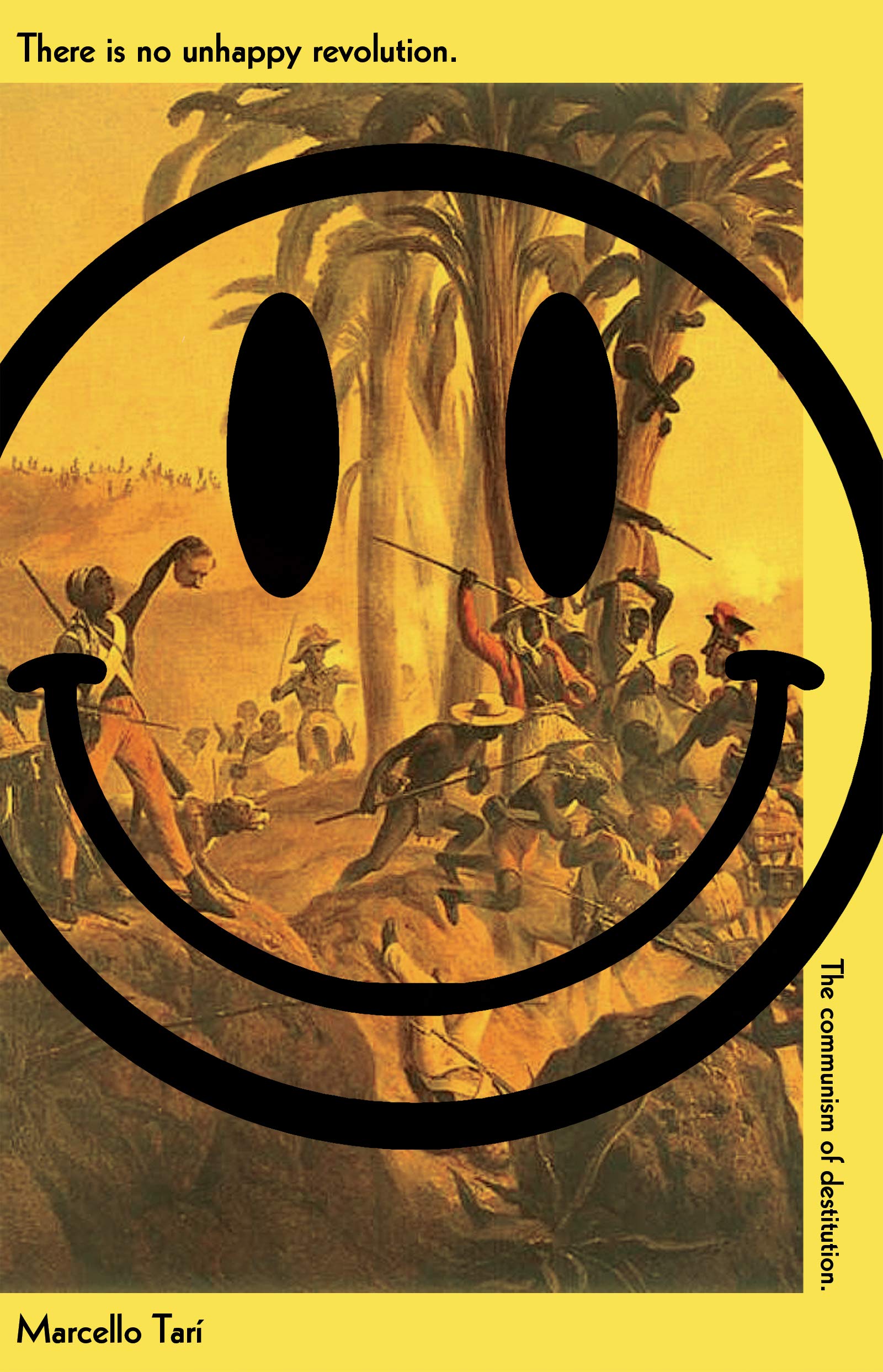



"A powerful case for the persistent questioning and existential interruption that accompanies that pursuit of [happiness and revolution], and fuels it, and constitutes and ruptures its vagrant, open end."— Fred Moten, author of In the Break: The Aesthetics of the Black Radical Tradition "It is hard today to escape the perception that financial violence and fascism are suffocating every possibility of happiness… There Is No Unhappy Revolution shows a possible way out from this despair."— Franco "Bifo" Berardi, author of Futurability: The Age of Impotence and the Horizon of Possibility . In a time of ongoing political, economic, and climate crisis can we afford our collective unhappiness any longer? There Is No Unhappy Revolution gives expression to the age of revolution unfolding before us. With equal parts sophistication and raw urgency, Marcello Tarì identifies the original moments as well as the powerful disruptive and creative content haunting our times like a specter. The age of revolution is back, and with it, instability and uncertainty as major markers of our times. There is a renewed faith in popular rebellion as a means to enact sorely needed systemic change. At the heart of these dynamics rests a new theory of social change and societal well-being. Happiness is collective, not individual, as Marcello Tarì explains, and our collective desire for happiness is a revolutionary force that cannot and should not be contained. One hundred years after the October Revolution, amidst our current civilizational crisis, is it still possible to think and build communism? Yes, Tarì responds, provided we radically rethink the tradition of revolutionary movements that have followed one century to another. Offering both a militant philosophy and a philosophy of militancy, he deftly confronts the different contemporary movements from the Argentinean insurrection of 2001 to Occupy Wall Street, the Spanish Indignados, the French movement against the labor law, and the Arab Spring, resurrecting and renewing a lineage of revolutionary thought, from Walter Benjamin to Giorgio Agamben, that promises to make life livable. Marcello Tarì is an independent researcher. He is author of numerous essays and books in French and Italian, including Il ghiaccio era sottile: Per una storia dell’autonomia (Derive Approdi, 2012) and Non esiste la rivoluzione infelice: Il comunismo della destituzione (Derive Approdi, 2017); as well as Autonomie!: Italie, les années 1970 (La Fabrique, 2011) and Il n y a pas de révolution malheureuse: Le communisme de la destitution (Editions Divergences, 2019). Tarì has lived in the last few years between France and Italy. There Is No Unhappy Revolution is his first book in English. “How does an epoch become an era, and thereby allow a new eon to be born? Or, how does a revolt turn into an insurrection, and this into a revolution? For centuries, every generation finds itself thrust against this unsolved, and always imperative, question. It could be said that revolutionaries come into the world at the very moment when individuals pose these questions to themselves and begin, together with others, to elaborate answers. A social and spiritual battle, one that has given rise to daring experiments and amazing adventures which, it is true, have more often than not been defeated. Yet it often happened that the fight ended by the abandonment of the questioner. The tricks of History have always prevailed over the scandal of truth. Franz Kafka said that of revolutionary spiritual movements, which are always movements against history, it is as if nothing had happened yet. Nevertheless, or precisely for this reason, the question continues to surface from the ruins of time, undiminished. Arriving now at the end of a civilization―ours, of course― the question finds itself urgently charged, carrying an unavoidable character, becoming even more precise, the silent reflection of an increasingly widespread disquiet. These are simple questions after all, repeated several times and from distant places. How to put an end to a dominion that does not want to end? How to put an end to the misery of an existence whose meaning escapes it from all sides? How to put an end to this present, whose architectural plan resembles that of a cell large enough to contain an entire population? How to put an end to a catastrophe that can no longer spread, since it is already everywhere, and has begun to dig under the feet of the Angel of history? Finally, and above all: how can we shift the axis of the world, orienting it along the abscissa of happiness? The answer is inseparable from the question, which, for this reason, must remain motionless but open to the use of whoever feels it emerge within itself. A historian of the Kabbala once remarked that the true doctrine consists entirely of questions. The answer then enters into existence, when it comes to completely coincide with the question. These days, however, it seems