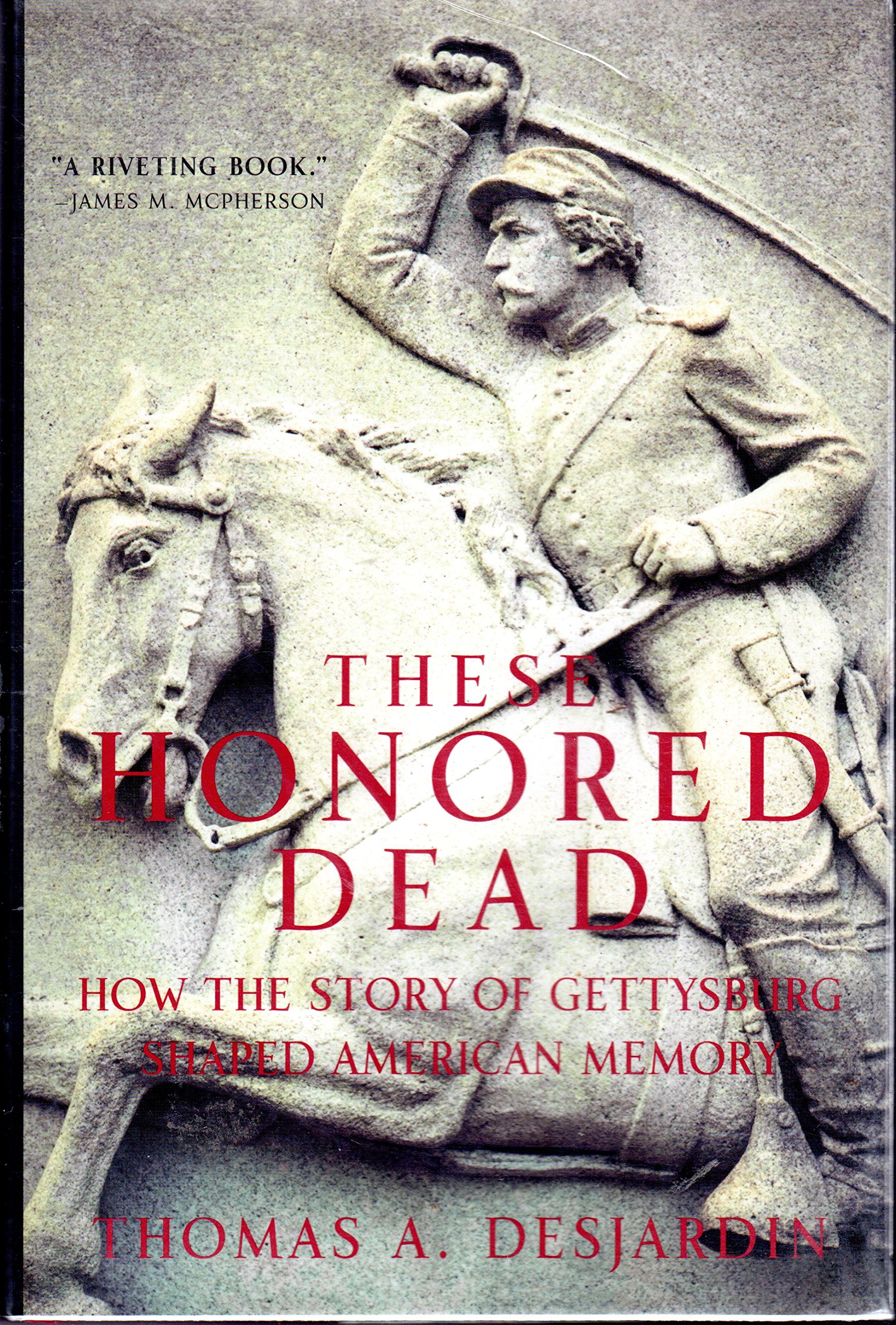
These Honored Dead: How The Story Of Gettysburg Shaped American Memory
$18.60
by Thomas A. Desjardin



Ever since the guns of Gettysburg fell silent in July 1863, and Lincoln stepped away from his two-minute speech on the same battleground four months later, the story of this three-day conflict has become an American legend, a cultural icon. American memory has established Gettysburg as the greatest, biggest, most important, most heroic, most savage, bloodiest battle this nation has ever fought. It has become our Waterloo, our battle of Marathon, our siege of Troy. The soldiers who fought there have become heroes in our national pantheon: They fought the hardest, endured the worst, and achieved the most, nothing less than saving the United States from self-destruction. Gettysburg has become the defining conflict in our history.How did the story of Gettysburg evolve? How did the battle become a legend? And how much truth is behind the myth? Thomas A. Desjardin, a prominent Civil War historian and keen cultural observer, shows how flawed our knowledge of this enormous event has become, and why that has happened. It is, in effect, the extraordinary biography of a story-the story of Gettysburg. It also shows how Americans have shaped, used, altered, and sanctified our national memory, fashioning the story of Gettysburg as a reflection of, and testimony to, our culture and our nation. In George Bernard Shaw's Devil's Disciple , British general Burgoyne faces certain defeat at Saratoga. A subordinate asks him how history will view the event. History, Burgoyne states, "will tell lies, as usual." Desjardin is a historian and an archivist at Gettysburg. In this intriguing look at the reliability of many of the assumed truths about the Battle of Gettysburg, he does not accuse "history" or individuals of deliberate deceit. Rather, he convincingly asserts that the memories of battle participants, many of them recorded a decade later, are fragmentary and often contradictory. Faced with confusing recollections, historians often chose to select those accounts that satisfied their own preconceptions. As their accounts were written and repeated over decades, they received the aura of sanctified truth. For example, what really happened on the second day at Little Round Top? Did Joshua Lawrence Chamberlain really "save the Union" with an unorthodox charge? In dissecting various accounts, Desjardin skillfully illustrates how hazy memories of the fog of battle are gradually codified into accepted fact. An excellent addition to Civil War collections. Jay Freeman Copyright © American Library Association. All rights reserved "A remarkably enlightened magical mystery tour of the Gettysburg battlefield...An entertaining, accurate and thought-provoking study." -- Portland Press Herald 02/22/04 "A very entertaining book that all lovers of military history from all eras should have on their shelves." -- The Wargamer February 2004 "Debunks some of the popular myths surrounding the three-day engagement...Challenge[s] the conventions of history." -- Army January 2004 "Desjardin's unique angle has won praise from national reviewers for its fresh take, while also pleasing...Civil War buffs." -- Morning Sentinel (ME) 03/31/04 "Eye-opening...Along comes Desjardin to painstakingly show that much of what we have come to believe is wrong." -- Rocky Mountain News 12/26/03 "Informative." -- Civil War Courier May 2004 "Myths began about Gettysburg the moment the last shot was fired...This is an interesting overview of those myths." -- Military Images March/April 2004 "Shines a harsh but brilliant light on the flawed reinterpretation of America's most misunderstood piece of history...exquisite detail." -- Utne Reader March/April 2004 "The extraordinary biography of a story-the story of Gettysburg." -- SirReadaLot.org 12/22/03 "Wonderfully written, provocative, and informative...A fabulous book...One of the better volumes written on the battle in many years." -- The Civil War News February/March 2004 Thomas A. Desjardin holds a Ph.D. in American History and has been an archivist and historian for the National Park Service at Gettysburg. He is currently Historic Site Specialist for the Maine Bureau of Parks and Lands and is a frequent television commentator on Civil War topics.