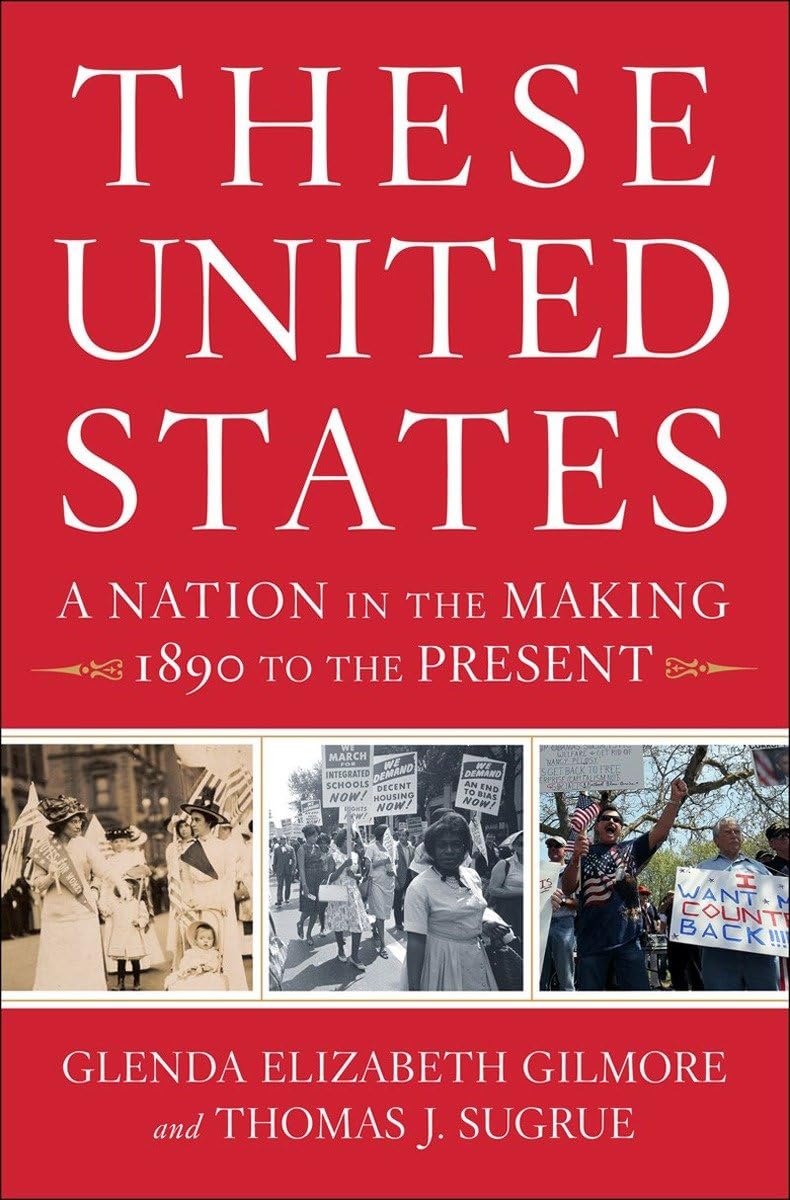
These United States: A Nation in the Making, 1890 to the Present
$59.96
by Glenda Elizabeth Gilmore



A powerful history of the making and unmaking of American democracy and global power, told in sweeping scope and intimate detail. In the winter of 1936, Franklin Roosevelt remarked in a fireside chat, “I do not look upon these United States as a finished product. We are still in the making.” Certainly apt in the midst of the Depression, the idea of a nation in the making still resonates today as we measure the achievements and shortcomings of our democracy. Over the long twentieth century, Americans have worked, organized, marched, and fought to make the nation’s ideals a reality for all. This shared commitment to achieving an American democracy is the inspiring theme of These United States . Acclaimed historians Glenda Elizabeth Gilmore and Thomas J. Sugrue forge the panoramic and the personal into an authoritative narrative. They give us insightful accounts of the century’s large events―war, prosperity, and depression, astute leadership and arrogant power, the rise and decline of a broad middle class. And they ground the history in the stories of everyday Americans such as William Hushka, a Lithuanian immigrant who makes and loses an American life; Stan Igawa, a Japanese-American who never doubts his citizenship despite internment during World War II; and Betty Dukes, a Wal-Mart cashier who takes on America’s largest corporation over wage discrimination. The history begins and ends in periods of concentrated wealth, with immigration roiling politics and racial divisions flaring. Its arc over those hundred-plus years raises key questions: how far has our democracy come? Were the postwar decades of middle-class prosperity and global power a culmination of the American Century or the exception in a long history of economic and political division? Gilmore and Sugrue frame these questions by drawing the illuminating connections characteristic of the best historical writing. 16 pages of illustrations; 10 maps "[A] timely, remarkable new survey of America since 1890 . . . required reading." ― Eric Herschthal, Slate "This marvelous book weaves together a sweeping yet strikingly intimate narrative of the nation’s century-long struggle to make real its founding promise. It is learned, passionate history, expertly told." ― Kevin Boyle, author of Arc of Justice "A tour de force : brilliantly conceived, elegantly written, and consistently insightful." ― Peniel Joseph, author of Stokely: A Life "An invigorating, inspiring, much-needed exploration of the ‘American Century.’" ― Beverly Gage, author of The Day Wall Street Exploded "Ambitious, wise, and briskly told…essential reading for anyone who cares about the course and fate of the nation." ― Michael Kazin, author of American Dreamers "A pleasure to read, These United States offers a consistent interpretation of our history, explaining our strengths and the origins of our problems." ― Linda Gordon, coauthor of Feminism Unfinished "Written by two of our most innovative historians, this beautifully realized volume stimulates thought, informs with great clarity, and advances the craft of historical synthesis." ― Ira Katznelson, author of Fear Itself "This vigorous narrative shows how the debates and decisions of the twentieth century shape those we face in the twenty-first… Combines a novelistic grasp of individual stories with the broad sweep of change across time." ― Jacquelyn Dowd Hall, coauthor of Like a Family Glenda Elizabeth Gilmore is the Peter V. and C. Vann Woodward Professor of History, African American Studies, and American Studies at Yale University. Her research interests include twentieth-century U.S. history; African American history since 1865; U.S. women's and gender history since 1865; history of the American South; and reform movements. Her publications include Norton’s Defying Dixie: The Radical Roots of Civil Rights, 1919-1950 , which was one of the American Library Association’s Notable Books and the Washington Post’s Best Books of 2008, and she edited Who Were the Progressives? and co-edited Jumpin’ Jim Crow: Southern Politics from Civil War to Civil Rights . Her first book, Gender and Jim Crow: Women and the Politics of White Supremacy in North Carolina, 1896-1920 , won the Frederick Jackson Turner Award, the James A. Rawley Prize, the Julia Cherry Spruill Prize, and the Heyman Prize. Thomas J. Sugrue is Professor of History and Social and Cultural Analysis at New York University, specializing in twentieth-century American politics, urban history, civil rights, and race. He is a Fellow of the American Academy of Arts and Sciences, a member of the Society of American Historians, and past president of both the Urban History Association and the Social Science History Association. He is author of Not Even Past: Barack Obama and the Burden of Race and Sweet Land of Liberty: The Forgotten Struggle for Civil Rights in the North . His first book, The Origins of the Urban Crisis , won the Bancroft