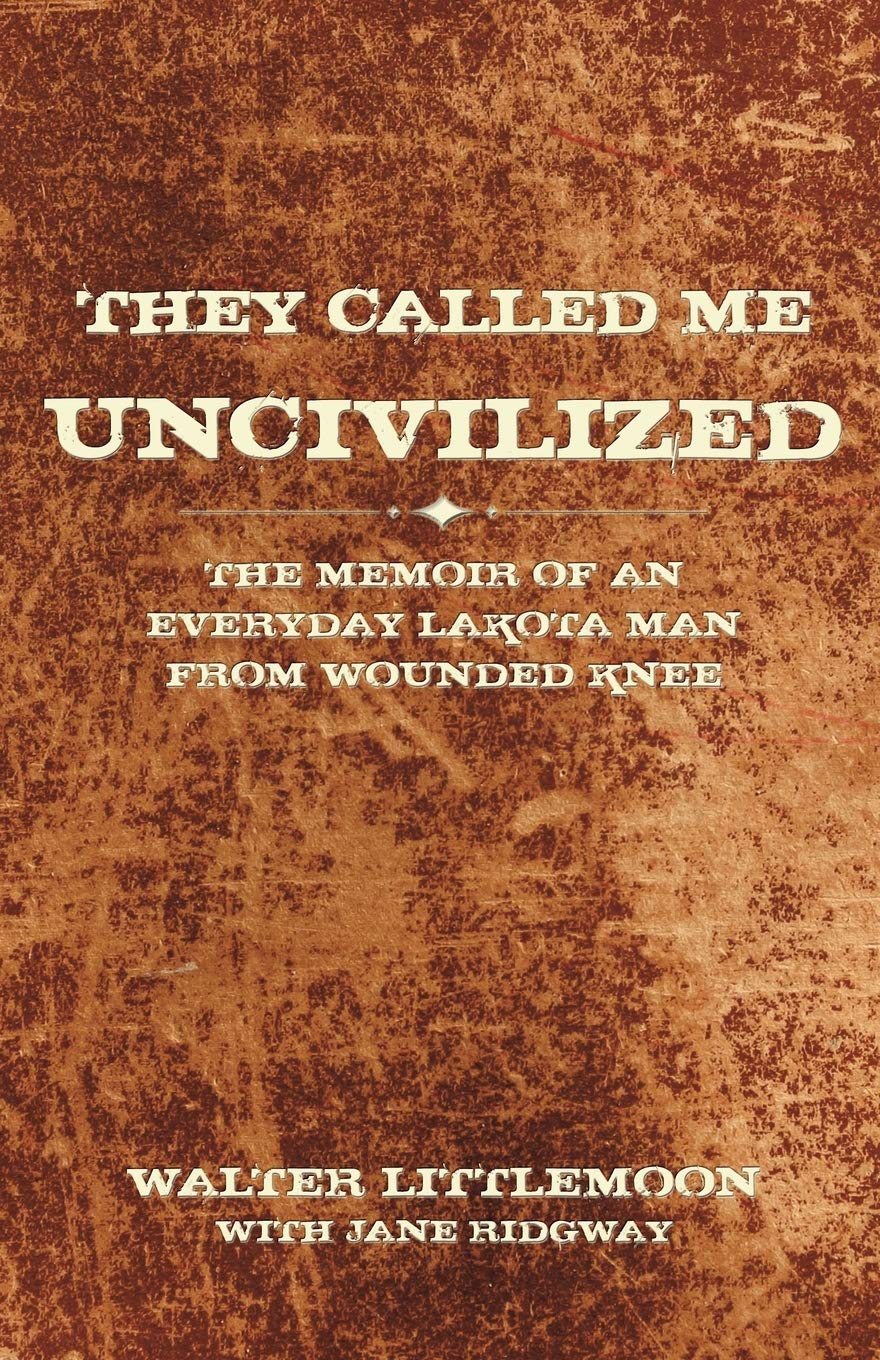
They Called Me Uncivilized: The Memoir of an Everyday Lakota Man from Wounded Knee
$12.95
by Walter Littlemoon



Walter Littlemoon's memoir, They Called Me Uncivilized , is a call to awareness from within the heart of Wounded Knee. In telling his story, Littlemoon describes the impact federal Indian policies have had on his life and on the history of his family. He gives a rare view into the cruelty inflicted on generations of Native American children through the implementation of U.S. government boarding schools, which resulted in a muted truth, called Soul Wound by some. In addition, and for the first time, his narrative provides a resident's view of the 1973 militant Occupation of Wounded Knee and the lasting impact that takeover has had on his community. His path toward a sense of peace and contentment is one he hopes others will follow. Remembering and telling the truth about traumatic events are prerequisites for healing. Many books have been written by scholars describing one aspect or another of Native American life, their history, their spirituality, the 1973 occupation, and a few have tried to describe the boarding schools. None have connected the dots. Until the language of the everyday man is used, scholarly words will shut out the people they describe and the pathology created by federal Indian policy will continue. They Called Me Uncivilized The Memoir of an Everyday Lakota Man from Wounded Knee By Walter Littlemoon Jane Ridgway iUniverse, Inc. Copyright © 2009 Walter Littlemoon All right reserved. ISBN: 978-1-4401-6278-7 Contents Foreword...............................................................viiPreface................................................................xiiiChapter 1 To Remember..................................................1Chapter 2 Who They Were................................................11Chapter 3 My Father's Drumming.........................................17Chapter 4 My Mother's Determination and Generosity.....................25Chapter 5 They Taught Me Indian........................................31Chapter 6 Learning to Be Civilized.....................................37Chapter 7 Culture Shock................................................55Chapter 8 Losing Ground................................................61Chapter 9 Our Own Worst Enemy..........................................69Chapter 10 Remembering the Lessons from the Elders.....................79 Chapter One To Remember Early one morning, while sitting at the kitchen table greeting a new day, I gazed upward to where the sky becomes deep blue and watched as a solitary hawk scanned the rolling landscape in search of food, his tail feathers flashing crimson in the sun. A patchwork quilt of colors spread out below him, golden fields, dark green slashes of pine, purple, pink, yellow, blue and red wildflowers sprinkled throughout. The hawk circled slowly, drifting downward and lit upon the immense cottonwood tree that stands just outside the kitchen, next to a small meandering creek, we call Mouse Creek. On the distant horizon rose the dark purple cone of Harney Peak where the Heyoka, Black Elk, sat and saw this future time of our people. Closer, less than two miles away, is the mass grave, the site of the last massacre, the one that took place in December 1890; it is a lonely place, windblown and unkempt. The tree the hawk rested on is solid. Its girth is wider than three men can reach around. It towers into the sky and provides safe haven, comfort, and shelter to many smaller birds and animals. It has been standing here for over one hundred years. That morning, the Tree began again to speak to me in the old way known to the Lakota. Its words came through as strong, heartfelt feelings as if it were saying: All things that ever happened in this place, Mouse Creek of Wounded Knee, are a part of today. They are not just history, over and done with, as some now think. I stood here listening to the Hotchkiss guns firing farther down the creek, hearing the screams of the people during what is now called the Wounded Knee massacre. I was already a tall tree when your Lakota grandparents, Little Moon and Rattle Woman, first arrived here to live in the late 1800s. Their parents: Iron Heart, Her Red Road, Never Missed and Helps also visited here. Your great grandmother, Iron Teeth, and her daughters rested here under my limbs on their way back to the Lame Deer Agency, where the Northern Cheyenne were placed in Montana. Through the passing of many days and nights, I have watched your relatives' come and go. They've gathered in groups and singly in the peaceful shade of my branches to restore their strength. Many of them still struggle, like you, to maintain their Lakota identity through all the chaos that has come to this place. I have held on to their stories and held on to who they are. From that moment when the Tree first spoke to me, I have repeatedly sought its counsel. I have struggled nearly all of my life to overcome what I've come to call my "fear of living," to be able to