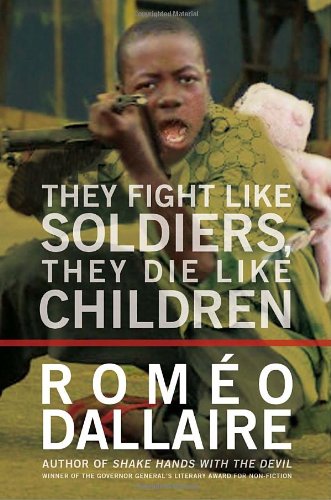
They Fight Like Soldiers, They Die Like Children: The Global Quest to Eradicate the Use of Child Soldiers
$13.01
by Romeo Dallaire



"The ultimate focus of the rest of my life is to eradicate the use of child soldiers and to eliminate even the thought of the use of children as instruments of war." —Roméo Dallaire In conflicts around the world, there is an increasingly popular weapon system that requires negligible technology, is simple to sustain, has unlimited versatility and incredible capacity for both loyalty and barbarism. In fact, there is no more complete end-to-end weapon system in the inventory of war-machines. What are these cheap, renewable, plentiful, sophisticated and expendable weapons? Children. Roméo Dallaire was first confronted with child soldiers in unnamed villages on the tops of the thousand hills of Rwanda during the genocide of 1994. The dilemma of the adult soldier who faced them is beautifully expressed in his book's title: when children are shooting at you, they are soldiers, but as soon as they are wounded or killed they are children once again. Believing that not one of us should tolerate a child being used in this fashion, Dallaire has made it his mission to end the use of child soldiers. In this book, he provides an intellectually daring and enlightening introduction to the child soldier phenomenon, as well as inspiring and concrete solutions to eradicate it. NATIONAL BESTSELLER A Globe and Mail Best Book “A compelling, moving and insightful book that exposes the problem of child soldiers in all its dimensions. . . . The book is emblematic of Dallaire’s resolve, compassion and abiding commitment to justice. . . . Refreshingly sincere.” — Samantha Nutt, The Globe and Mail (Best Book) “Gripping.” — Calgary Herald “Discover for yourself the compassion that shines through in this book. . . . Heartbreaking and informative. . . . After all the horrors Dallaire has seen, his enthusiasm and optimism is a wonder. But it’s also infectious and refreshing.” — The Gazette “Painful but beautifully rendered.” — The Vancouver Sun “As a documentation of the changing face of modern global warfare it is a must-read.” — Telegraph-Journal LGEN THE HON. ROMÉO DALLAIRE (Ret) served thirty-five years with the Canadian Armed Forces and now sits in the Canadian Senate. His Governor General's Literary Award-winning book, Shake Hands with the Devil , exposed the failures of the international community to stop the worst genocide in the twentieth century. It has been turned into an Emmy Award-winning documentary as well as a feature film; it has also been entered into evidence in war crimes tribunals trying the perpetrators of the Rwandan genocide. Dallaire has received numerous honours and awards, including Officer of the Order of Canada in 2002, Grand Officer of the National Order of Québec in 2005, the Aegis Award for Genocide Prevention from the Aegis Trust (United Kingdom) and the United Nations Association in Canada's Pearson Peace Medal in 2005. As a champion of human rights, his activities include work on genocide prevention, the non-proliferation of nuclear weapons and the Child Soldier Initiative, which seeks to develop a conceptual base for the elimination of the use of child soldiers. 1. WARRIOR BOY When I was a child, my father set out to build a cabin in the bush in the Laurentian Mountains in Quebec. The site was on a small cliff overlooking a violin-shaped lake, with virgin bush for tens of kilometres in nearly all directions around it. In the late fall and winter, the local farmers would go into the woods with their enormous horses and chains and tackles and sleighs to cut and then haul out spruce and cedar, and even the odd oak, to the provincial road where the logs would be piled sky-high until spring. I would marvel at these weather-beaten and muscle-bound farmers and their sons, who seemed to effortlessly wield enormous axes and bucksaws a hundred feet long. My father was a staff-sergeant serving in the Canadian Army, with three children and a wife to support and no money to spare on any kind of a dream cabin. And so he brought down some of the huge trees around the site (he’d been a lumberjack before he joined the army in 1928), had them sawn into lumber at the village sawmill, and over the course of several years scrounged the rest of what he needed to complete what we not-so-affectionately dubbed the Slave Camp. Nothing really fit, be it window, plumbing or stairs. The dock regularly went astray, as the battle between man and beast (the beavers) kept the water levels in constant flux. A trip to the cabin meant steady work. Beyond the need to constantly tweak the make-do materials of our shelter in the woods, there were other reasons for the unending labour. Dad was a huge man with a very powerful chest, heavily tattooed arms, and hands that could smother a pineapple. He was a veteran of the Second World War, and like many veterans was haunted by that experience, sometimes to the point of allowing that destructive world to invade our home life. When the brain inj