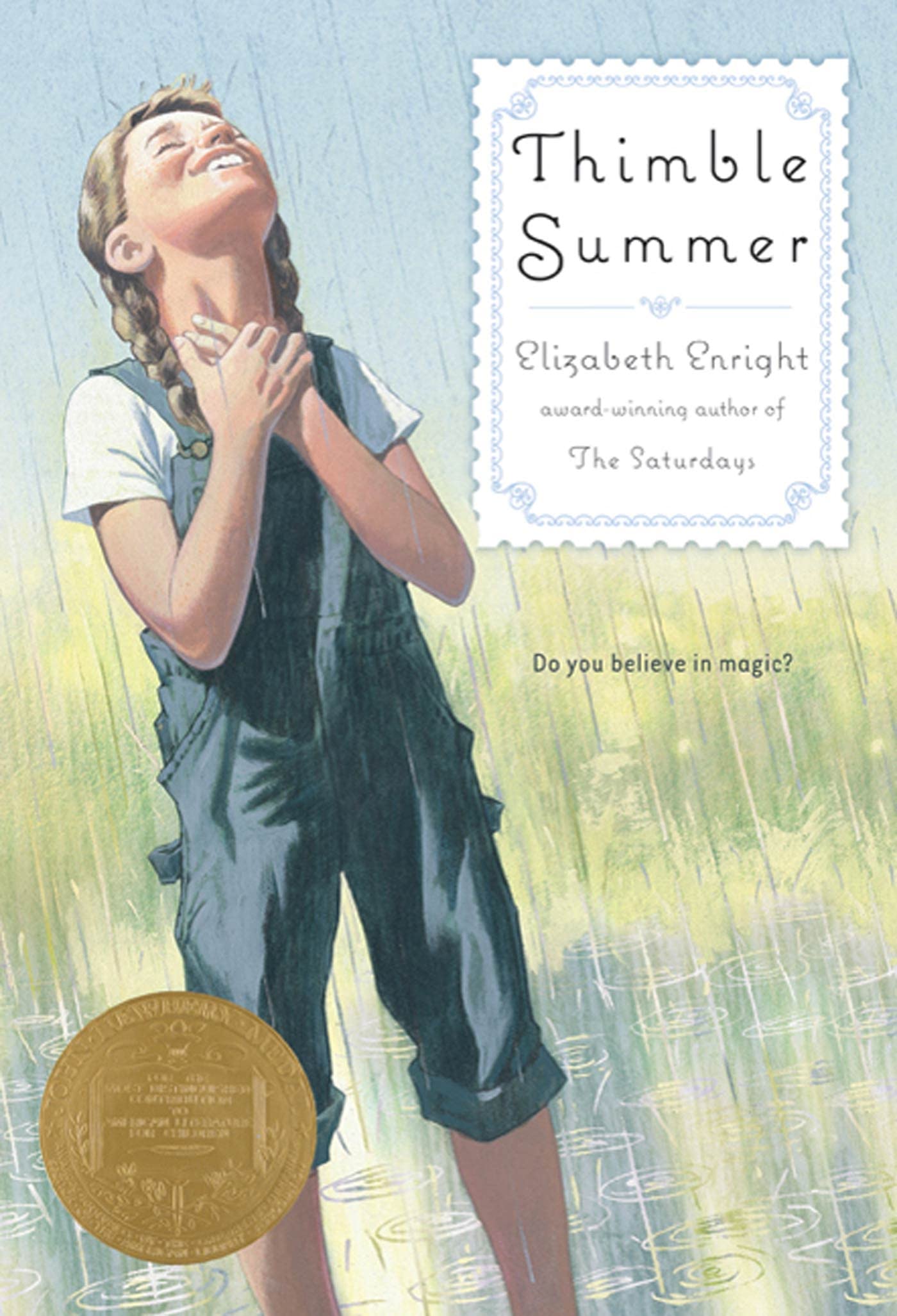



A silver thimble and a new friend make a girl's summer magical in Elizabeth Enright's Thimble Summer. A few hours after nine-year-old Garnet Linden finds a silver thimble in the dried-up riverbed, the rains come and end the long drought on the farm. The rains bring safety for the crops and the livestock, and money for Garnet's father. Garnet can't help feeling that the thimble is a magic talisman, for the summer proves to be interesting and exciting in so many different ways. There is the arrival of Eric, an orphan who becomes a member of the Linden family; the building of a new barn; and the county fair at which Garnet's carefully tended pig, Timmy, wins a blue ribbon. Every day brings adventure of some kind to Garnet and her best friend, Citronella. As far as Garnet is concerned, the thimble is responsible for each good thing that happens during this magic summer―her thimble summer. “This story of a Wisconsin farm sings with the happiness and contentment of a small girl whose roots are sinking deep into the soil of a loved place.” ― School Library Journal, Starred Review “This is a story of the sort for which there is a constant demand. . . . There is the flavor of real life . . . expressed with charm and humor.” ― The New York Times Book Review 'One of the best written of this season's juveniles.... will interest both girls and boys, since it is about Garnet Linden and her brother Jay, and can find readers up to twelve and over. The setting is a middle-western farm, and the descriptions of wind and weather are vivid and authentic. There is a truly American quality about it that delighted me.' - Rosemary Carr Benet, The Saturday Review of Literature. Elizabeth Enright (1907-1968) was born in Oak Park, Illinois, but spent most of her life in or near New York City. Her mother was a magazine illustrator, while her father was a political cartoonist. Illustration was Enright's original career choice and she studied art in Greenwich, Connecticut; Paris, France; and New York City. After creating her first book in 1935, she developed a taste, and quickly demonstrated a talent, for writing. Throughout her life, she won many awards, including the 1939 John Newbery Medal for Thimble Summer and a 1958 Newbery Honor for Gone-Away Lake. Among her other beloved titles are her books about the Melendy family, including The Saturdays , published in 1941. Enright also wrote short stories for adults, and her work was published in The New Yorker , The Ladies Home Journal , Cosmopolitan , The Yale Review , Harper’s , and The Saturday Evening Post . She taught creative writing at Barnard College. Translated into many languages throughout the world, Elizabeth Enright's stories are for both the young and the young at heart. Thimble Summer By Elizabeth Enright Macmillan Copyright © 1966 Elizabeth Enright Gillham All rights reserved. ISBN: 978-0-312-38002-1 Contents TITLE PAGE, COPYRIGHT NOTICE, DEDICATION, I. THE SILVER THIMBLE, II. THE CORAL BRACELET, III. THE LIME KILN, IV. THE STRANGER, V. LOCKED IN, VI. JOURNEY, VII. "AS A RAGPICKER'S POCKET", VIII. FAIR DAY, IX. ICE-CREAM CONES AND BLUE RIBBONS, X. THE SILVER THIMBLE, NEWBERY MEDAL ACCEPTANCE SPEECH, ABOUT THE AUTHOR, ALSO BY ELIZABETH ENRIGHT, COPYRIGHT, CHAPTER 1 The Silver Thimble GARNET thought this must be the hottest day that had ever been in the world. Every day for weeks she had thought the same thing, but this was really the worst of all. This morning the thermometer outside the village drug store had pointed a thin red finger to one hundred and ten degrees Fahrenheit. It was like being inside of a drum. The sky like a bright skin was stretched tight above the valley, and the earth too, was tight and hard with heat. Later, when it was dark, there would be a noise of thunder, as though a great hand beat upon the drum; there would be heavy clouds above the hills, and flashes of heat lightning, but no rain. It had been like that for a long time. After supper each night her father came out of the house and looked up at the sky, then down at his fields of corn and oats. "No," he would say, shaking his head, "No rain tonight." The oats were turning yellow before their time, and the corn leaves were torn and brittle, rustling like newspaper when the dry wind blew upon them. If the rain didn't come soon there would be no corn to harvest, and they would have to cut the oats for hay. Garnet looked up at the smooth sky angrily, and shook her fist. "You!" she cried, "Why in time can't you let down a little rain!" At each step her bare feet kicked up a small cloud of dust. There was dust in her hair, and up her nose, making it tickle. Garnet was halfway between nine and ten. She had long legs and long arms, two taffy-colored pigtails, a freckled nose that turned up, and eyes that were almost green and almost brown. She wore a pair of blue overalls, cut off above the knee. She could whistle between her teeth like a b