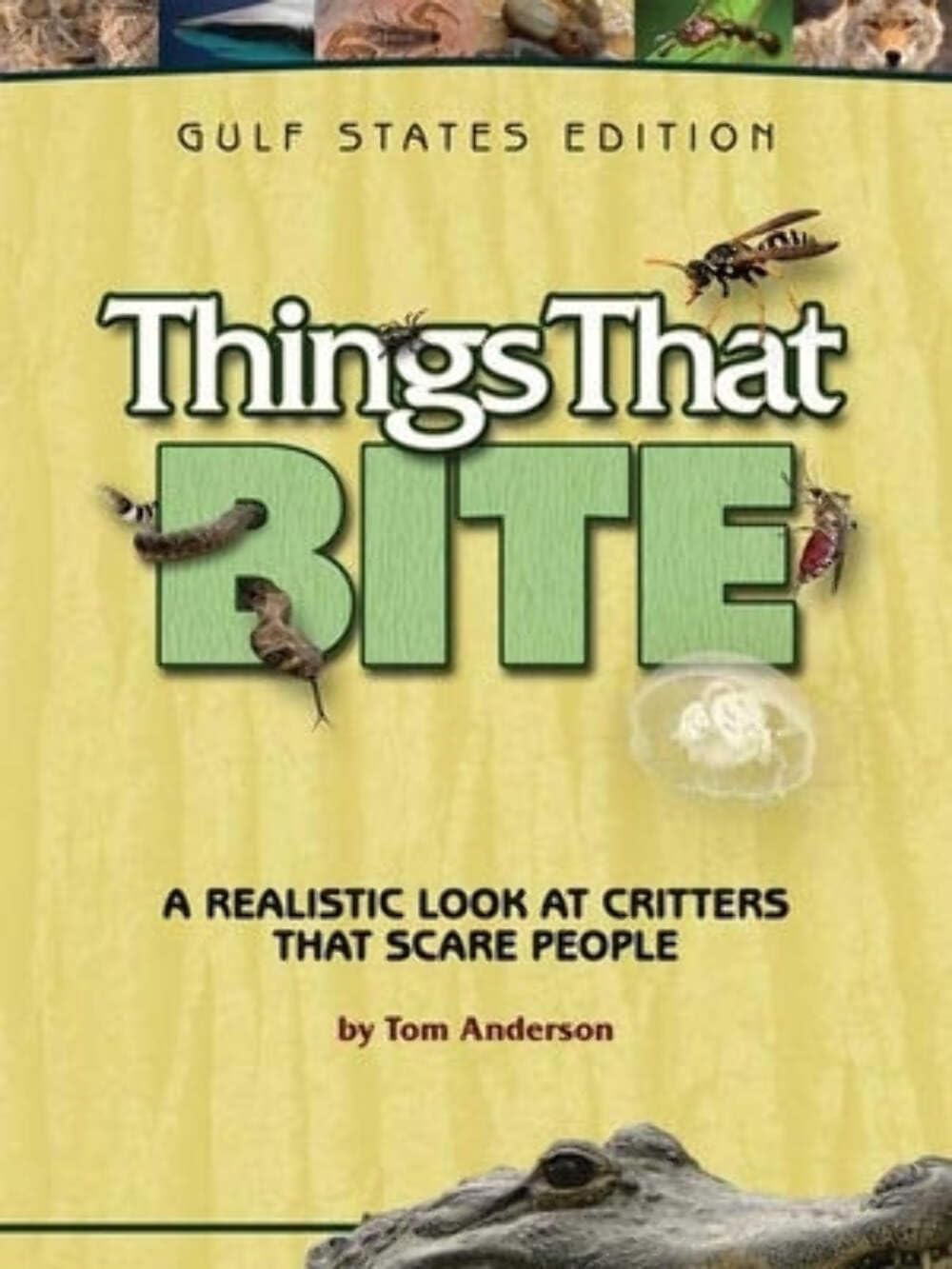
Things That Bite: Gulf States Edition: A Realistic Look at Critters That Scare People
$9.20
by Tom Anderson



Be Aware, Not Afraid Spiders, snakes, sharks and gators - they're out there, but there's no reason to fear them. Things That Bite takes a matter-of-fact look at more than 30 creatures found in the states that border the Gulf of Mexico. Detailed information includes fascinating facts, environmental benefits of each species, discussion of why some might bite, bite prevention and myths about each creature. Tom Anderson is a professional naturalist, an award-winning writer and a wildlife expert. For sixteen years he was director of the Lee and Rose Warner Nature Center, which is associated with the Science Museum of Minnesota and is located in Marine on St. Croix, Minnesota. In addition to his work at the nature center, Tom is a well-known writer and columnist. For nearly 15 years he wrote “Reading Sign,” an award-winning column for the Chisago County Press. He is also the author of two books, Learning Nature by a Country Road and Black Bear: Seasons in the Wild, both from Voyageur Press. He is a published poet and was a columnist for Midwest Fly Fishing Magazine and the Science Museum of Minnesota periodical Encounters. Tom has been honored many times for his writing. He was one of 20 Minnesota artists chosen to participate in the Millennium Journal Project. In 2003 he was awarded the “Best Commentary Award” by The National Association of Interpretation’s periodical, The Legacy. In 2004 he was runner-up for the “Best Feature” category. The natural world and our intimate connection to it inspires Tom to write. He lives southwest of North Branch, but he travels often, especially in the far North. He lives with his lovely wife Nancy Conger in the nineteenth century farmhouse his Swedish great-great grandparents built. Chiggers Nels, one of my best friends, was camping in southern Texas near the Rio Grande. Since he was Minnesotan, everything about the area was new and exciting, especially the native wildlife. While hiking, Nels overheard a flock of Black-bellied Whistling Ducks. He crawled through sand and thick buffelgrass to sneak closer for a better look. After watching the birds for a while, he retreated, excited about the sighting. That night, he felt a burning sensation around his ankles. As it turns out, Nels had encountered more than a few ducks; he’d also met another resident species of the Gulf Coast―chiggers. By morning he had bites from his toes to his waist. For a few days his nightly scratching only seemed to make the itching worse. The chiggers made sure that Nels would never forget that outing! About Chiggers Like ticks and spiders, chiggers are arachnids, not insects. Chiggers start out very small; their larvae are only 1⁄150 of an inch in diameter, and it’s actually these tiny larvae that cause us discomfort. As chiggers develop, they grow larger and their diet changes. As nymphs and adults, chiggers no longer feed upon us; instead, they prey upon insect eggs and small invertebrates in the soil. Chiggers are found throughout the Gulf Coast region and are sometimes called mites or red bugs because adults are covered in dense red hairs. Life and Times . . . Like other arachnids, chiggers go through four life stages: egg, larva, nymph and adult. The complete life cycle takes roughly 50–70 days. Male chiggers die shortly after mating. Fertilized females lay up to 400 eggs in early spring after the soil begins to warm. The female chigger dies shortly after laying her eggs. In a matter of days, the eggs hatch, producing the chigger’s tiny larval stage. Shortly after hatching, the larvae climb to a perch where they can easily latch onto a passing host. Unlike their tick cousins who sit and wait, chigger larvae are nearly constantly on the move. Larvae feed on a number of host species, including mammals, birds, reptiles and even some amphibians. Larvae are most likely to be found in areas with thick vegetation and high humidity. Due to their thin skin and small size, larvae are susceptible to dehydration. Sandy, dry areas are not humid enough for their survival. After a larva finds a host and feeds for three days, it drops off and crawls into the soil where it develops into the nymph stage. Nymphs are essentially scaleddown versions of adults and feed on tiny soil invertebrates until they are ready to change into adults. Both nymphs and adults have eight legs. Three generations of chiggers are born over the course of spring, summer and early fall. In warmer areas of the Gulf Coast region, chiggers thrive in all three of their life stages at any time of the year. Fascinating Facts A larval chigger’s saliva includes an enzyme that turns skin cells into a liquid, which the larva then drinks. - Like mosquitoes, chiggers are attracted to the carbon dioxide given off by a passing host. - Chiggers are capable of getting all over a person’s body in minutes. They climb from a victim’s feet to the belt line (a favorite point of attack) in an ascent that takes about 15 minutes. That’s no small feat for such a