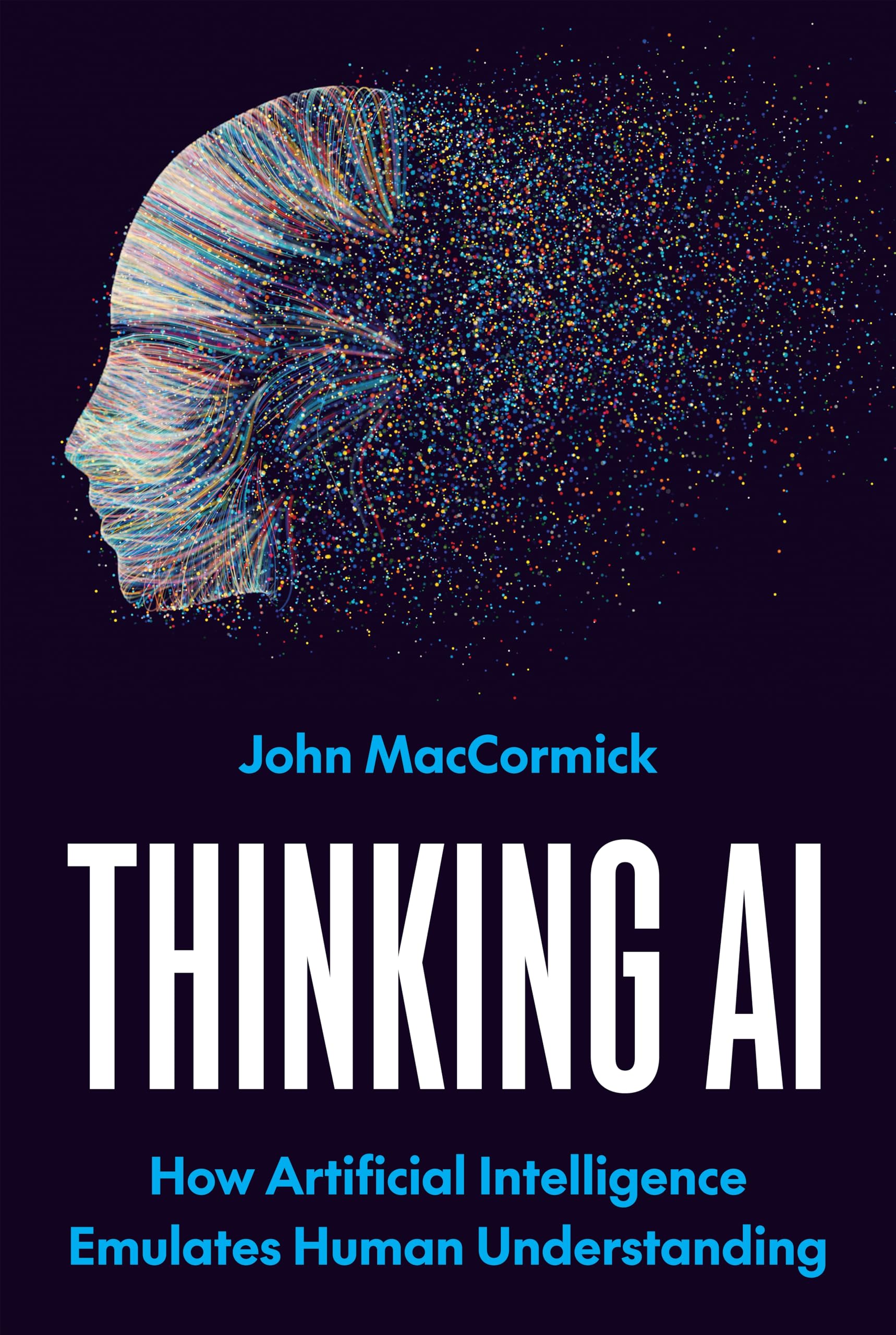
Thinking AI: How Artificial Intelligence Emulates Human Understanding
$29.95
by John MacCormick



Can a computer program think like a human? “Can machines think?” Ever since Alan Turing posed this question in an influential 1950 paper, it has been central to research in artificial intelligence. More than seventy-five years after Turing’s paper, we grapple with it every time we wonder if Watson was actually smarter than Jeopardy! champions, or if ChatGPT really knows what it’s talking about. In Thinking AI , computer scientist John MacCormick explores Turing’s question from a perspective informed by a detailed understanding of the way modern AI systems work. MacCormick explains, in accessible fashion, the ideas behind the two main pillars of the twenty-first century AI revolution: deep neural networks and reinforcement learning. MacCormick offers a tour of the most famous AI systems, including AlexNet and VGG16, deep neural networks for object recognition that led to a Nobel prize; DeepMind’s AlphaGo, which shocked AI researchers with its superhuman performance in the game of Go; and OpenAI’s ChatGPT, which stunned the world with its natural language capabilities. He describes how each system works, and points to parallels with human brain processes. Both human minds and computer programs, MacCormick explains, can induce intelligence through emergence : the capability for new phenomena to emerge from the interactions of many small, simple components. Does this mean that a computer program can think like a human? In many ways, MacCormick argues, the answer is yes . In Thinking AI , he reveals a new landscape of emergent intelligence—a world in which computer programs can emulate many or all aspects of human thinking but humanity retains its meaning and purpose. “When I heard that John MacCormick was writing a book on AI, I was immediately eager to read it, and this book does not disappoint. Directly addressing a key question of our age, he brings extensive historical and scientific research and a deep understanding of the internal workings of modern AI models to produce a beautifully calibrated exposition. I shall be recommending this book to basically everyone I know.” —Andrew Fitzgibbon, Engineering Fellow, Graphcore “This book is a much-needed addition to the public conversation around AI. MacCormick cuts through the immense media hype to provide an accessible and fascinating exploration of how machines can appear to think like humans, equipping readers to form their own conclusions about the provocative question that Turing posed over fifty years ago.”— Kerry McInerney, University of Auckland and Leverhulme Centre for the Future of Intelligence, University of Cambridge “ Thinking AI does a wonderful job of making the foundations of modern artificial intelligence systems accessible to nonexperts. It explains the building blocks of these systems—deep neural networks and reinforcement learning. Using illustrative examples, it examines the connections between AI systems and biological brains and offers nuanced answers to weighty philosophical questions, such as whether machines can fully emulate human intellect and creativity.” —Marc Najork, Distinguished Research Scientist, Google DeepMind “A worthy and thoughtful contribution to the public’s understanding of AI.” —Rich Sutton, winner of the 2024 Turing Award “After so much has been written about dangers and threats from AI, it is refreshing to read this celebration of AI from a highly articulate teacher. John MacCormick reminds us of the huge intellectual achievement that modern AI represents and shows us the very high degree to which it can emulate human-like understanding.”— Andrew Blake, University of Cambridge, former Director of Microsoft Europe John MacCormick is professor of computer science at Dickinson College. He is the author of Nine Algorithms That Changed the Future: The Ingenious Ideas That Drive Today's Computers and What Can Be Computed? A Practical Guide to the Theory of Computation (both Princeton).