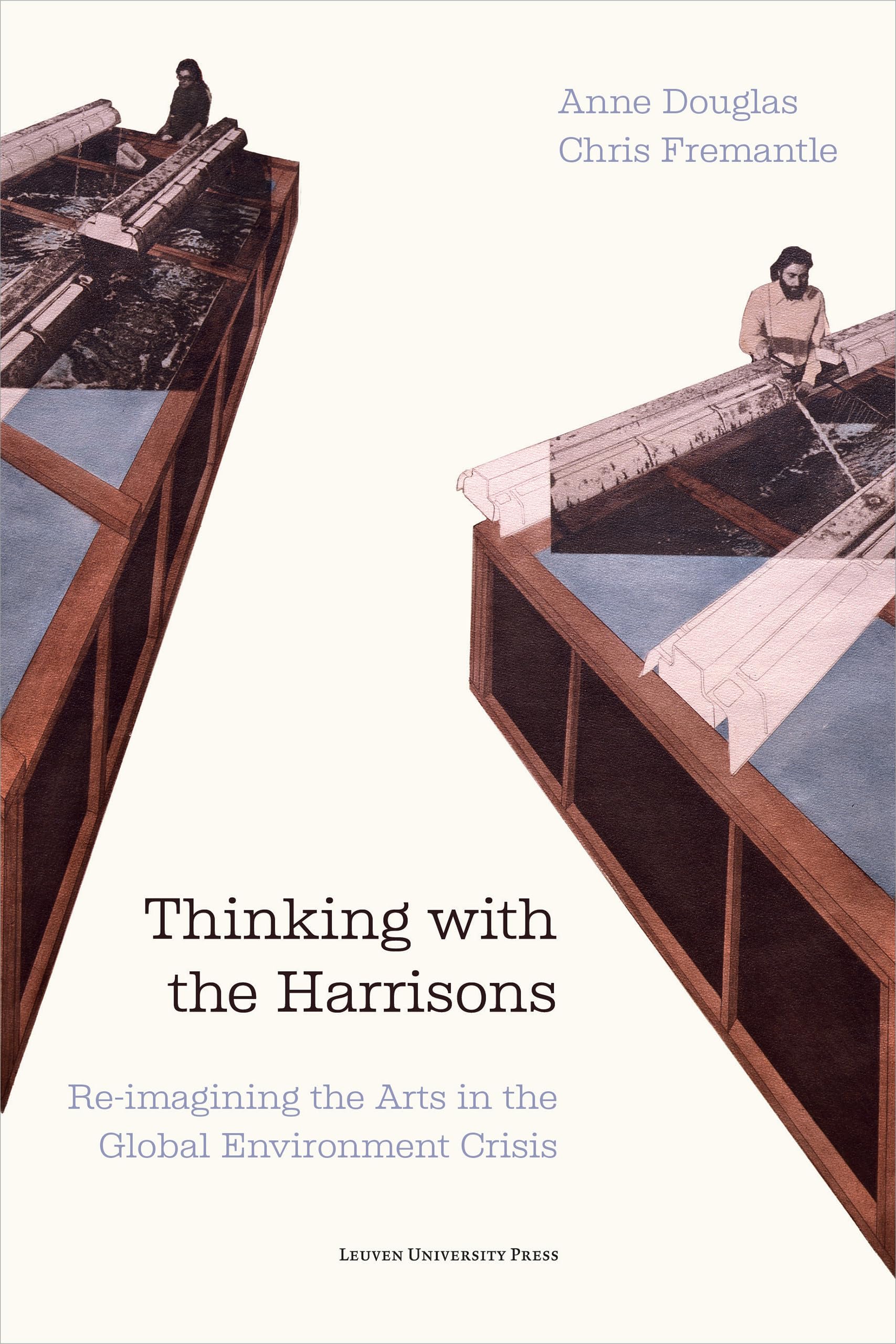
Thinking with the Harrisons: Re-imagining the Arts in the Global Environment Crisis
$24.99
by Anne Douglas



Helen Mayer Harrison and Newton Harrison, known as 'the Harrisons', dedicated five decades to exploring and demonstrating a new approach to artistic practice, centred on "doing no work that does not attend to the wellbeing of the web of life." Their collaborative practice pioneered a way of drawing together art and ecology. They closely observed, often with irony and humour, how human intervention disrupts the dynamics of life as a web of interrelationships. The authors of this book 'think with' the Harrisons, critically tracing their poetics as a reimaging and reconfiguring of the arts in response to the unfolding planetary crisis. They draw parallels between the artists' poetics and rethinking in the philosophy of science, particularly drawing on the work of Isabelle Stengers. Thinking with the Harrisons is for anyone concerned with the implications of ecological concerns as a reimagining of public life, including the interaction of art and science. Throughout their joint practice, the Harrisons sought to engage policy makers, governments, ecologists, artists, and inhabitants of specific places, sensitizing us to the crises that emerge from grounded experiences of place and time. As pioneers of environmental art, Newton and Helen Harrison were fifty years ahead of their time. Their proposal was for nothing less than a new paradigm for research, at once earth-centred, open-ended, responsive and communal, uniting science and art around urgent questions of planetary ecology. In this book, Anne Douglas and Chris Fremantle offer the first full-length appraisal of the Harrisons' work. In a world reeling from the destructive impacts of unfettered technoscience, its relevance has never been greater. -- Tim Ingold, University of Aberdeen Through a deeply considered re-examination of the work of the Harrisons, Douglas and Fremantle remind us that many of the answers to address the crisis of climate change already exist. This book offers an enlightened framework to see a different future for the arts within the ecological solutions needed for our world today. -- Cameron Cartiere, Emily Carr University of Art + Design The passage of time has only confirmed the prescience and centrality of the Harrison's work for understanding our current planetary crisis, and the crucial role that art can play in addressing it. This extensive, historically and theoretically informed analysis of their work is long overdue and a real joy to read. It's well past time for the broader art world to fully acknowledge the importance of the Harrisons' work, and this book is an essential starting point for that process. -- Grant Kester, University of California San Diego The passage of time has only confirmed the prescience and centrality of the Harrison's work for understanding our current planetary crisis, and the crucial role that art can play in addressing it. This extensive, historically and theoretically informed analysis of their work is long overdue and a real joy to read. It's well past time for the broader art world to fully acknowledge the importance of the Harrisons' work, and this book is an essential starting point for that process. -- Grant Kester, University of California San Diego Anne Douglas is a Professor Emerita, Gray's School of Art, Robert Gordon University, Scotland, who explores the changing place of the artist in public life. Her research has increasingly focused on art and the environmental crisis from a practice-led perspective. She co-produced the Harrisons' work 'On the Deep Wealth of this Nation: Scotland' (2017) in collaboration with Newton Harrison and the Centre for the Study of the Force Majeure, University of California Santa Cruz. Chris Fremantle is a researcher and producer of award-winning projects, including the Harrisons' project 'Greenhouse Britain: Losing Ground, Gaining Wisdom'. He is a longstanding member of the international ecoart network and co-editor of 'Ecoart in Action', a collection of activities, case studies and provocations drawn from the network. He lectures at Gray's School of Art, Robert Gordon University, Scotland.