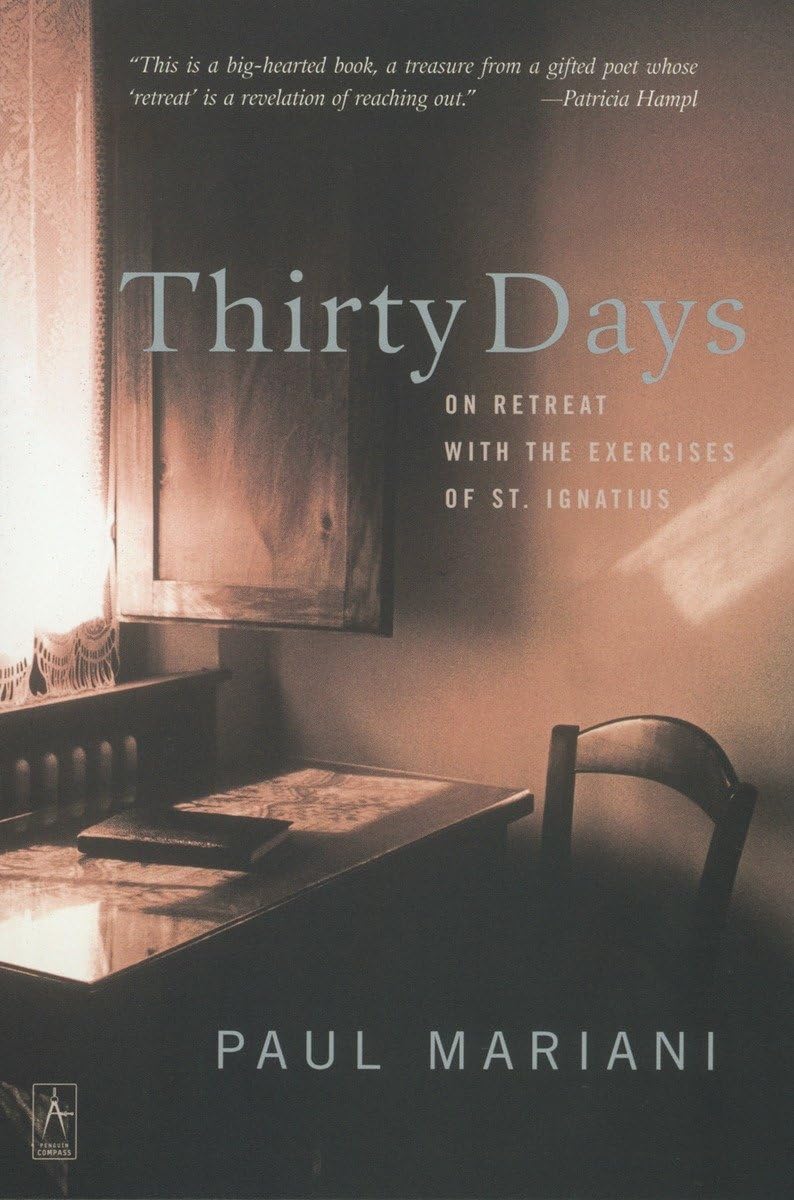
Thirty Days: On Retreat with the Exercises of St. Ignatius (Compass)
$14.03
by Paul Mariani



From the day Paul Mariani arrives at Eastern Point Retreat House to take part in the five-hundred-year-old Spiritual Exercises of St. Ignatius, he realizes that his expectations and assumptions about who he is, what he knows, and what he believes are about to change radically. In this profound memoir Mariani blends a brief life of St. Ignatius and meditations on the life of Jesus with the day-to-day unfolding of thirty days of silence at the retreat house. His journey of introspection, self-revelation, and spiritual renewal leads him to a new understanding of his relationship with God and of what it truly means to put others before oneself. "An engagingly and earnestly told story." — The Washington Post Book World "Mariani's journey is a courageous act, and even an inspiring one." — San Francisco Chronicle Paul Mariani , an award-winning poet, biographer of William Carlos Williams and Robert Lowell, and critic, holds a Chair in English at Boston College. A former professor of English at the University of Massachusetts, he has lectured widely across the country and lives in Montague, Massachusetts. Prologue By the term "Spiritual Exercises" we mean every method of examination of conscience, meditation, contemplation, vocal or mental prayer, and other spiritual activities, such as will be mentioned later. For just as taking a walk, traveling on foot, and running are physical exercise, so is the name of spiritual exercises given to any means of preparing and disposing our soul to rid itself of all its disordered affections and then, after their removal, of seeking and finding God's will in the ordering of our life for the salvation of our soul. -St. Ignatius of Loyola, Spiritual Exercises tuesday, january 4, 2000 4:00 p.m. An ordering, as in a set of directions for getting there. And so, finally, by map, northeast of Boston and east of Gloucester, to a room (call it a cell) facing the North Atlantic. Beginning to settle in-whatever that means-here at Gonzaga Retreat House on Eastern Point, a place run by the New England Jesuits, preparing for a Thirty-Day silent directed retreat. Oh boy! Drizzle and fog all afternoon, inside as well as out. Damn hard leaving Eileen. I could see she was keeping herself busy cleaning shelves, doing laundry, writing notes. Anything to keep her mind off the fact that in a short while her husband would walk out the door for five weeks, with two half-day visits only, and those on the eleventh and twenty-first days of the retreat. I too dithered about as long as I could, and then-at a quarter to one-kissed her goodbye and drove east along Route 2, past Gardner, Fitchburg, and Lexington, then onto Interstate 95 heading north around Boston, then east, and so to Gloucester. One hundred and fifteen miles. A two-hour-plus trip. In the hours before I left, everything took on added significance. It was almost as if I'd been going off to war, or to a hospital from which I might not be returning. The truth is you can no more rehearse separation than you can death. I packed-casual stuff, for there will be no formalities here, no grand dinners, no events. Just the daily round of silence and prayer and meetings with a spiritual director. And at this point I don't even know if my director is a man or a woman, though I hope it's a Jesuit. The place is officially called Gonzaga, after Aloysius Gonzaga, a Jesuit saint-an Italian nobleman of the illustrious Gonzagas-who died at the age of twenty-three caring for plague victims. The place took his name because he was young and this was once a Jesuit retreat house for high-school boys before being turned into a general retreat house some forty years ago. Everywhere a faded glory still hangs about the place: in the fine wood paneling and molded ceiling decorations, all dating back to the early 1920s, when the main house, built in a combination English Tudor and French country-estate style, was still a private residence with a commanding view of the Atlantic. These jerrybuilt, ugly aluminum windows and doors and the added wing that once served as a dorm for students on retreat, and which now houses other retreatants, look to have been added in the '50s, perhaps the worst decade ever in American architectural history. A mix of rubbed splendor and practicality: like the Jesuits themselves. Good real estate turned to practical ends, rather like Napoleon's troops turning the Prado into stables for their horses. A place had to be found for retreats, and the Jesuits found it, here at Eastern Point. Still, one has all the luxury of living on an estate: walks along the Atlantic, three squares a day, heat, a roof over one's head, a room of one's own. Plus a spiritual director for the care and feeding of the soul. All this for thirty dollars a day, plus my undivided attention. Not bad. The only downside is living alone, in unbroken silence, praying every day for hours on end, and no movies, no TV, no radio, and one or two newspapers on a table for all of us to