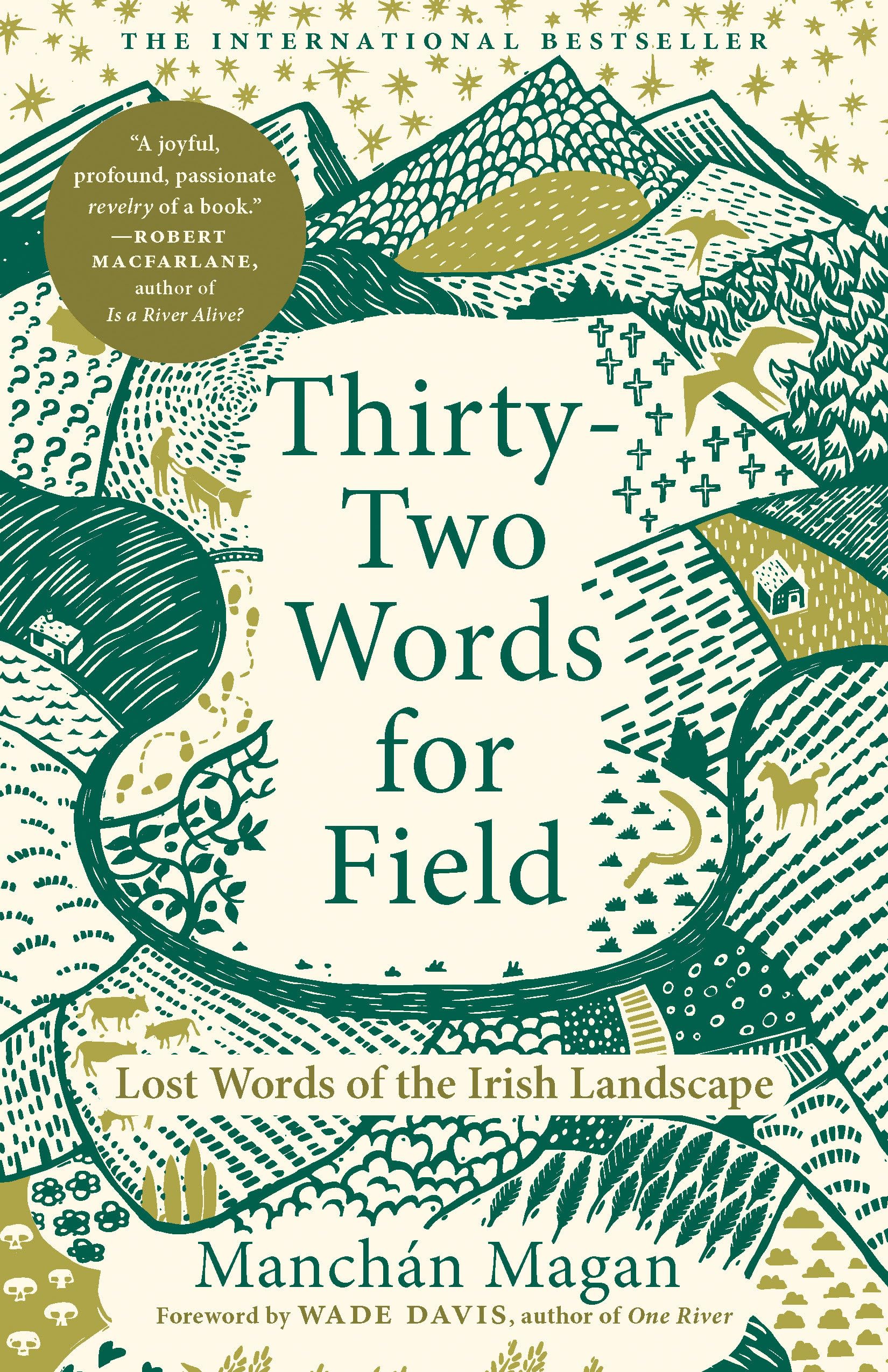



NATIONAL INDIE BESTSELLER "What a joyful, profound, passionate revelry of a book this is—an illumination of how words make worlds; a reminder of what is lost when a language is lost; an act of salvage for ways of being and seeing which are fast vanishing."—Robert Macfarlane, author of Is a River Alive? In this lyrical exploration of the Irish language's deep-rooted connection to nature, myth and memory, bestselling Irish author Manchán Magan offers readers a fresh way of seeing the world through words shaped by wind, water, ancestors, and the ancient rhythms of the land. The Irish language has thirty-two words for field. Among them are: Geamhar – a field of corn-grass • Tuar – a field for cattle at night • Reidhlean – a field for games or dancing • Cathairin – a field with a fairy-dwelling in it. The richness of the Irish language is closely tied to the natural landscape and offers a more magical way of seeing the world. Most people associate Britain and Ireland with the English language, a vast, sprawling linguistic tree with roots in Latin, French, and German. But the inhabitants of these islands originally spoke another tongue. Look closely enough and English contains traces of the Celtic soil from which it sprung, found in words like bog, loch, cairn, and crag. Today, this heritage can be found nowhere more powerfully than in modern-day Gaelic. In Thirty-Two Words for Field , Manchán explores how Gaelic, a three-thousand-year-old lexicon, has imbued the natural world with meaning and magic, evoking a time-honored way of life, from its thirty-two separate words for a field to terms like bróis (whiskey for a horseman at a wedding), iarmhaireacht (the loneliness you feel when you are the only person awake at dawn), and bladhmann (steam rising from a fermented haystack or idle boasting). Manchán urges readers to consider the sublime beauty and profound oddness of this ancient tongue that has been spoken in close connection to the land for thousands of years. Told through stories collected from his own life and travels, Thirty-Two Words for Field is an enthralling celebration of Irish words and a testament to the indelible relationship between landscape, culture, and language. "This is a remarkable work that deepened my feeling of connection to a living world and expanded my sense of the possible.”—Merlin Sheldrake, author of Entangled Life "What a joyful, profound, passionate revelry of a book this is—an illumination of how words make worlds; a reminder of what is lost when a language is lost; an act of salvage for ways of being and seeing which are fast vanishing. To read Thirty-Two Words For Field is to be given new eyes and ears for land, weather, creaturely life, time, light and the animate Earth itself. In its plenishing of both word and mind, it is a work of quiet activism." —Robert Macfarlane, author of Is a River Alive? “Magan traces the hidden filaments of the Irish language with astonishing vision and grace, revealing webs of relation between people and place, weather, and memory. This is a remarkable work that deepened my feeling of connection to a living world and expanded my sense of the possible.” —Merlin Sheldrake, author of Entangled Life “Magan shows how language is not just a tool of description but a way of inhabiting a place. By recovering these forgotten words, he makes visible the subtle textures of an older Ireland—one that still has much to teach us about perception, belonging, and care for the world we live in.” —Fintan O’Toole, author of We Don’t Know Ourselves "Manchán Magan listens to language as a practice of belonging. These words are more than history—they are tools for remembering how to be in right relationship with land, weather, and one another. Manchán inspires me to keep being voracious in learning the languages of this world i love.” —adrienne maree brown, author of Loving Corrections and We Will Not Cancel Us "Manchán Magan’s book welcomes those of us who don’t speak Irish into threads of that ancient culture by teaching us various words and phrases. His book reminds us that countless generations came before us and, through their carefully crafted language, left us gifts of perspective and understanding. A sunrise is never the same again once you know that, in Irish, it has five named stages. I got great joy from being gently guided into Magan’s language and culture. When I set this book down, I looked at our fields and the light across them with new eyes, and to do that in a book is no small achievement.” —James Rebanks, author of The Place of Tides " There are books that punctuate your life—changing your ways of thinking and living with such intensity that there is a clear before and after. Thirty-Two Words for Field is such a book. Manchán Magan has done the powerful work of stitching language back to breath, breath back to body, and body back to ecology. While the book resurrects the living myths seeded within t