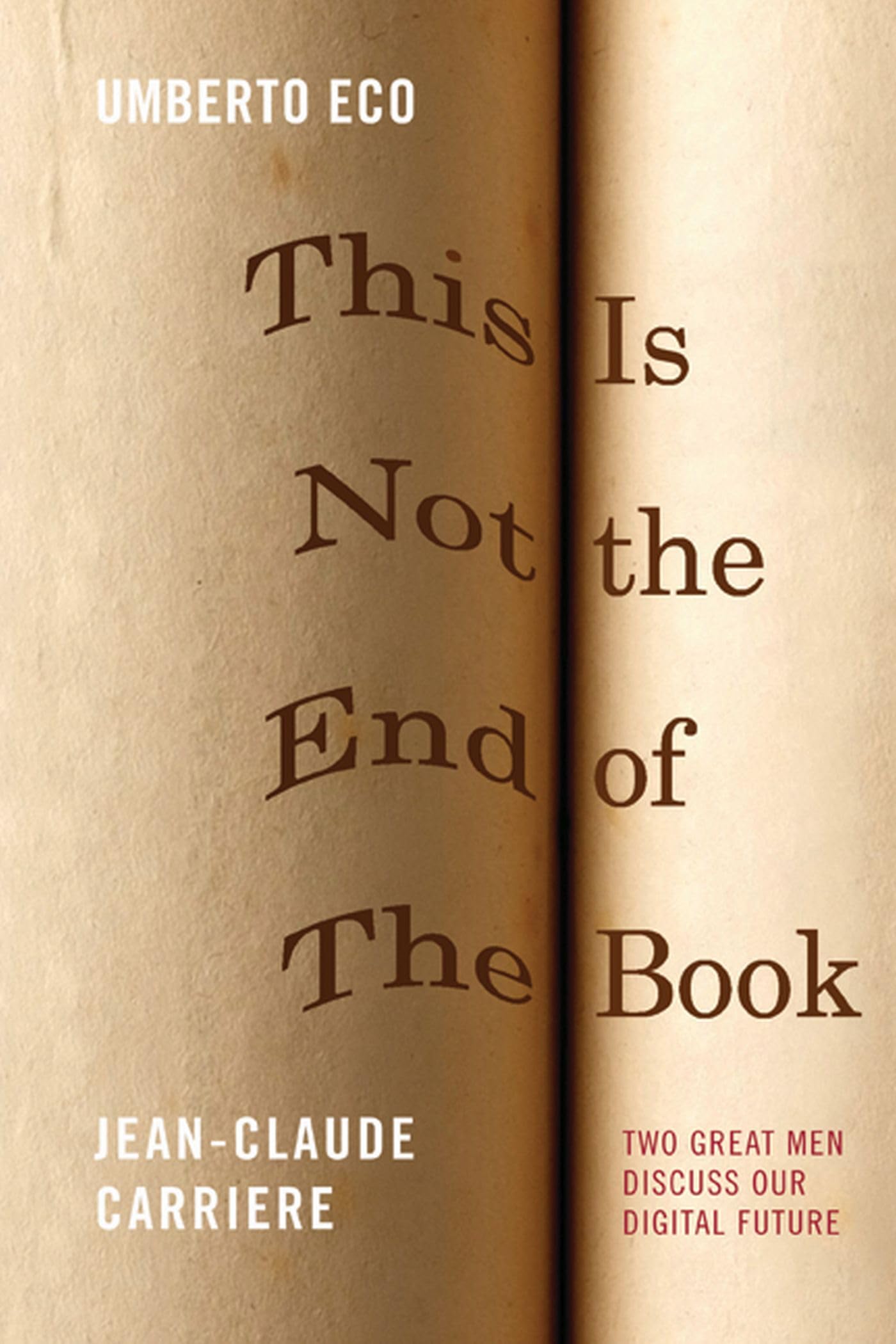



A book lover today might sometimes feel like the fictional medieval friar William of Baskerville in Eco’s The Name of the Rose , watching the written word become lost to time. In This Is Not the End of the Book , that book’s author, Umberto Eco, and his fellow raconteur Jean-Claude Carriere sit down for a dazzling dialogue about memory and the pitfalls, blanks, omissions, and irredeemable losses of which it is made. Both men collect rare and precious books, and they joyously hold up books as hardy survivors, engaging in a critical, impassioned, and rollicking journey through book history, from papyrus scrolls to the e-book. Along the way, they touch upon science and subjectivity, dialectics and anecdotes, and they wear their immense learning lightly. A smiling tribute to what Marshall McLuhan called the Gutenberg Galaxy, this dialogue will be a delight for all readers and book lovers. UMBERTO ECO is an Italian novelist, medievalist, semiotician, philosopher, and literary critic. He is the author of several best-selling novels, including The Name of the Rose (1983), Foucault’s Pendulum (1989), The Island of the Day Before (1995), Baudolino (2001), and The Prague Cemetery (2011). His collections of essays include Travels in Hyperreality (1986), Kant and the Platypus (1999), Serendipities (1998), Five Moral Pieces (2001), and On Literature (2004). He has also written academic texts and children’s books. JEAN-CLAUDE CARRIERE is one of France’s most distinguished writers. He received the 1972 Prix Goncourt for his novel L’Épervier de Maheux . His other works include the historical drama The Controversy of Valladolid ( 2005) and the novel Please, Mr. Einstein (2006). With the English director Peter Brook, Carrière adapted the Indian epic poem The Mahabharata for the stage in 1987. Carrière has collaborated with many film directors, including Jacques Tati, Milos Forman, Luis Buñuel, and Jean-Luc Godard. He wrote the screenplays for The Unbearable Lightness of Being (1988), Cyrano de Bergerac (1990), and The Tin Drum (1979), among many others. This Is Not the End of the Book A conversation curated by Jean-Philippe de Tonnac By JEAN-CLAUDE CARRIÈRE UMBERTO ECO NORTHWESTERN UNIVERSITY PRESS Copyright © 2009 Éditions Grasset & Fasquelle All right reserved. ISBN: 978-0-8101-2747-0 Contents Preface...........................................................................................1The book will never die...........................................................................11There is nothing more ephemeral than long-term media formats......................................37It took chickens almost a century to learn not to cross the road..................................61Do we need to know the name of every soldier at the Battle of Waterloo?...........................79The revenge of the filtered-out...................................................................107Every book published today is a post-incunabulum..................................................145Books with a will to survive......................................................................171Our knowledge of the past comes from halfwits, fools and people with a grudge.....................187Nothing can put an end to vanity..................................................................205In praise of stupidity............................................................................229The Internet, or the impossibility of damnatio memoriae...........................................243Fire as censor....................................................................................267All the books we haven't read.....................................................................289Books on the altar and books in 'Hell'............................................................323 Chapter One The book will never die Jean-Claude Carrière
At the World Economic Forum in Davos in 2008, one of the speakers was a futurologist who argued that four phenomena would drastically change humanity over the next fifteen years. The first was oil at 500 dollars a barrel. The second was that water, like oil, would become a commercial product, and be traded on the Stock Market. The third was the inevitability of Africa becoming an economic power certainly something we would all like to see. The fourth phenomenon, according to this professional prophet, was the disappearance of the book. The question is whether the permanent eclipse of the book should it in fact take place would have the same consequences for humanity as the predicted shortage of water, or affordable oil. Umberto Eco
Will the book disappear as a result of the Internet? I wrote about this at the time by which I mean at a time when the question seemed topical. Now, when I'm asked for my opinion, I simply repeat myself, rewriting the same text. Nobody notices this, firstly because there'
At the World Economic Forum in Davos in 2008, one of the speakers was a futurologist who argued that four phenomena would drastically change humanity over the next fifteen years. The first was oil at 500 dollars a barrel. The second was that water, like oil, would become a commercial product, and be traded on the Stock Market. The third was the inevitability of Africa becoming an economic power certainly something we would all like to see. The fourth phenomenon, according to this professional prophet, was the disappearance of the book. The question is whether the permanent eclipse of the book should it in fact take place would have the same consequences for humanity as the predicted shortage of water, or affordable oil. Umberto Eco
Will the book disappear as a result of the Internet? I wrote about this at the time by which I mean at a time when the question seemed topical. Now, when I'm asked for my opinion, I simply repeat myself, rewriting the same text. Nobody notices this, firstly because there'