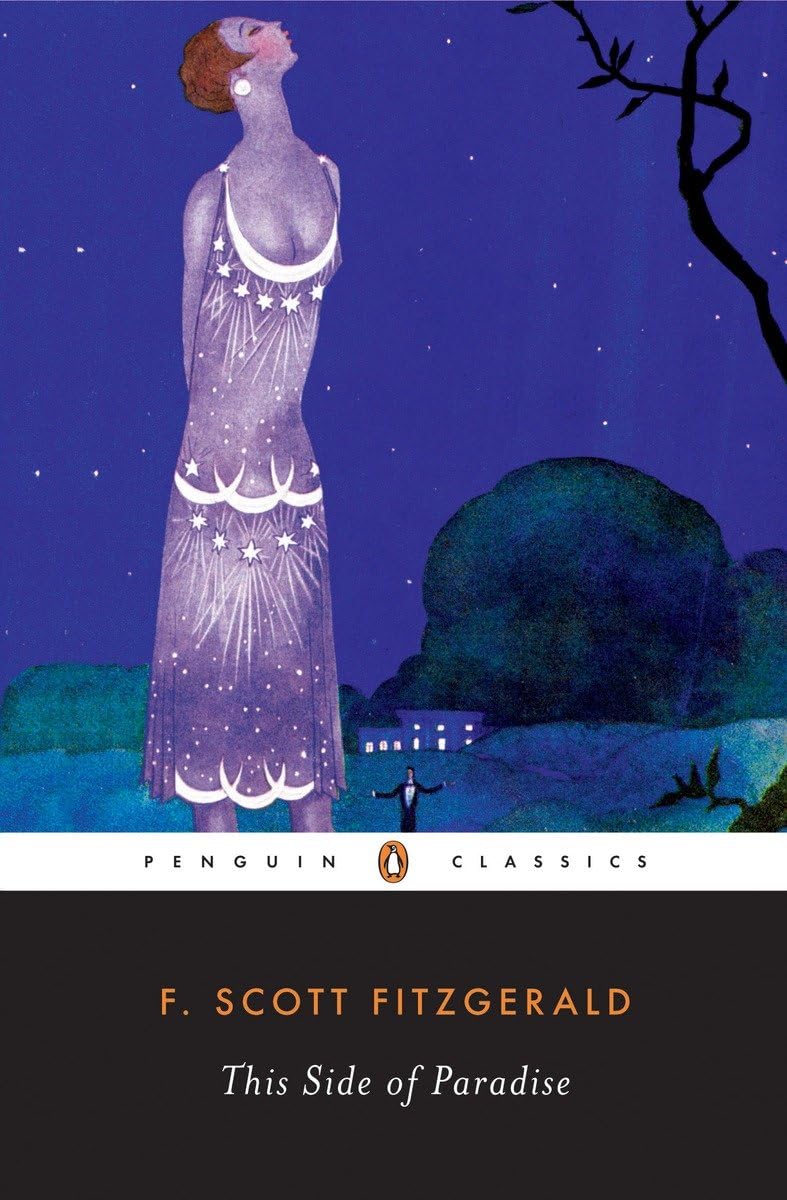



First published in 1920, This Side of Paradise marks the beginning of the career of one of the greatest writers of the first half of the twentieth century. In this remarkable achievement, F. Scott Fitzgerald displays his unparalleled wit and keen social insight in his portrayal of college life through the struggles and doubts of Amory Blaine, a self-proclaimed genius with a love of knowledge and a penchant for the romantic. As Amory journeys into adulthood and leaves the aristocratic egotism of his youth behind, he becomes painfully aware of his lost innocence and the new sense of responsibility and regret that has taken its place. Clever and wonderfully written, This Side of Paradise is a fascinating novel about the changes of the Jazz Age and their effects on the individual. It is a complex portrait of a versatile mind in a restless generation that reveals rich ideas crucial to an understanding of the 1920s and timeless truths about the human need for--and fear of--change. "A very enlivening book indeed, a book really brilliant and glamorous, making as agreeable reading as could be asked . . . There are clever things, keen and searching things, amusingly young and mistaken things, beautiful things and pretty things . . . and truly inspired and elevated things, an astonishing abundance of each, in THIS SIDE OF PARADISE. You could call it the youthful Byronism that is normal in a man of the author's type, working out through a well-furnished intellect of unusual critical force." --The Evening Post, 1920 "An astonishing and refreshing book . . . Mr. Fitzgerald has recorded with a good deal of felicity and a disarming frankness the adventures and developments of a curious and fortunate American youth. . . . [It is] delightful and encouraging to find a novel which gives us in the accurate terms of intellectual honesty a reflection of American undergraduate life. At last the revelation has come. We have the constant young American occupation--the 'petting party'--frankly and humorously in our literature." --The New Republic, 1920 The first novel that launched Fitzgerald to literary fame and glory in 1920 is now in the public domain and will undoubtedly be released by a number of publishers. These two editions represent both ends of the spectrum. The Cambridge edition is the latest in its ongoing series of corrected texts of Fitzgerald's work. Aimed at the scholarly audience, it includes an introduction, explanatory notes, and illustrations. The Penguin paperback also has an introduction but is a basic, no-frills edition, which is adequate for the casual reader. Serious American literature collections should stock the Cambridge text, which is probably the finest edition of this novel to date. Copyright 1996 Reed Business Information, Inc. “As nearly perfect as such a work could be . . . The glorious spirit of abounding youth glows throughout this fascinating tale. Amory, the romantic egotist, is essentially American.” – The New York Times “[A] bravura display of literary promise . . . Fitzgerald’s prose is capable of soaring like a violin, and of moving his readers with understated husky notes as well as with notes of piercing purity . . . Fitzgerald knew that glamour was bound to fail, that there is an ineradicable human instinct for it which is utterly mistaken.” –from the Introduction by Craig Raine F. Scott Fitzgerald was born in 1896 in St Paul, Minnesota, and went to Princeton University which he left in 1917 to join the army. Fitzgerald was said to have epitomised the Jazz Age, an age inhabited by a generation he defined as ‘grown up to find all Gods dead, all wars fought, all faiths in man shaken’. In 1920 he married Zelda Sayre. Their destructive relationship and her subsequent mental breakdowns became a major influence on his writing. Among his publications were five novels, This Side of Paradise , The Great Gatsby , The Beautiful and the Damned , Tender is the Night and The Love of the Last Tycoon (his last and unfinished work): six volumes of short stories and The Crack-Up , a selection of autobiographical pieces. Fitzgerald died suddenly in 1940. After his death The New York Times said of him that ‘He was better than he knew, for in fact and in the literary sense he invented a “generation” … he might have interpreted them and even guided them, as in their middle years they saw a different and nobler freedom threatened with destruction.’ Book One The Romantic Egotist Amory, Son of Beatrice Amory Blaine inherited from his mother every trait, except the stray inexpressible few, that made him worth while. His father, an ineffectual, inarticulate man with a taste for Byron and a habit for drowsing over the Encyclopædia Britannica, grew wealthy at thirty through the death of two elder brothers, successful Chicago brokers, and in the first flush of feeling that the world was his, went to Bar Harbor and met Beatrice O’Hara. In consequence, Stephen Blaine handed down to posterity his height