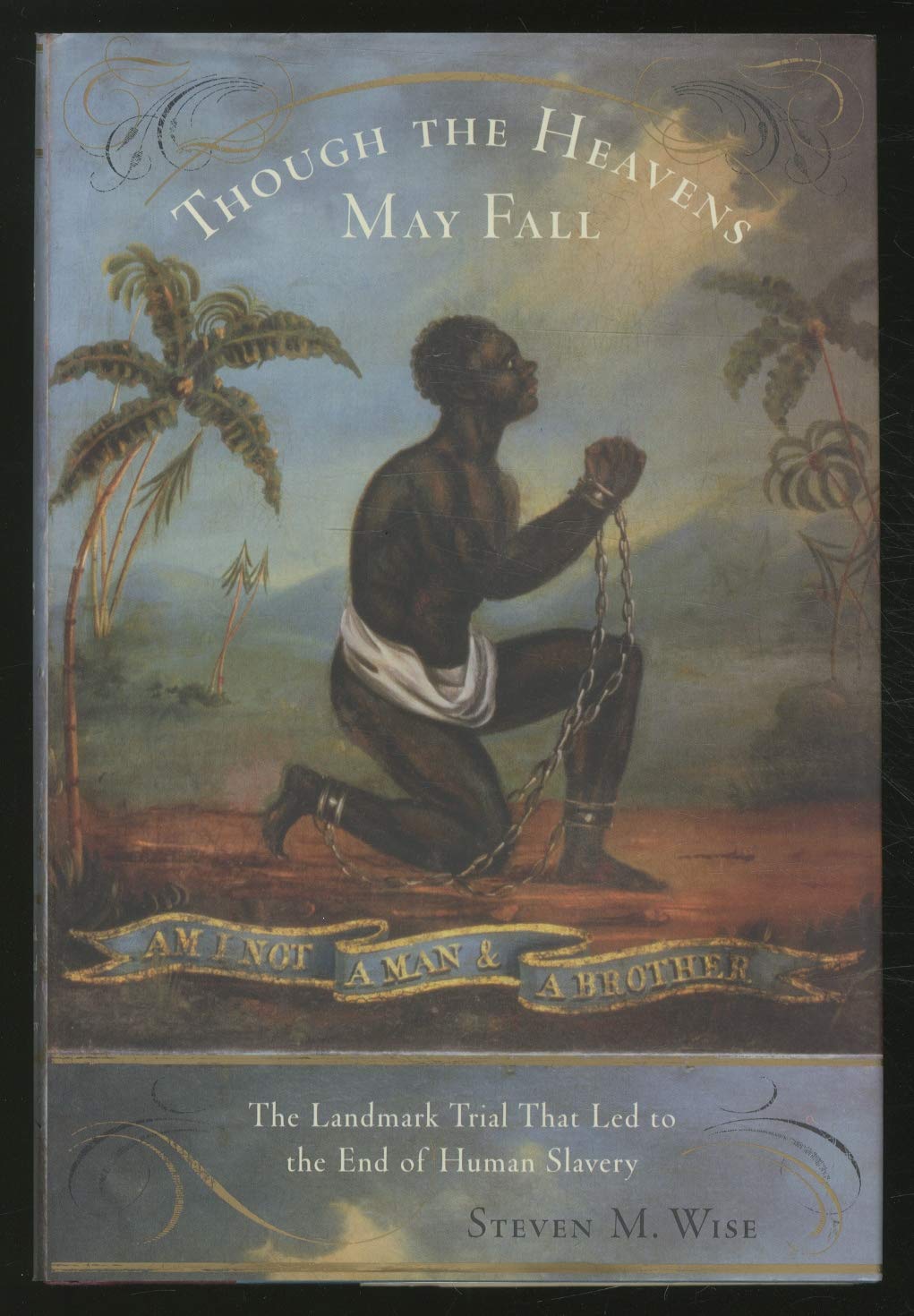
Though the Heavens May Fall: The Landmark Trial That Led to the End of Human Slavery
$21.00
by Steven M. Wise



The 1772 London trial of James Somerset, rescued from a ship bound for the West Indies slave markets, was a decisive turning point in history. As in the Scopes trial, two encompassing world views clashed in an event of passionate drama. Steven M. Wise, trial lawyer and legal historian, has uncovered layer upon layer of fascinating revelations in a case which threatened, according to slave owners, to bring the economy of the British Empire to a crashing halt. In a gripping narrative of Somerset's trial-and of the slave trials that led up to it-he sets the stage for the unexpected decision by the famously conservative judge, Lord Mansfield, which would lead to the abolition of slavery, both in England and the United States, and the end of the African slave trade.The characters in this great historical moment go beyond a screenwriter's dream: Somerset's novice attorneys arguing their first case; the fervent British abolitionist Granville Sharp, a cross between Ralph Nader and William Lloyd Garrison, who had brought case after case to court in an attempt to abolish slavery; the master's two-faced and skillful lawyer, who had recently argued before Mansfield that slavery could not exist in England; and finally, the greatest judge of his time, Lord Mansfield, whose own mulatto grand-niece, Dido Belle, was his slave.As the case drew to a close Lord Mansfield spoke these stirring words that continue to resound more than two centuries later: "Let Justice be done, though the Heavens may fall."A Merloyd Lawrence Book In England, near the end of the eighteenth century, a legal ruling that came to be known as the Mansfield Judgment set the precedent for outlawing slavery in the modern Western world. Somerset, a black American slave, accompanied his master on a journey to England, where slavery had been outlawed. Somerset legally petitioned Lord Mansfield, the premier jurist of the period, to let him remain in England as a free man. Granville Sharpe, England's leading abolitionist, took up the cause. Wise offers a multilayered examination of the characters--the modest Sharpe and the high-born Mansfield--and legal confluences between British tradition and common law behind this case. He also explores the conflict between the ideals of human rights and the commercial interests of slave traders, insurers, and bankers, and the underlying threat to the social order of oppressive apprenticeships as the institution of slavery was challenged. This is a complex and absorbing look at the legal and social forces that eventually led to the outcry against slavery throughout the Western world. Vernon Ford Copyright © American Library Association. All rights reserved "A captivating account...Wise brings alive the story...for an entertaining read, pick up Wise's book." -- Law and Politics Book Review 5/05 "A detailed account." -- The Economist 2/3/05 "A thorough and convincing account of the case that led to the official banning of slavery in England." -- New York Review of Books 7/14/05 "An important book." -- Deseret Morning News 2/18/05 "Fascinating reading." -- Curled Up With a Good Book 1/15/05 "Somerset's trial is full of high drama." -- Cleveland Plain Dealer 2/6/05 "Well-crafted...set[s] forth the legal battles with admirable clarity [and] portray[s] a fascinating gallery of advocates and jurists." -- Boston Globe 1/30/05 "Wise does a good job of guiding the reader through the thicket of eighteenth-century common law...Engaging." -- The Nation 2/14/05 "[Wise's] thoughtful analysis provides an underpinning for the social and legal context of slavery, making this a recommended book." -- Library Journal 2/15/05 "[Wise] has an eye for evocative detail and an interest in the trappings and procedures of an 18th-century courtroom ." -- New York Times Book Review 1/9/05 Steven M. Wise, J.D., has practiced animal law for over twenty years and has taught at the Harvard, Vermont, and John Marshall law schools. He is President of the Center for the Expansion of Fundamental Rights, which he founded in 1995. The author of Rattling the Cage , praised by Cass Sunstein as "an impassioned, fascinating, and in many ways startling book" ( New York Times Book Review ), and Drawing the Line , which Nature called "provocative and disturbing," he has been profiled nationally by such publications as the New York Times , the Washington Post , and Time magazine. Author: Wise, Steven M.. Publisher: Da Capo Press Pages: 312 Publication Date: 2005-01-02 Edition: First Edition Binding: Hardcover MSRP: 25 ISBN13: 9780738206950 ISBN: 0738206954 Language: en Store Location: History "Book cover image may be different than what appears on the actual book."