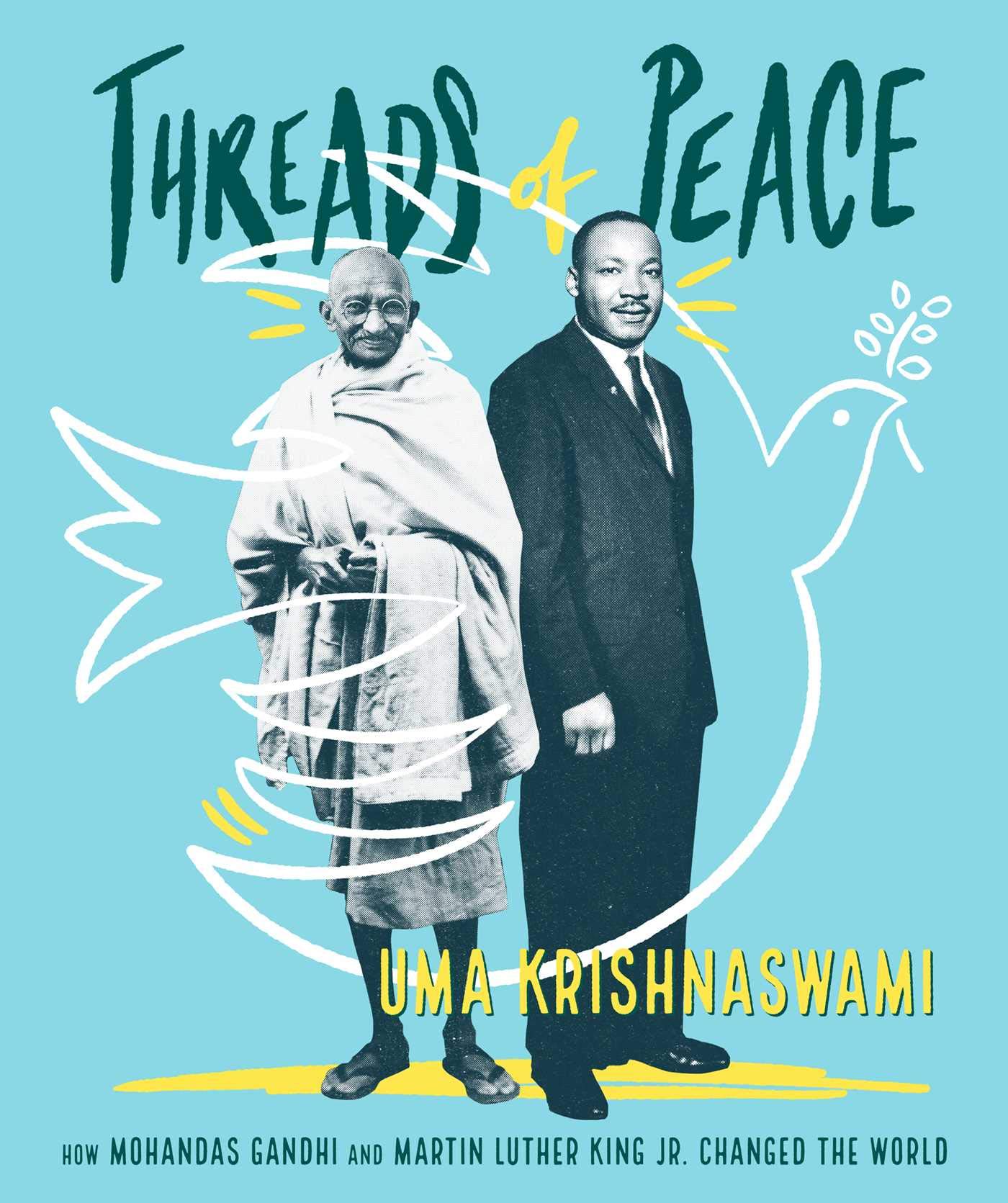
Threads of Peace: How Mohandas Gandhi and Martin Luther King Jr. Changed the World
$13.88
by Uma Krishnaswami



“Inviting and original.” — Kirkus Reviews (starred review) Mohandas Gandhi and Reverend Martin Luther King Jr. both shook and changed the world in their quest for peace among all people, but what threads connected these great activists together in their shared goal of social revolution? A lawyer and activist, tiny of stature with giant ideas, in British-ruled India at the beginning of the 20th century. A minister from Georgia with a thunderous voice and hopes for peace at the height of the civil rights movement in America. Born more than a half-century apart, with seemingly little in common except one shared wish, both would go on to be icons of peaceful resistance and human decency. Both preached love for all human beings, regardless of race or religion. Both believed that freedom and justice were won by not one, but many. Both met their ends in the most unpeaceful of ways—assassination. But what led them down the path of peace? How did their experiences parallel...and diverge? Threads of Peace keenly examines and celebrates these extraordinary activists’ lives, the threads that connect them, and the threads of peace they laid throughout the world, for us to pick up, and weave together. Gr 7-10-While Martin Luther King, Jr.'s adoption of the strategy of nonviolence for the civil rights movement had its roots in India, few are aware of the exchange of philosophies between Mohandas Gandhi and Black activist leadership beginning in the 1920s. The volume begins with key moments of discrimination experienced by King on a bus at the age of 15 and Gandhi on a train in South Africa, and progresses into nine chapters covering Gandhi's life and work and 14 on King, with a few concluding chapters reinforcing themes and discussing their modern impact. Captioned photographs, pull quotes, vocabulary definitions, and sidebars pepper the text, offering students insights in an attractive format. While the work occasionally struggles to condense complex Indian politics into a few sentences, the largely narrative text benefits from key quotes that are meticulously sourced in the page-by-page notes in the back matter. Krishnaswami also points out the contradictory philosophies or opinions of the two leaders' contemporaries. An author's note, parallel time lines, and a comprehensive glossary, as well an extensive bibliography and index also provide researchers with wonderful starting points. VERDICT An in-depth and well-researched volume that complements existing YA biographies on these two individuals by forging a little-known connection between American Black activism and the Indian nonviolent movement.-Courtney Lewis, St. Catherine's Sch., Richmond, VAα(c) Copyright 2011. Library Journals LLC, a wholly owned subsidiary of Media Source, Inc. No redistribution permitted. History has been carefully intertwined with the present in this engaging and reflective book. -- Kirkus Reviews, *STARRED REVIEW* ― July 1, 2021 A reflective presentation that will inspire young peacemakers. -- Booklist *STARRED REVIEW* ― August 1, 2021 An in-depth and well-researched volume that complements existing YA biographies on these two individuals by forging a little-known connection between American Black activism and the Indian nonviolent movement. -- School Library Journal ― October 1, 2021 Uma Krishnaswami is the author of several books for children including The Grand Plan to Fix Everything and The Problem with Being Slightly Heroic . She was born in New Delhi, India, and now lives in British Columbia, Canada. Chapter 1: A Place of Warm Breezes 1 A Place of Warm Breezes PORBANDAR, INDIA: 1869 Mohandas Karamchand Gandhi came into the world in a seaside town called Porbandar in the Kathiawar Peninsula of western India. It is a place of warm breezes. The land juts out into the Arabian Sea, its ear turned to the ocean and to the world beyond. Once a bustling port, Porbandar was now a sleepy town on the water’s edge. Outside its borders, vast tracts of the Indian subcontinent lay under the rule of the British. Scattered in between were princely states, large and small, still ruled by Indian kings. Some were kind rulers, others tyrannical. Some were independent in name. Most quaked at the power of the British Empire on their doorsteps. In turn, the British kept an eye on the Indian royals, to make sure that none of them gained any real strength. The kingdom of Porbandar was too small to pose any threat to the British. It consisted of a single town, on a coastal strip less than twenty-five miles wide. Its creamy-white limestone buildings earned it the name of the “White City.” Map of British India, 1867 The British in India The British came as traders to India—and stayed. The East India Company had been chartered in 1600 to buy and sell spices. Over the years, the company also traded in tea, indigo, salt, silk, cotton, and other goods—among them, vast quantities of the drug opium, sold to China. Soon the compa