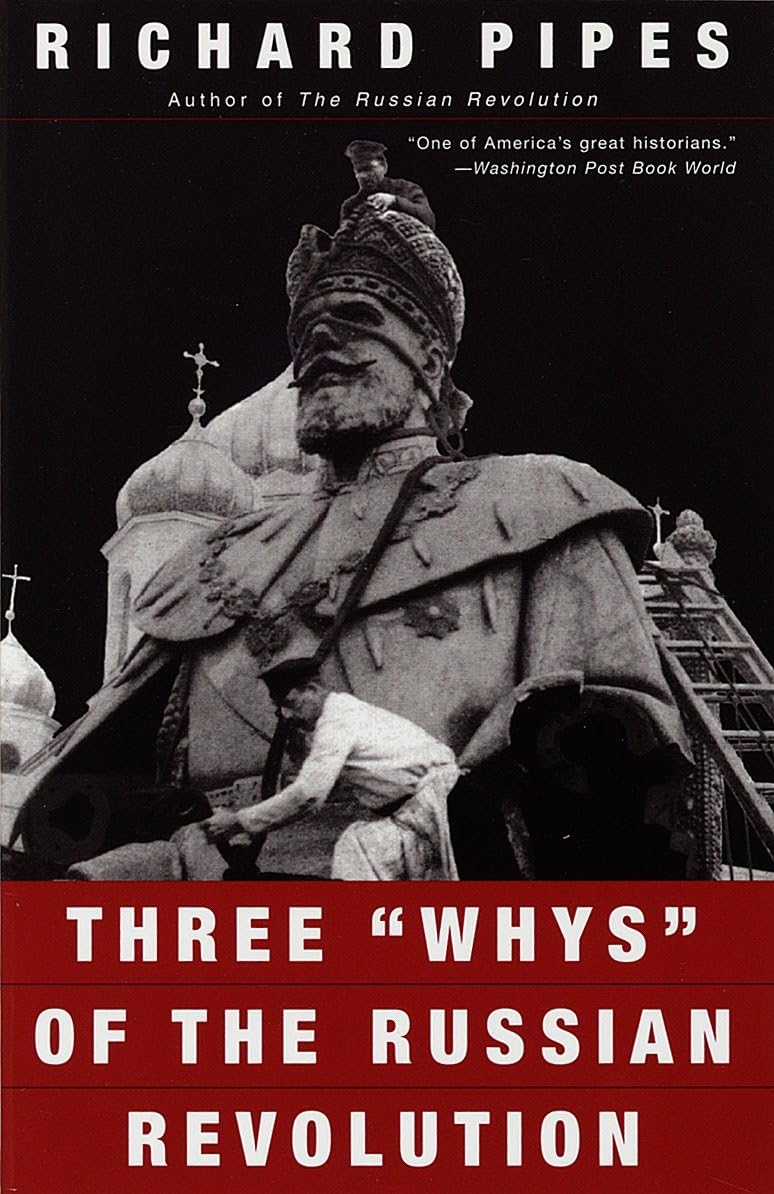



America's foremost authority on Russian communism—the author of the definitive studies The Russian Revolution and Russia Under the Bolshevik Regime— now addresses the enigmas of that country's 70-year enthrallment with communism. Succinct, lucidly argued, and lively in its detail, this book offers a brilliant summation of the life's work of "one of America's great historians" ( Washington Post Book World ). "The author has distilled his arguments concerning several key questions: Why did tsarism fall? Why did the Bolsheviks triumph? Why did Stalin succeed Lenin? The book, based on lectures given at the Institute for Human Sciences in Vienna, has a nicely colloquial feel, clarity, and vigor. At the heart of the answers to the first two questions is Pipes's assertion that, far from being the product of large, impersonal forces of history, the fall of the tsar and the rise to power of the Bolsheviks (in, he reminds us, a coup d' tat largely unsupported by the Russian people) were the result of the old regime's clear failings and Lenin's genius for manipulation and appetite for total power. Stalin succeeded Lenin, Pipes asserts, because Lenin had so successfully suppressed all elements of democracy that no alternatives were possible.... A concise and eminently straightforward summary of current research on the rise and nature of Communism in Russia." — Kirkus For those without the energy or leisure to digest Pipes's magisterial history of revolutionary Russia (Russia Under the Bolshevik Regime, 1994; The Russian Revolution, 1990), the author has distilled his arguments concerning several key questions: Why did tsarism fall? Why did the Bolsheviks triumph? Why did Stalin succeed Lenin? The book, based on lectures given at the Institute for Human Sciences in Vienna, has a nicely colloquial feel, clarity, and vigor. At the heart of the answers to the first two questions is Pipes's assertion that, far from being the product of large, impersonal forces of history, the fall of the tsar and the rise to power of the Bolsheviks (in, he reminds us, a coup d'tat largely unsupported by the Russian people) were the result of the old regime's clear failings and Lenin's genius for manipulation and appetite for total power. Stalin succeeded Lenin, Pipes asserts, because Lenin had so successfully suppressed all elements of democracy that no alternatives were possible. There's little new here, but the volume does offer a concise and eminently straightforward summary of current research on the rise and nature of Communism in Russia. -- Copyright ©1997, Kirkus Associates, LP. All rights reserved. "The author has distilled his arguments concerning several key questions: Why did tsarism fall? Why did the Bolsheviks triumph? Why did Stalin succeed Lenin? The book, based on lectures given at the Institute for Human Sciences in Vienna, has a nicely colloquial feel, clarity, and vigor. At the heart of the answers to the first two questions is Pipes's assertion that, far from being the product of large, impersonal forces of history, the fall of the tsar and the rise to power of the Bolsheviks (in, he reminds us, a coup d' tat largely unsupported by the Russian people) were the result of the old regime's clear failings and Lenin's genius for manipulation and appetite for total power. Stalin succeeded Lenin, Pipes asserts, because Lenin had so successfully suppressed all elements of democracy that no alternatives were possible.... A concise and eminently straightforward summary of current research on the rise and nature of Communism in Russia." — Kirkus remost authority on Russian communism--the author of the definitive studies The Russian Revolution and Russia Under the Bolshevik Regime--now addresses the enigmas of that country's 70-year enthrallment with communism. Succinct, lucidly argued, and lively in its detail, this book offers a brilliant summation of the life's work of a master historian. Richard Pipes conducts a succinct inquest, asking: Why did tsarism fall virtually overnight? Why did the Bolsheviks - the smallest of the three main Russian radical parties - triumph? Why did Stalin succeed Lenin? In answering these questions, Pipes gives us our clearest picture yet of the vulnerability of the tsarist system as well as of the ruthless opportunism that enabled Lenin to seize the reins of power. Dispelling years of revisionist mythology, Pipes demonstrates the extent to which Stalin was the logical heir to a party that had assumed control over every aspect of Russian life. Richard Pipes was for many years a professor of history at Harvard University. He is the author of numerous books and essays on Russia, past and present, including Russia Under the Bolshevik Regime . In 1981–82 he served as President Reagan's National Security Council adviser on Soviet and East European affairs, and he has twice received a Guggenheim fellowship. He lives in Cambridge, Massachusetts, and Marlborough, New Hampshire.