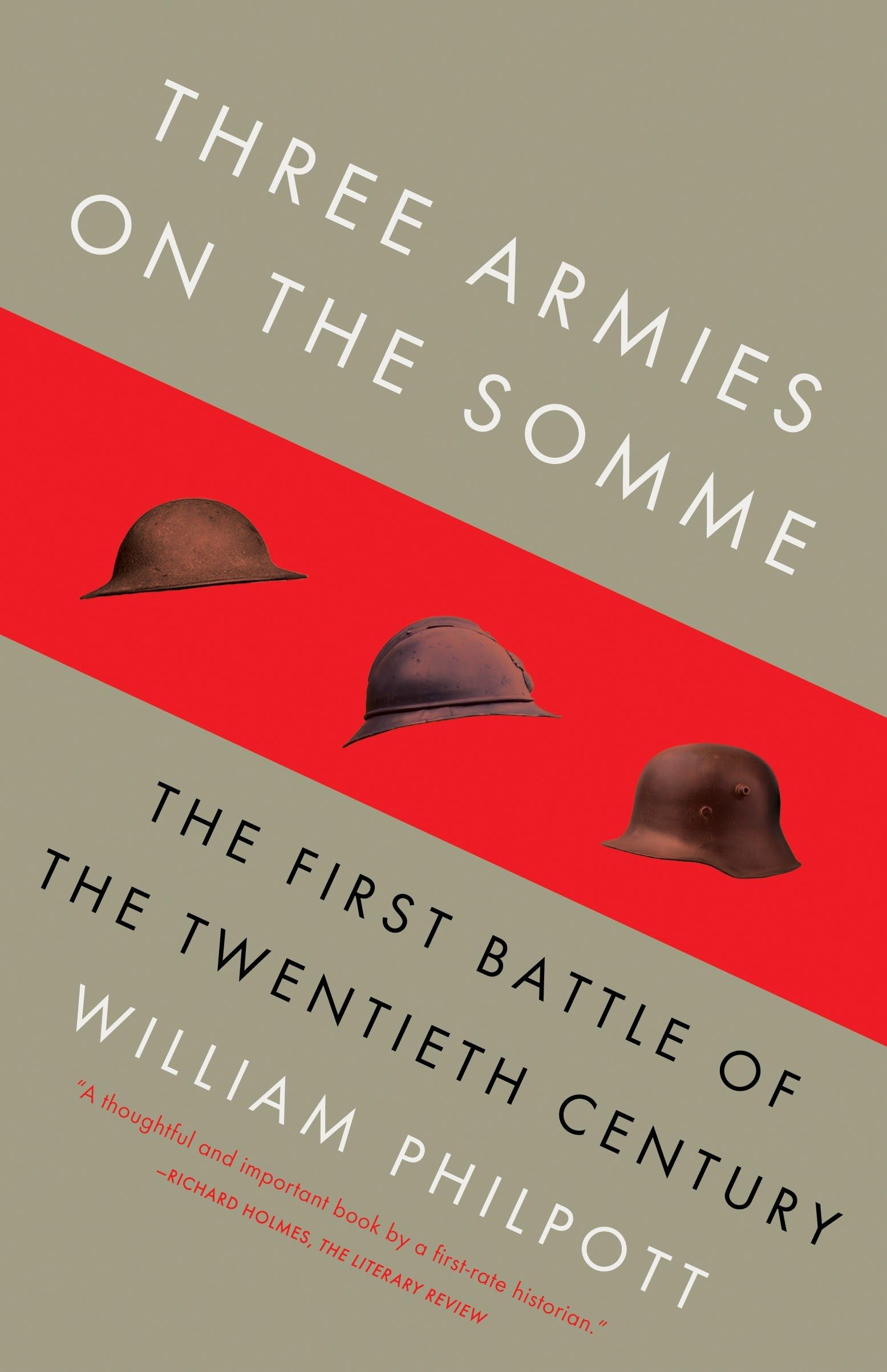
Three Armies on the Somme: The First Battle of the Twentieth Century
$19.00
by William Philpott



For decades, the Battle of the Somme has exemplified the horrors and futility of trench warfare. Here William Philpott argues that the battle ultimately gave the British and French forces on the Western Front the knowledge and experience to bring World War I to a victorious end. Philpott shows that twentieth-century war as we know it simply didn’t exist before the battle: new technologies like the armored tank made their debut, while developments in communications lagged behind commanders’ needs. Attrition emerged as the only means of defeating industrialized belligerents that were mobilizing all their resources for war. An exciting, indispensable work of military history, Three Armies on the Somme challenges our received ideas about the Battle of the Somme, and about the very nature of war. “A thoughtful and important book by a first-rate historian” —Richard Holmes, The Literary Review “Philpott displays a great mastery of detail. . . . He can certainly claim to have made a solid contribution to what has been an extraordinarily long-running debate.” — The Times (London) “A magnificent and powerful book, destined to become the standard work on the subject. Philpott is a confident guide to the battlefield and offers striking images of the fighting.” — Daily Express (London) “In this excellent account, Philpott makes full use of his learning and his sources to describe this particular battle and its aftermath in a style which would be readily recognized by the participants if they were still in the land of the living.” — The Herald (Scotland) “Philpott brushes aside traditional mythmaking by Winston Churchill and Basil Liddell Hart for a fresh appraisal of this four-year ‘massacre of the innocents.’ . . . A knowledgeable, all-encompassing dissection of this supreme example of ‘the consummate killing power of the machine age.’” — Kirkus Reviews William Philpott is Professor of the History of Warfare in the Department of War Studies at King’s College, London. He is a specialist in the operations on the Western Front and has published extensively on the subject. He lives in London. On 1 July 1916, at precisely 07:28, a series of huge explosions tore open the ground around the small French hamlet of La Boisselle. A company of the 10th Battalion the Lincolnshire Regiment (the "Grimsby Chums") dashed from the British front line, outpacing men from the German110 Reserveinfanterieregiment (RIR) to seize the newly blown Lochnagar minecrater. All along the front the deadly race was repeated, as thousands ofBritish and French infantry rose in a long surging line, and Germanmachine-gunners hastened to their weapons. The winners might live to see adifferent world. "The Last Post" is sounded at Lochnagar Craterevery 1 July, although nowadays there are no longer veterans among themourners. Nevertheless they will not fade away. Dutifully each year theirchildren, and after them their grandchildren and great-grandchildren, willgather at that sacred shell-hole to honour the memory of those who fought-andthose who died-in Britain's greatest battle. Elsewhere small parties of Frenchand Germans, Australians, Canadians and South Africans pay their respects, asthe Battles of the Somme pass from experience, through memory, into history. THE RIVER SOMME, which meanders across north-west France,bisecting the rolling uplands of Picardy, has lent its name to four battles.The first encounter was in September and October 1914. The second and greatest-theBattle of the Somme-lasted for four and a half months, from June to November1916. The third took place in March 1918; the fourth in August 1918. Eventoday, the mention of this quiet river evokes deep atavistic sentiments: pride,anger, anguish, grief. The 1916 battle scarred the British national psyche inparticular: up to that point Britain had had no Verdun, the "Meusemill" which ground up the French army in early 1916, or Langemarck, theGerman army's Kindermord sacrifice of her eager young volunteers in autumn1914. Yet the reasons for that scar, and the true nature of the historicalphenomenon which inflicted it, are little understood. The 1916 Somme campaignwas a struggle of three armies, and three empires. Each left its young men andtheir memorials in that patch of Picardy downland, now lush, quiet andmournful. On the hills opposite Albert, the British army made its longest and greatestsacrifice in the allied cause. Astride the river to the south their Frenchallies were fighting their own gruelling battle, closely integrated withBritish operations but all but forgotten by posterity. To the east the Germanarmy fought its prolonged defensive Battle of the Somme, more bloody and morale-sappingthan the Anglo-French offensive, yet rarely acknowledged or recounted. In the summer of 1916 Walter Page, the Americanambassador in London, noted that "war has come to be the normal state of life." The world had paused as three great empires, championed by theirarmies, staked th