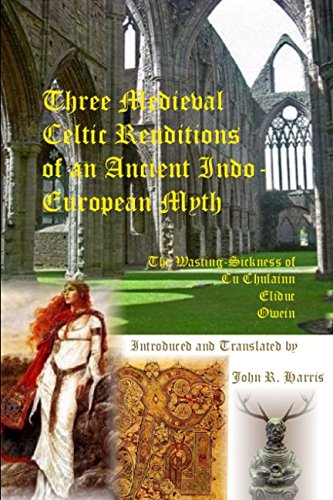
Three Medieval Celtic Renditions of an Ancient Indo-European Myth: The Wasting-Sickness of Cú Chulainn (Traditional Irish), The Lay of Eliduc (Marie
$11.99
by John Harris



This unusual text was originally undertaken to fulfill a complex need in the typical World Literature classroom. Translations generally fail to capture much of their original’s vivacity, especially those of older works (where cultural difference is compounded by temporal remoteness). This book’s translation of Marie’s Eliduc renders the original in an English that replicates the poem’s metrical qualities rather than shifting to a dry prose. The same goes for its Irish and Welsh translations (the former again striving to preserve a significantly versified work’s phonetic effects): that is, every effort was made to reproduce the distinctive cadence of the Celtic tongues. Eager students are often delighted by the exotic style of an alien culture’s narratives. Dr. Harris himself was first drawn to Irish Studies by the immortal plays of John Millington Synge. Yet many scholars sneered at Synge, and their intellectual descendants have been heard at times sneering at this book’s endeavor. Ironically, the stuffy academic is more apt to praise a translation of a classic into contemporary street talk and jive than an effort to approximate the original’s ring and rhythm. Beyond translation, a very specific motive dictated the selection of these particular romances—a motive that may open up new and rewarding possibilities for survey classes and students of comparative mythology. The three translations, while drawn from medieval Ireland, Wales, and Brittany, have at least one famous analogue in classical Indian drama—a correspondence far from surprising. Celtic culture continued to circulate much myth and lore that prospered in Persia and India long after the proto-Indo-Europeans went their separate ways, even as the old traditions vanished entirely from Greece, Rome, and the Germanic world. A unique version of the myth of the Other World Traveler is one such fascinating Celtic/Indic “bridge.” It implicates the hero in a love triangle that includes his mortal wife and an adoring fairy queen. The basic sequence is embedded in Kalidasa’s sophisticated Sanskrit play Shakuntala. Ironically, the oral/tribal ethos of the source-myth is much more visible in the late Irish Serglige (for whose paganism the scribe comically apologizes in a postscript) than in the Indian drama. As an artist, Kalidasa belongs in the same camp as Marie de France and the unknown Welsh story-teller: all three are trying to transform the myth into an expression of soul-searching and spiritual awakening. Of course, the two Europeans do so in the context of a Christian faith that subtly absorbs pagan belief into a new vision of striving and hope. Only this book’s introduction handles Shakuntala, the full text of which must be obtained elsewhere. The focus is on the three Celtic romances, and more specifically on how Christianity did indeed (at least in this trio) succeed in uplifting a tragic vision of the cosmos into a prospect of individual hope and redefined virtue.