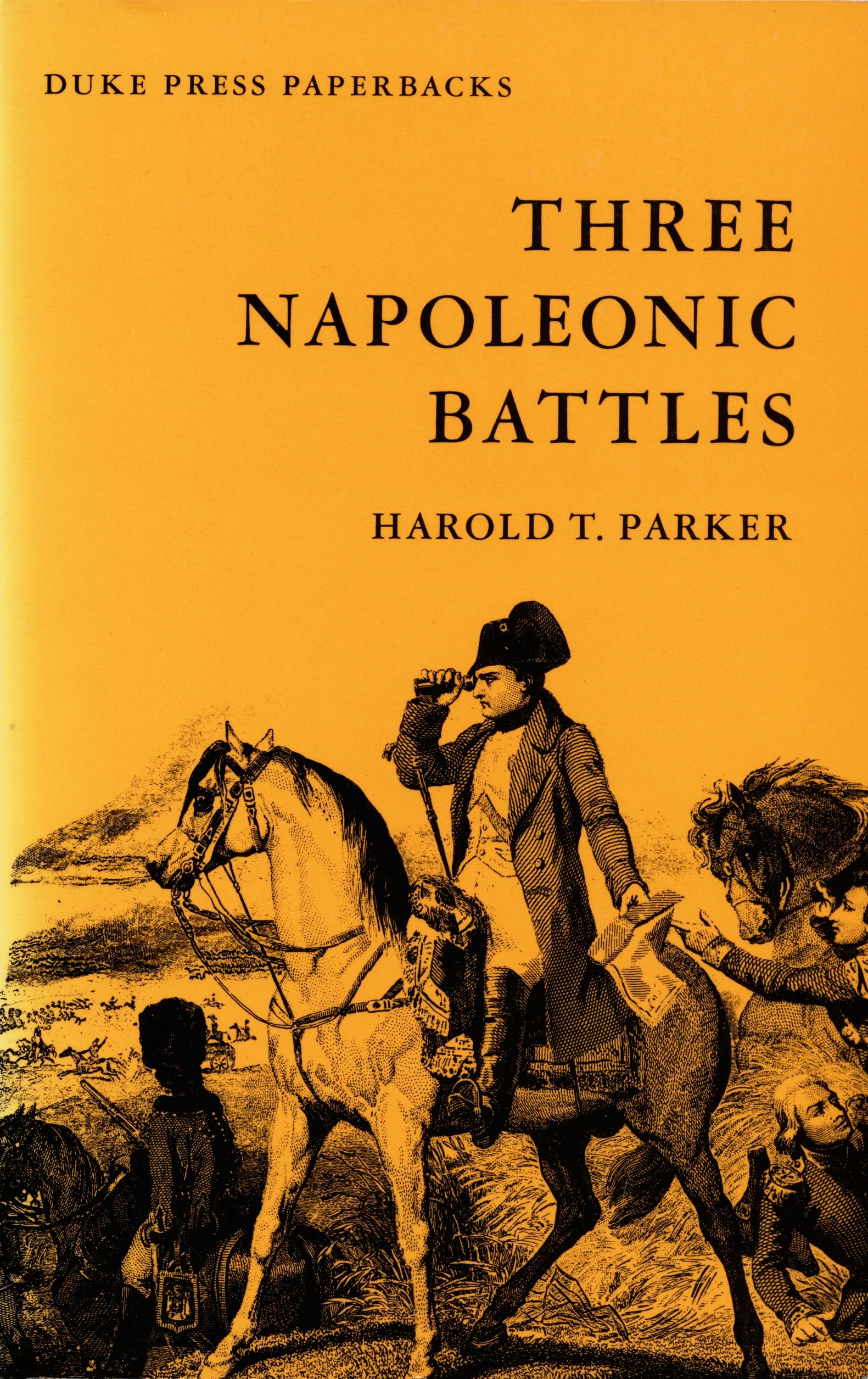



This narrative account of three Napoleonic battles adheres rather closely to the Aristotelian configuration of evolving tragedy. The historian succeeds in presenting herein events and character not only in historical reality but also in unities employed by the artist or tragedian. For a beginning of this lively, military story, Harold T. Parker chooses a portrayal of Napoleon at the height of his power, the battle of Friedland. The middle episode is concerned with Napoleon in his first serious personal check, the battle of Aspern-Essling. To complete the unity and to conclude the tragic progression, the author resurveys the episode of Napoleon's final defeat at the battle of Waterloo. Three Napoleonic Battles By Harold T. Parker Duke University Press Copyright © 1988 Duke University Press All rights reserved. ISBN: 978-0-8223-0547-7 Contents MAPS, FOREWORD, INTRODUCTION, FRIEDLAND, FROM FRIEDLAND TO ASPERN-ESSLING, ASPERN-ESSLING, FROM ASPERN-ESSLING TO WATERLOO, WATERLOO, AFTERWORD ON METHOD, SUGGESTIONS FOR FURTHER READING, CHAPTER 1 FRIEDLAND The small town of Friedland lies in northeastern Europe, in East Prussia, on the left bank of the River Alle. It is built on a small peninsula of land, bounded on the south and east by the twisting Alle, on the north by the lake and marsh of the tributary Mill Stream. By land, it opens to the west. In that direction, back from the town stretches an immense plain, which slopes gently upward from the river into the distance. Around and beyond the plain, about two miles away, lies a forest. In a vast, irregular semicircle, with only a few breaks, it sweeps from the River Alle south of the town, around to the west, and then to the north until again its trees fringe the river. In the plain thus enclosed on three sides by a forest and on the fourth by a river, there is only one notable irregularity: the Mill Stream, scarcely fordable, from the forest in the west to Friedland, cuts across at the bottom of a steep ravine. It divides the plain into two sections, northern and southern. Along that edge of the forest which borders the plain lie three villages: to the south of Friedland, on the river, the village of Sortlack; to the west, Posthenen, on the road to Eylau; to the northwest, Henrichsdorflf, on the road to Königsberg. At the opening of the nineteenth century these villages and Friedland were inhabited by Germans, then a frugal and industrious race. By good farming, which requires character as well as skill, their ancestors and they had raised the Friedland region to a high level of well-being, cleanliness, and comfort. And in the spring of 1807, as they had done for many years before, they went into the Friedland plain, plowed and harrowed and sowed rye and wheat. The crop prospered. By the middle of June it stood so high that a kneeling man would be concealed behind it. Except then for gardens along the river, the entire plain was a vast field of grain stretching away to the forests which bound the horizon. Now, it so happened that on June 13, 1807, in the Friedland area just beyond the horizon to the south and southwest, armies were marching. Coming down the Alle from the south, the Russian Army was retreating along the river-road which passed Friedland on the opposite bank. Coming cross-country from the southwest, the French, in pursuit, were scattered along a road which passed from the town of Eylau, Napoleon's headquarters, through the Friedland forest, through the village of Posthenen on the edge of that forest, and then across the two-mile plain into Friedland. When the Russian advance cavalry arrived opposite Friedland at 3 P.M., June 13, they found the town occupied by a French regiment of hussars. The Russian cavalry crossed the river over a bridge, attacked, drove out the French, took prisoners, and occupied the town. From the prisoners, the Russian commander, General Bennigsen, who came up that night with the rest of the army, learned that only the French advance guard, a division or two, were on the Friedland plain. He calculated, therefore, that he had time to cross the river with part of his army, whip the advance guard, and make off before Napoleon and the French Army could catch him. In accordance with this calculation, the next morning at dawn, he ordered a division to cross the river and attack; that proving insufficient, he ordered another division across, and another, and another, and so on. As a result, through most of that June morning his entire army of forty-six thousand men, like grains of sand in the neck of a huge hourglass, trickled across the long, frame town bridge and the two pontoon army bridges, worked their way through the narrow streets of Friedland, and then fanned out into the plain beyond. On the French side, opposed to Bennigsen was first of all General Oudinot, a tall, dark, handsome man in uniform, who, though forty, was still slender, erect, and full of grace, a commander of men. Hi