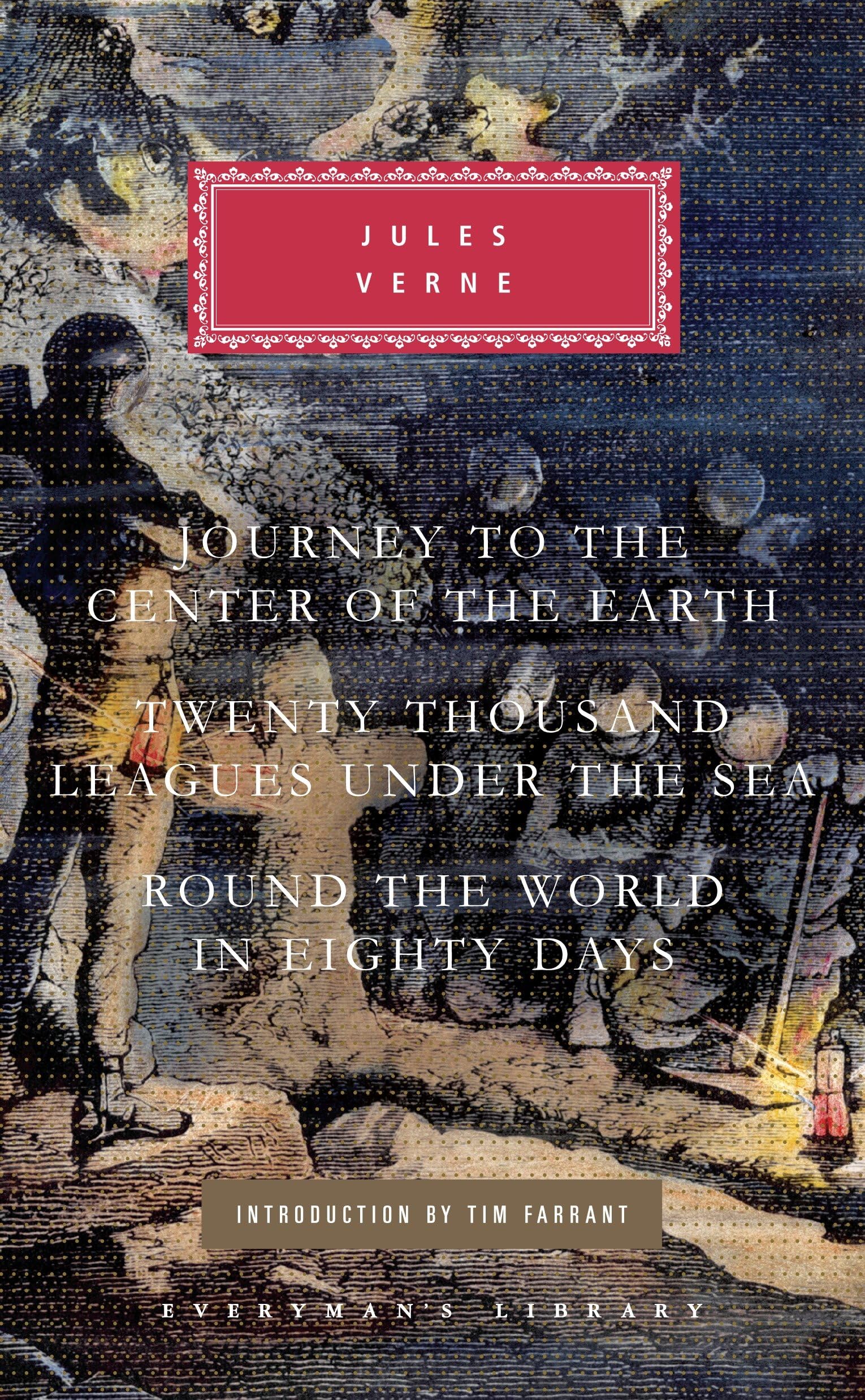
Three Novels: Journey to the Center of the Earth / Twenty Thousand Leagues Under the Sea / Round the World in Eighty Days
$27.79
by Jules Verne



Jules Verne’s most beloved novels are gathered here in one hardcover volume: three thrilling tales of fabulous journeys under, through, and around the earth. Verne was one of the great pioneers of science fiction. Born in France in 1828, he wrote brilliantly about space, air, and underwater travel long before airplanes and space ships had been invented, and he is still one of the most widely read internationally of all science-fiction writers. But beyond charting new territory for adventurous fiction, his creations have entered our culture and taken on the magnitude and vitality of myth. It is hard to imagine anyone who has not heard of Captain Nemo and his giant submarine exploring the ruins of Atlantis in Twenty Thousand Leagues Under the Sea, Phileas Fogg’s frantic race around the world by every means of transportation in Round the World in Eighty Days, and the harrowing descent through a volcanic crater to underground caverns where prehistoric creatures roam in Journey to the Center of the Earth . These stories have seized the imaginations of readers for generations and are as vivid and exciting now as when their author first imagined traveling beyond the bounds of the possible. Translated by Henry Frith “The tension between the armchair and adventure, between security and possibility, lies at the heart of Verne, as of his age—an age of scientific, technical, industrial, colonial expansion, but also of questioning and reverie . . . The template of Verne’s great novels [is] a fusing of myth and the real; a new, modern, awestruck apprehension of the man-made and the natural; a dream—yet sometimes nightmare—of the possibilities of mankind, technology and the sublime.” —from the Introduction by Tim Farrant JULES VERNE, the "father of science fiction," was born in Nantes, France, in 1828 and died in 1905. He began writing while studying to be a lawyer; when his father discovered this, he cut him off and Verne was forced to support himself as a stockbroker. Victor Hugo and Alexandre Dumas offered the young Verne writing advice, and eventually he found a publisher who brought out his first adventure novel, Five Weeks in a Balloon , in 1863. Set in Africa, it was an instant hit and made Verne financially independent; he went on to write one to two books a year for the rest of his life. TIM FARRANT is a Lecturer in French at Oxford University and a Fellow of Pembroke College. He is the author of An Introduction to Nineteenth-Century French Literature and Balzac's Shorter Fictions . Excerpted from the Introduction We all ‘know’ Jules Verne – or at least, we think we do. Anyone who has ever thrilled to the exploits of a round-the-world yachtsman, or a jungle explorer, or an astronaut; anyone who has been transfixed by a mountaineer, by a deep-sea diver, by a Jacques Cousteau or a David Attenborough, in some sense‘knows’ Verne, for without him it is difficult to imagine that we would be quite as alive to the excitement of exploration, adventure and discovery, that we would get quite the same fix from the new. The novels presented here, Journey to the Centre of the Earth , Twenty Thousand Leagues under the Sea and Round the World in Eighty Days are three key texts from the pivotal phase of his career: beginning with his first major success, Five Weeks in a Balloon (1863), and The Adventures of Captain Hatteras (1864), the first of the Extraordinary Journeys , the defining series of his work; and ending with the outstanding triumph of Round the World in Eighty Days and the consecration of the Extraordinary Journeys by the French Academy in 1872. In the meantime Verne had acquired the Legion of Honour, and a fishing-boat – the first of three ever more pretentious vessels on which he would write and sail to destinations as various as Gravesend and the Mediterranean. In 1867 the first English translation of his fiction had appeared – From the Earth to the Moon , in the New York Weekly Magazine . From1873 he would go global, publishing a run of outstandingly popular novels – including The Mysterious Island, Michel Strogoff, The Steam House, Robur the Conqueror, Propellor Island, An Antarctic Mystery and Master of the World (the last before his death in 1905) – and multiple stage adaptations of his work. Verne is, according to UNESCO, still one of the world’s most translated writers (behind Walt Disney Productions and Agatha Christie, but ahead of Shakespeare and Enid Blyton). The present renderings, first published in 1876 and 1879, can give some impression of how Verne’s earliest English readers encountered him. Two things found Verne’s career: trade and travel. Born in 1828, of a lawyer father and a minor-noble mother, into a family of ship-owners and merchants in the busy maritime city of Nantes, Verne himself was sent to Paris to study law. But, like many another young man of the period, and, spurred on by another repentant lawyer, Alexandre Dumas, he turned to the theatre in hi