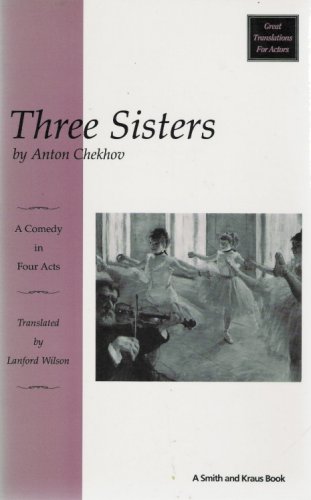
Three Sisters: A Comedy in Four Acts (Great Translations for Actors Series)
$11.27
by Anton Pavlovich Chekhov



The play focuses on the lives of three sisters, Olga, Masha, and Irina, young women of the Russian gentry who try to fill their days in order to construct a life that feels meaningful while surrounded by an array of military men, servants, husbands, suitors, and lovers, all of whom constitute a distractions from the passage of time and from the sisters' desire to return to their beloved Moscow. It was inevitable that the American theater's most Chekhovian writer, Lanford Wilson, would be asked to translate Chekhov. The great Russian's influence marks virtually all of Wilson's plays, from Balm in Gilead to Fifth of July and Talley's Folly . What could not have been predicted was how sensitive and intelligent a translator Wilson would be. First commissioned by the Hartford Stage Company in the early 1980s and rewritten several times since its first production in 1984, Wilson's Three Sisters is a breathtaking, evocative work in which every character springs to life on the page. Of course, even in stilted translations, one feels for the play's central characters--Olga, Masha, and Irina--and their fruitless yearning to transcend their petty lives and see Moscow. But in Wilson's literate, highly readable version, one comes to understand and feel sympathy even for the play's so-called villainess, the gauche upstart sister-in-law, Natalya. We eagerly await Wilson's next translating project: Uncle Vanya . Jack Helbig Lanford Wilson received the 1980 Pulitzer Prize for Drama and the New York Drama Critic's Circle Award for Talley's Folly as well as Obies for The Hot L. Balitmore and The Mound Builders. He received Tony nominations for Talley's Folly, 5th of July, and Angels Fall. Wilson makes his home in Sag Harbor, New York Used Book in Good Condition