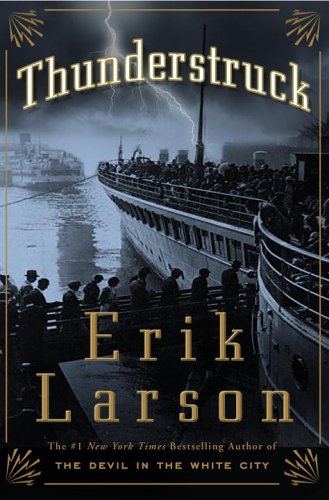



A true story of love, murder, and the end of the world’s “great hush” In Thunderstruck , Erik Larson tells the interwoven stories of two men—Hawley Crippen, a very unlikely murderer, and Guglielmo Marconi, the obsessive creator of a seemingly supernatural means of communication—whose lives intersect during one of the greatest criminal chases of all time. Set in Edwardian London and on the stormy coasts of Cornwall, Cape Cod, and Nova Scotia, Thunderstruck evokes the dynamism of those years when great shipping companies competed to build the biggest, fastest ocean liners, scientific advances dazzled the public with visions of a world transformed, and the rich outdid one another with ostentatious displays of wealth. Against this background, Marconi races against incredible odds and relentless skepticism to perfect his invention: the wireless, a prime catalyst for the emergence of the world we know today. Meanwhile, Crippen, “the kindest of men,” nearly commits the perfect crime. With his superb narrative skills, Erik Larson guides these parallel narratives toward a relentlessly suspenseful meeting on the waters of the North Atlantic. Along the way, he tells of a sad and tragic love affair that was described on the front pages of newspapers around the world, a chief inspector who found himself strangely sympathetic to the killer and his lover, and a driven and compelling inventor who transformed the way we communicate. Thunderstruck presents a vibrant portrait of an era of séances, science, and fog, inhabited by inventors, magicians, and Scotland Yard detectives, all presided over by the amiable and fun-loving Edward VII as the world slid inevitably toward the first great war of the twentieth century. Gripping from the first page, and rich with fascinating detail about the time, the people, and the new inventions that connect and divide us, Thunderstruck is splendid narrative history from a master of the form. Adult/High School–Larson's page-turner juxtaposes scientific intrigue with a notorious murder in London at the turn of the 20th century. It alternates the story of Marconi's quest for the first wireless transatlantic communication amid scientific jealousies and controversies with the tale of a mild-mannered murderer caught as a result of the invention. The eccentric figures include the secretive Marconi and one of his rivals, physicist Oliver Lodge, who believed that he was first to make the discovery, but also insisted that the electromagnetic waves he studied were evidence of the paranormal. The parallel tale recounts the story of Dr. Hawley Harvey Crippen, accused of murdering his volatile, shrewish wife. As he and his unsuspecting lover attempted to escape in disguise to Quebec on a luxury ocean liner, a Scotland Yard detective chased them on a faster boat. Unbeknownst to the couple, the world followed the pursuit through wireless transmissions to newspapers on both sides of the Atlantic. A public that had been skeptical of this technology suddenly grasped its power. In an era when wireless has a whole new connotation, young adults interested in the history of scientific discovery will be enthralled with this fascinating account of Marconi and his colleagues' attempts to harness a new technology. And those who enjoy a good mystery will find the unraveling of Dr. Crippen's crime, complete with turn-of-the-century forensics, appealing to the CSI crowd. A thrilling read. –Pat Bangs, Fairfax County Public Library, VA Copyright © Reed Business Information, a division of Reed Elsevier Inc. All rights reserved. As with Erik Larson's previous book, The Devil in the White City (*** May/June 2003), Thunderstruck alternates between the perspectives of two historical figures, one a scientist and one a killer. Opinions vary as to whether Thunderstruck is as successful as its predecessor. The murderer's story is deeply compelling, but the recounting of Marconi's tribulations and triumphs as an inventor occasionally fails to hold some readers' interest. Moreover, the two stories take place in different years, which creates perspective shifts that some critics found disorienting. Reviewers uniformly praised the pacing and language, however, and admired Larson's choice of main characters, both of whom are as fascinating as they were a hundred years ago. Copyright © 2004 Phillips & Nelson Media, Inc. *Starred Review* In his follow-up to the enormously popular The Devil in the White City (2003), Larson sticks to a formula that works: pairing the story of a progressive development, in this case, wireless communication, with an exciting murder mystery set in England. The murderer in this book is Hawley Harvey Crippen, a mild_-mannered doctor and unlikely killer, who murdered his overbearing wife to be with his young lover. Crippen and Guglielmo Marconi take center stage in the book, and their stories gradually come together as Marconi's invention is integral in apprehending Crippen. Larson parallels