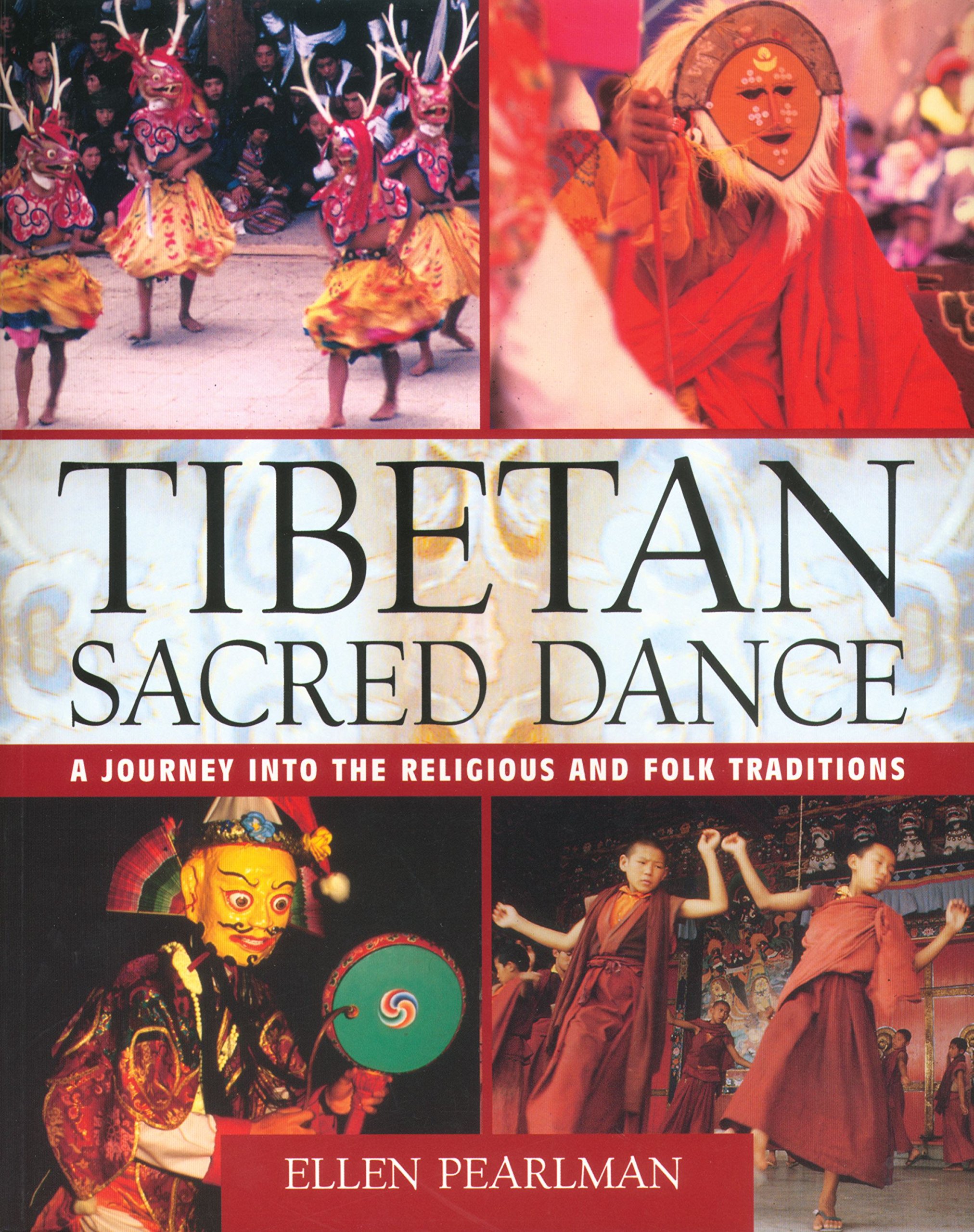
Tibetan Sacred Dance: A Journey into the Religious and Folk Traditions
$18.90
by Ellen Pearlman



The first book to explore the significance and symbolism of the sacred and secular ritual dances of Tibetan Buddhism. • Lavishly illustrated with color and rare historic photographs depicting the dances, costumes, and masks. • Looks at both sacred (cham) and folk (achi lhamo) forms and their role in the development, practice, and culture of Tibetan Buddhism. From the time Buddhism entered the mythical land of the snows, Tibetans have expressed their spiritual devotion and celebrated their culture with dance. Only since the diaspora of the Tibetan people have outsiders witnessed these performances, and when they do, no one explains why these dances exist and what they really mean. Ellen Pearlman, who studied with Lobsang Samten, the ritual dance master of the Dalai Lama's Namgyal monastery in India, set out to discover the meaning behind these practices. She found the story of the indigenous shamanistic Bon religion being superseded by Buddhism--a story full of dangerous and illicit liaisons, brilliant visions, secret teachings, betrayals, and unrevealed yogic practices. Pearlman examines the four lineages that developed sacred cham --the secret ritual dances of Tibet's Buddhist monks--and achi lhamo storytelling folk dance and opera. She describes the mental and physical process of preparing for these dances, the meaning of the iconography of the costumes and masks, the spectrum of accompanying music, and the actual dance steps as recorded in a choreography book dating back to the Fifth Dalai Lama in 1647. Beautiful color photographs from the Tibetan Institute of Performing Arts and Pearlman's own images of touring monastic troupes complement the rare historic black-and-white photos from the collections of Sir Charles Bell, chief of the British Mission in Tibet during the life of the Thirteenth Dalai Lama. "The Buddhist search for inner peace pervades almost every aspect of Tibetan life. One facet of that heritage that has received comparatively less attention is Tibet's sacred dance with its vivid depiction of such fundamental themes as the triumph of virtue and the supremacy of truth. This colorful book serves to redress that lapse." ― His Holiness the Fourteenth Dalai Lama “ Tibetan Sacred Dance is the first book ever written for a general audience on this fascinating subject. With beautiful photographs and accessible text, Ellen Pearlman takes us through the myriad forms and rich traditions of Tibetan dance and music.” ― Valrae Reynolds, curator of the Asian Collections, The Newark Museum “Extraordinarily well researched and in depth.” ― Nugodup Tsering, former director of the Tibetan Institute of Performing Arts " . . . provides an important glimpse into Tibetan culture, history, and spiritual practice as it contributes to world culture." ― E. C. Ramirez, Choice, June 2003 " . . . a well written narrative and beautiful photographs of a culture that is rarely seen by Westerners." ― Dance Spirit magazine, May/June 2003 ". . . an engaging invitation garnering immediate access to the multidimensional and vital realm of Tibetan dance and ritual." ― Laura Simms, Parabola, August 2003 ". . . examines the history, rituals, and iconography of cham, touching on how the traditional forms are influencing Tibetan artists today." ― Tricycle, Winter 2003 "This is the first book of its kind, and it can serve as an iconographic gold mine for many specialists." ― Isabelle Henrion-Dourcy, Harvard University Journal of Asian Studies, Feb 2006 "Tibetan Sacred Dance is a clear achievement in the documentation and preservation of Tibetan Buddhist dance history." ― The North Brooklyn Community News, June 5-19, 2003 Ellen Pearlman has been a Buddhist practitioner for thirty years under Chögyam Trungpa Rinpoche and has studied with Buddhist teachers in the Far East and the Americas. She traveled to England, Germany, India, and Russia in preparation for this book. She lives in Brooklyn, New York. CHAPTER TWO CHAM SACRED MONASTIC DANCE "In a meditative state...the dance comes out of that...In tantra oneself becomes the Buddha." ?Lobsang Samten, ritual dance master of the Namygal monks "Only in meditation are the methods of chanting and instrumental playing revealed." ?His Holiness, The l6th Gylwya Karmapa Cham dances are the secret ritual dances of the Tibet's Buddhist monks. They are part of an elaborate and intensive ritual initiation that lasts anywhere from one day up to two weeks. Cham dances are performed for deep emotional, psychic, and spiritual purification, and while they are now able to be witnessed by spectators, they remain in many ways a mystery. Part of the reason for this mystery is that while we are able to observe the form of the dance, we are unable to see the deep spiritual cleansing that is occurring for the practitioner. And yet even as a spectator, when I first saw Cham dancing on my first visit to Tibet in the early 1980s, I experienced something very power