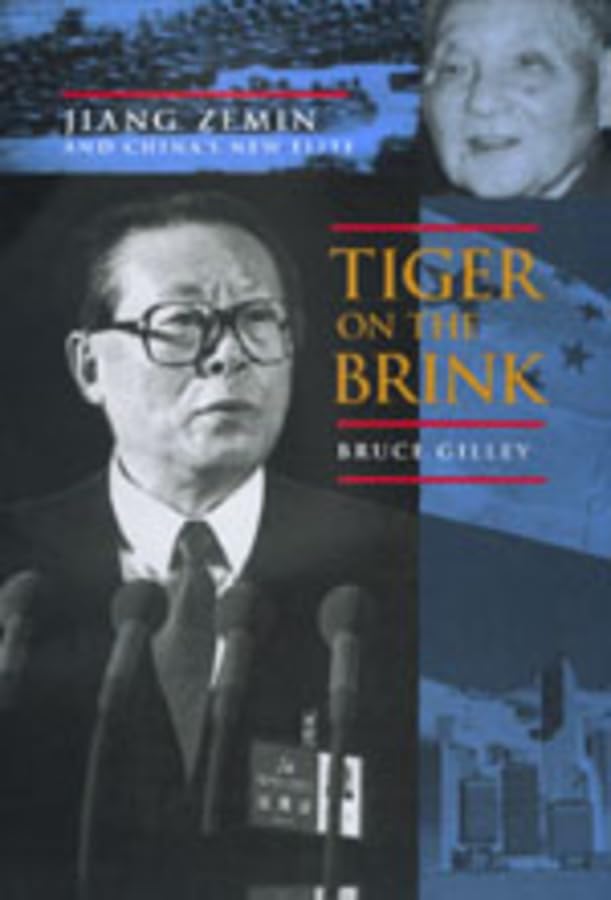



This pathbreaking book is the first full-length study of the rise to power of Jiang Zemin, now the central figure in China's "third generation" of leaders. Tracing Jiang's beginnings as a student in the underground Communist movement in Shanghai through his appointment by Deng Xiaoping as party general secretary and his sudden elevation to central authority in the wake of the 1989 Tiananmen Massacre in Beijing, Bruce Gilley offers a fascinating and highly readable look at how Jiang Zemin has secured his position as one of the world's most powerful figures. Gilley follows Jiang's life and career from his early years as the adopted son of a revolutionary martyr, through his training in Western science and engineering, to his emergence as what many believed would be an interim figurehead in the wake of Tiananmen. Gilley shows how Jiang instead persisted as China's key leader following the death of Deng Xiaoping: While he shared the concerns of the last of the Party elders―including their idealistic views of Chinese socialism―he also accommodated the younger generation of economic reformers who have helped China to achieve staggering growth in its domestic economy and foreign trade. Gilley's analysis of the careful and methodical transition of power from Deng to Jiang during the 1990s is a remarkable study in complexity and contrast, clearly illustrating Jiang's ability to either placate his allies and adversaries or ruthlessly exploit their weaknesses. Based on first-hand interviews and primary documents as well as a variety of mainland Chinese and international media sources, Tiger on the Brink is an unprecedented and immensely revealing look into the highest echelons of Chinese politics on the eve of the twenty-first century, and will be of interest to anyone concerned with the world's most populous nation and its newest emerging superpower. When Deng Xiaoping died in 1997, his unlikely heir as China's principal leader was the former mayor of Shanghai, a middle-level leader who seemingly came from nowhere to occupy a position of central importance to the world. Bruce Gilley, a writer for the Far Eastern Economic Review , traces the life of Jiang Zemin, the adopted son of a hero of the Chinese revolution who himself took part in demonstrations against the nationalist government before joining the Communist party and assuming a series of posts. Removed from power during the Cultural Revolution, which he would later call "a period of unprecedented destruction," Jiang became a cautious critic of the old-line regime, rising to prominence only in the aftermath of the Tienanmen Square demonstrations of 1989. In the 1990s, Gilley maintains, Jiang helps preserve something of the Communist status quo while opening the government to younger reformers--who, Gilley suggests, will exert some pressure on the Chinese government to democratize, a pressure that government is likely to resist. --Gregory McNamee A detailed study of the rise to power of China's dominant leader. In 1989, just before the debacle of the Tiananmen Massacre was to occur, Deng Xiaoping picked from seemingly nowhere an owl-faced, bespectacled man to lead China's ruling Communist Party. This man, Jiang Zemin, went on to head not only the party, but China's state and military apparatus as well. Gilley, Hong Kong correspondent for the Far Eastern Economic Review, argues in this fascinating biography that Jiang's rise was no accident, that he was, rather, the right man (and Chinese politics remains a man's club) at the historically right time to lead China. Born in Yangzhou, a city near Shanghai, in 1926, Jiang at 72 is a relatively young man in the aged world of Chinese leadership. He rose steadily if unspectacularly in the party bureaucracy, mostly in Shanghai, and in the byzantine setting of factional strife that was the China of Mao Zedong, he learned the art of political caution, accommodation, and leading by consensus-building. He did not create, as did other leaders, ``a private kingdom'' within the party that was at once a power base and also vulnerable to attack. While Jiang had few ardent supporters, he also had few enemies. Once Deng picked him for greatness, he was generally acceptable to all power bases within the party. He has been able to expand his power by slowly winning influence over, rather than attacking and destroying, as in the past, those who oppose him. Jiang is no ``emperor'' in the mold of Mao or Deng, nor, Gilley explains, is such an autocratic style of leadership possible any longer in China; while China is certainly not a democracy, certain checks on the authority of even the top leaders do exist. Within this setting, Jiang has attempted, with success, to combine social stability with rapid economic growth. A well-crafted if overly long work that adds much to our understanding of the politics of modern China. -- Copyright ©1998, Kirkus Associates, LP. All rights reserved. "...a highly readable account of modern Chinese