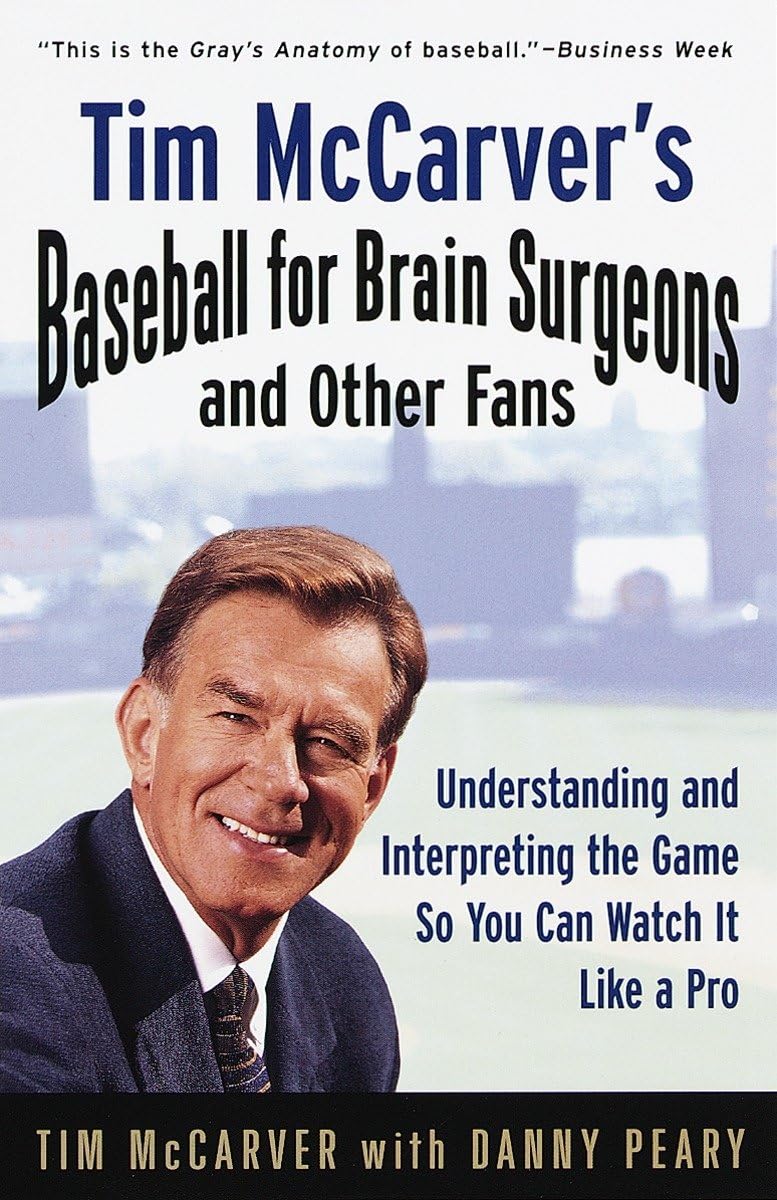
Tim McCarver's Baseball for Brain Surgeons and Other Fans: Understanding and Interpreting the Game So You Can Watch It Like a Pro
$18.00
by Tim McCarver



"I started McCarver's book because I was sure he would teach me something. I finished it as Casey Stengel."--The Cincinnati Enquirer Tim McCarver, baseball's preeminent analyst, has set down all that he knows about how the game should be played and watched. With his trademark wit and style, McCarver explains the fundamentals and proper mechanics at the level necessary for success in the major leagues. Baseball for Brain Surgeons and Other Fans is a gold mine for all fans, brain surgeons or otherwise, and anyone learning how to play or coach the game. (Even major leaguers will pick up some pointers.) After the wonderful 1998 season, America's pastime has never been more popular, and with the deeper knowledge and understanding of baseball that Brain Surgeons provides, any fan will be able to watch it like a pro. "The most intelligent book ever written about our secular national religion." --Pete Hamill "Read any chapter and you'll never watch baseball again in quite the same way."--The Arizona Republic "McCarver and Peary answer virtually every strategic question about how the sport is played." --Baseball Weekly "One of the most significant baseball books in years."--Publishers Weekly "I started McCarver's book because I was sure he would teach me something. I finished it as Casey Stengel."--The Cincinnati Enquirer Tim McCarver, baseball's preeminent analyst, has set down all that he knows about how the game should be played and watched. With his trademark wit and style, McCarver explains the fundamentals and proper mechanics at the level necessary for success in the major leagues. Baseball for Brain Surgeons and Other Fans is a gold mine for all fans, brain surgeons or otherwise, and anyone learning how to play or coach the game. (Even major leaguers will pick up some pointers.) After the wonderful 1998 season, America's pastime has never been more popular, and with the deeper knowledge and understanding of baseball that Brain Surgeons provides, any fan will be able to watch it like a pro. "The most intelligent book ever written about our secular national religion." --Pete Hamill "Read any chapter and you'll never watch baseball again in quite the same way."--The Arizona Republic "McCarver and Peary answer virtually every strategic question about how the sport is played." --Baseball Weekly "One of the most significant baseball books in years."--Publishers Weekly Tim McCarver was a two-time All-Star and played on two world championship teams with the Cardinals (1964 and 1967). He has provided analysis for FOX games since 1996. Danny Peary's books include Cult Movies; Cult Baseball Players; We Played the Game; and Super Bowl. INTRODUCTION I was signed, I was traded, I was waived, I was released. I played it and plied it. I was angered by it, disappointed in myself because of it, gladdened and heartened by it. I was cheered in parades, I was booed off the field, I was treated with silent indifference. I was on world champions and cellar dwellers. I was a hero, and I failed miserably. I felt on top of the world and like I wanted to crawl under a rock. I spiked and was spiked, took out hard and was taken out hard. I was hit by “that little white rat” more times than I could count. I hit it hard, I hit it weakly. I lifted it, grounded it, popped it, and lined it. I hit it foul and fair while realizing there was nothing fair about it. Baseball. I’ve been thrilled about it and wearied by it, but more than anything else I’ve lived it—and always loved it. I’ve been talking about it for many years. Now I am writing about it. During the Philadelphia Phillies’ successful run for the 1980 National League pennant, some of the fans at Veterans Stadium might have done a double take when they saw someone in a Phillies uniform conducting postgame interviews down on the field. I was the guy with the microphone. Having played for the Phillies from mid-1975 through the 1979 season, I had been activated in September so that I could become a rare four-decade major leaguer. Although I wasn’t on their World Series roster, I was part of the team and dressed for each game. I still had on my Phillies cap but was “wearing” my new hat, that of a Phillies broadcaster. I had officially retired the previous October, and, as had been agreed on two years before, I became the fifth announcer in the Phillies’ four-man booth, joining the much-missed Richie Ashburn, Harry Kalas, Andy Musser, and Chris Wheeler, who’d be my partner on cable games. I had no training in the booth, so in preparation I spent three months with Chris honing my skills at an empty studio at Channel 17, WPHL, in Philadelphia. The first time we sat there, Chris put on a videotaped game minus the sound and waited for me to start describing the action as if I were broadcasting to people in their homes. Cowed by the silence, I looked at the television and looked at Chris. Finally, Chris said, “Go ahead.” I stammered, “Go ahead and w