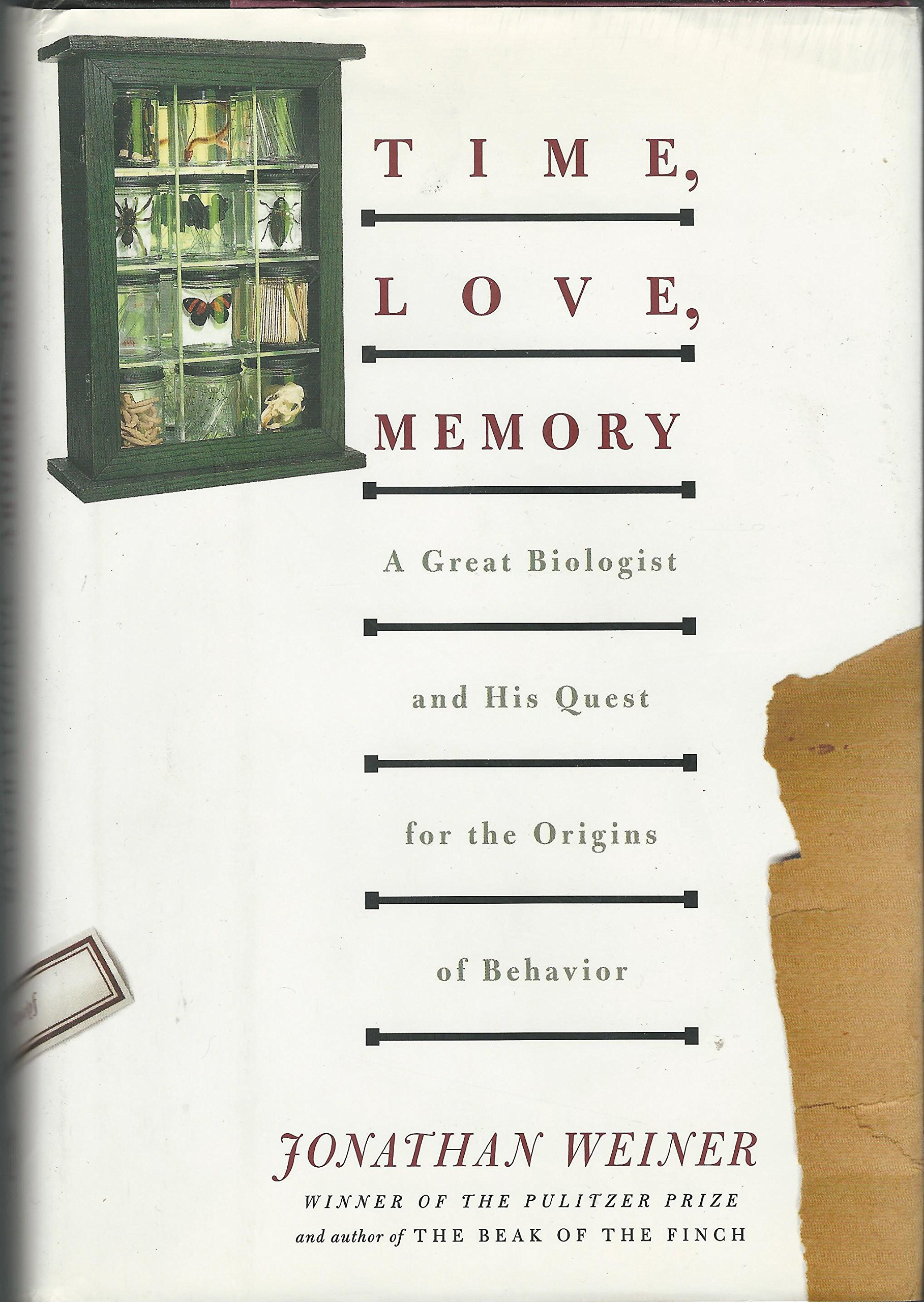
Time, Love, Memory: A Great Biologist and His Quest for the Origins of Behavior
$18.13
by Jonathan Weiner



From the author of the Pulitzer Prize-winning The Beak of the Finch, the riveting story of a biologist's search for the foundations of behavior. Looking over the shoulder of some of the premier scientists in the filed, Jonathan Weiner takes us into their laboratories to show us how pieces of DNA actually shape behavior. He focuses on the work of Seymour Benzer, who, decades ago, with James Watson and Francis Crick, helped to crack the genetic code. Then, in a simple experiment using a few test tubes, a light bulb, and 100 fruit flies, Benzer invented the genetic dissection of behavior. Now we see how he and his students find and study genes that build our inner clocks, genes that shape the way we love, and genes that decide what we can (or cannot) remember. These breakthroughs help explain secrets of human behavior and may lead to advance treatments for behavioral disorders ranging from rage to autism to schizophrenia. In a narrative that sweeps from the first years of the century to the present, Weiner makes the process of scientific discovery and understanding almost tangible on the page. Time, Love, Memory is a brilliant work of scientific reportage. In the words of Jonathan Weiner, "Time, love, and memory are ... three cornerstones of the pyramid of behavior." While some find it difficult to view humans as mere machines, molecular biologists maintain that most behavior is genetically based. Even skeptics and opponents agree that molecular biology may well change the way we all live in the 21st century. Little-known outside this exploding field, Seymour Benzer, his mentors, and his generations of students have studied the common fruit fly, Drosophila , and discovered genes that seem to have some influence upon our internal clock, our sexuality, and our ability to learn from our experiences. Weiner (whose last book, The Beak of the Finch , won a Pulitzer Prize) has written an affectionate history about the development of the science while offering charming glimpses of the people involved--trading haircuts to stretch their grant money in the early years, roaming the laboratory into the wee hours, naming the genes associated with learning after Pavlov's dogs. It's not all sweetness and light, however; ethical questions are raised, some of the hype (and hysteria) surrounding the human genome project is dissipated, and the complicated "clockwork" gene "looks less like an invitation to human intervention and more like a cautionary tale or object lesson for anyone who might try, in the 21st century, to improve on nature's four-billion-year-old designs." That said, the scientists in Weiner's tale reveal a very human side of this fast-moving science, and their belief that they'll find answers to important questions is contagious and compelling. As Benzer himself said, "It's a wonderful, fabulous world, and it's been kicking around a long time." --C.B. Delaney Armed with only a few test tubes, a light bulb, and 100 fruit flies, physicist-turned-biologist Seymour Bezmour revolutionized molecular biology. Weiner's fascinating book recounts how Bezmour's beautifully simple experiments revealed the genetic origins of human behavior. (LJ 5/15/99) Copyright 2000 Reed Business Information, Inc. Time, Love, Memory is a beautifully written book that seamlessly weaves together science, history and personalities. Weiner makes behavioral genetics come alive... It's a biography of a scientist, a summary of 20th-century genetics, and a fly's-eye (i.e., multifaceted) view of trends and controversies in biologyall told by an expert science writer with one Pulitizer Prize already to his credit (The Beak of the Finch, 1994). Seymour Benzer is the fly man par excellence and a dream subject for profiling. Curious and restless, he made his mark in physics and phage genetics (phage are viruses that infect bacteria) before turning to the fruit fly and launching a second wave of fly genetics that not only sparked a revolution in developmental biology but now has turned to the study of behavior. Yes, flies behave. They have courtship songs; they have circadian rhythms; they can learn and remember. Indeed, time, love, and memory (and thus learning) have become associated with specific fly genes. And these genes have counterparts in mammals, including humans. Benzer et al. are saying that behavior as well as the housekeeping rules that govern cellular metabolism get encoded in living organisms as products of evolutionary adaptation. Its not that there is a gene for this or that, but rather complex sets of interacting genes affected by environment. But some, like Richard Lewontin and Jonathan Beckwith, will have none of that, categorically denying the relevance of fly genetics to human behavior. Weiner gives them a fair hearing, as well as E.O. Wilson and others on either side of the nature-nurture fence. Fair play aside, the momentum of the new studies could play out in the 21st century with the rich opting for ``favored'' genes