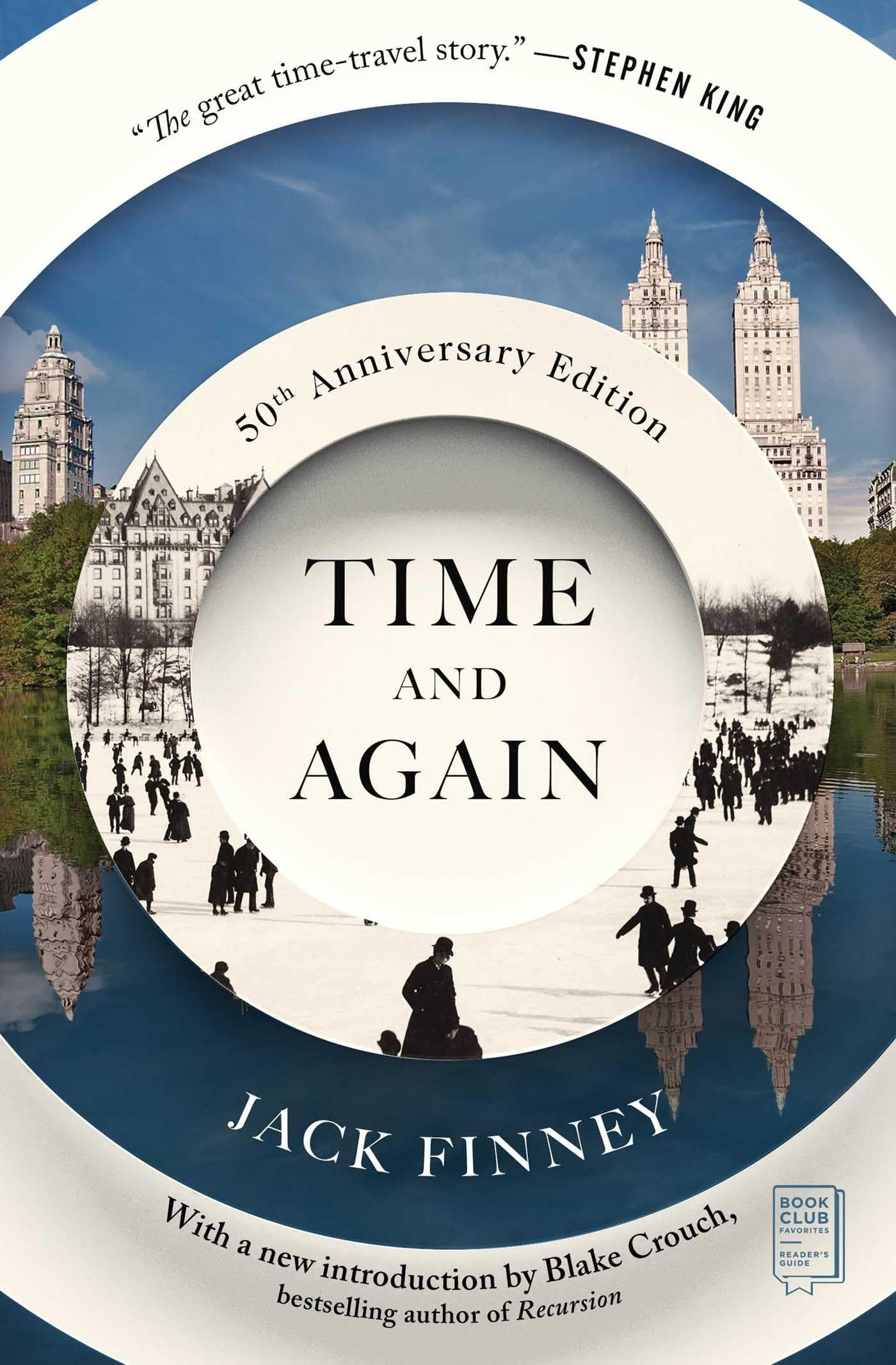



The 50th anniversary edition of the beloved classic that Stephen King has called “ THE great time-travel story.” Featuring a brand-new introduction by the New York Times bestselling author of Recursion , Blake Crouch. When advertising artist Si Morley is recruited to join a covert government operation exploring the possibility of time travel, he jumps at the chance to leave his mundane 20th-century existence and step into the past. But he also has another motivation for going back in time: a half-burned letter that tells of a mysterious, tragic death and ominously of “fire which will destroy the whole world.” Traveling to New York City in January 1882 to investigate, he finds a Manhattan teeming with a different kind of life, the waterfront unimpeded by skyscrapers, open-air markets packed with activity, Central Park bustling with horse drawn sleighs—a city on the precipice of great things. At first, Si welcomes these trips as a temporary escape but when he falls in love with a woman he meets in the past, he must choose whether to return to modern life or live in 1882 for good. “Pure New York fun” (Alice Hoffman, New York Times bestselling author), Time and Again is meticulous recreation of New York in the late nineteenth century, exploring the possibilities of time travel to tell an ageless story of love, longing, and adventure. Finney’s magnum opus has been a source of inspiration for countless science fiction writers since its first publication in 1970. " The great time-travel story." —Stephen King " Go back to a wonderful world and have a wonderful time doing it." — The New York Times “Pure New York fun.” —Alice Hoffman, author of The Rules of Magic Jack Finney (1911–1995) was the author of the much-loved and critically acclaimed novel Time and Again , as well as its sequel, From Time to Time. Best known for his thrillers and science fiction, a number of his books—including Invasion of the Body Snatchers— have been made into movies. Time and Again 1 IN SHIRT-SLEEVES, the way I generally worked, I sat sketching a bar of soap taped to an upper corner of my drawing board. The gold-foil wrapper was carefully peeled back so that you could still read most of the brand name printed on it; I’d spoiled the wrappers of half a dozen bars before getting that effect. This was a new idea, the product to be shown ready for what the accompanying copy called “fragrant, lathery, lovelier you” use, and I had the job of sketching it into half a dozen layouts, the bar of soap at a slightly different angle in each. It was just exactly as boring as it sounds, and I stopped to look out the window beside me, down twelve stories at Fifty-fourth Street and the little heads moving along the sidewalk. It was a sunny, sharply clear day in mid-November, and I’d have liked to be out in it, the whole afternoon ahead and nothing to do; nothing I had to do, that is. Over at the paste-up table Vince Mandel, our lettering man, thin and dark and probably feeling as caged-up today as I was, stood working with the airbrush, a cotton surgical mask over his mouth. He was spraying a flesh-colored film onto a Life magazine photo of a girl in a bathing suit. The effect, when he finished, would be to remove the suit, leaving the girl apparently naked except for the ribbon she wore slanted from shoulder to waist on which was lettered MISS BUSINESS MACHINES. This kind of stunt was Vince’s favorite at-work occupation ever since he’d thought of it, and the retouched picture would be added to a collection of others like it on the art-department bulletin board, at which Maureen, our nineteen-year-old paste-up girl and messenger, refused ever to look or even glance, though often urged. Frank Dapp, our art director, a round little package of energy, came trotting toward his partitioned-off office in the northeast corner of the artists’ bullpen. As he passed the big metal supply cabinet just inside the room he hammered violently on its open door, yodeling at full bellow. It was an habitual release of unused energy like a locomotive jetting steam, a starting eruption of sound. But neither Vince nor I nor Karl Jonas at the board ahead of mine glanced up. Neither did anyone in the typists’ pool outside, I knew, although strangers waiting in the art-department reception room just down the hall had been known to leap to their feet at the sound. It was an ordinary day, a Friday, twenty minutes till lunchtime, five hours till quitting time and the weekend, ten months till vacation, thirtyseven years till retirement. Then the phone rang. “Man here to see you, Si.” It was Vera, at the switchboard. “He has no appointment.” “That’s okay. He’s my connection; I need a fix.” “What you need can’t be fixed.” She clicked off. I got up, wondering who it was; an artist in an advertising agency doesn’t usually have too many visitors. The main reception room was on the floor below, and I took the long route through Accounting and Media, but