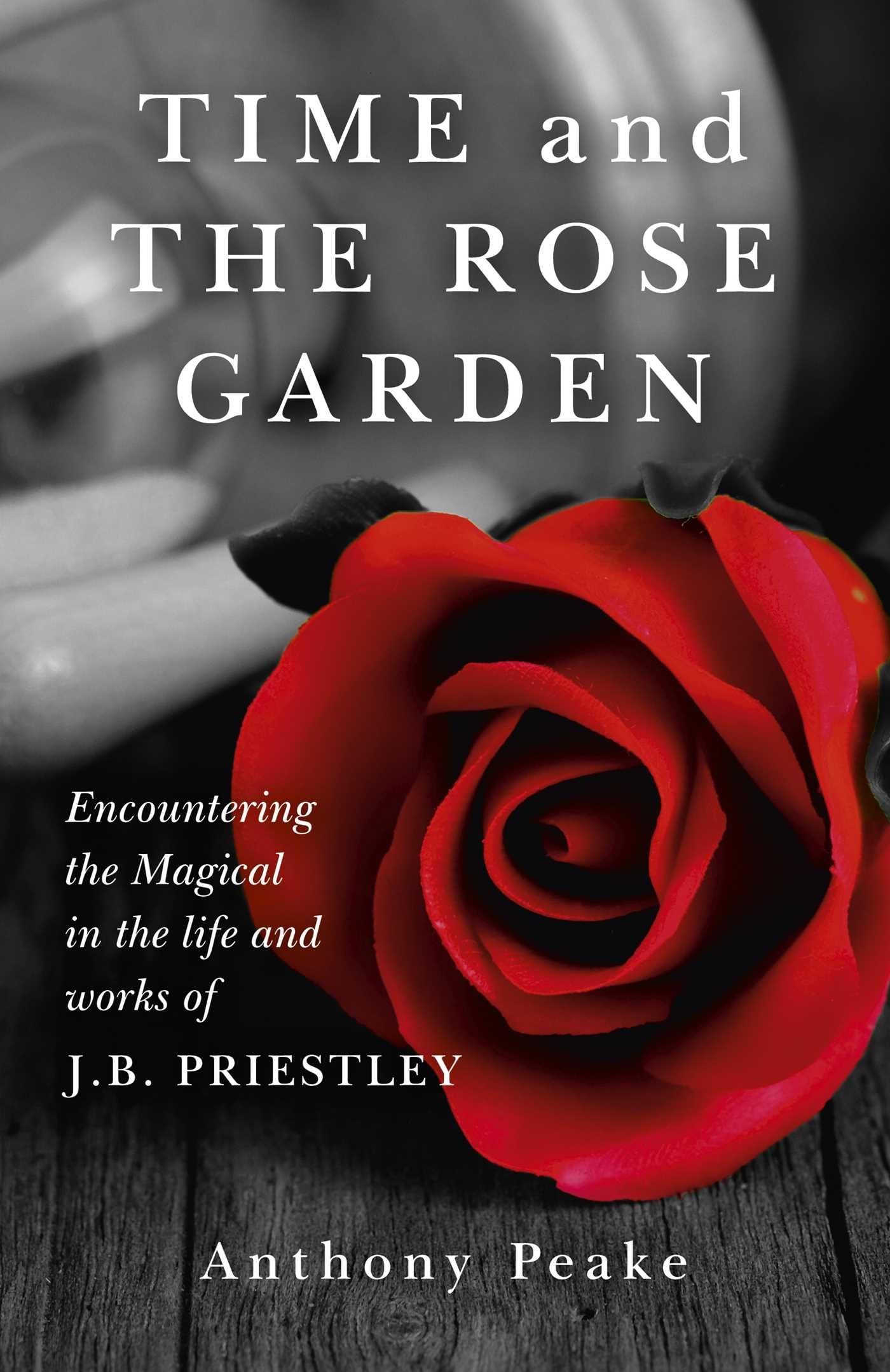
Time and The Rose Garden: Encountering The Magical In The Life And Works Of J.B. Priestley
$15.03
by Anthony Peake



J.B. Priestley is considered by many to be an old-fashioned playwright whose work is locked in a pre-war world of provincialism and whose ideas are way past their sell-by date. In Time and the Rose Garden, internationally recognised author Anthony Peake re-assesses the plays and novels of this fascinating writer. In doing so, Peake argues that Priestley should be recognised as one of the most prescient of all middle century playwrights and that his ideas on time, consciousness and mortality can be found in hugely popular blockbusters such as The Matrix, Vanilla Sky, Deja Vu, Sliding Doors, Butterfly Effect and many others. Anthony Peake, a writer and speaker, was born in Merseyside. His work has been translated into many languages including French, Russian and Spanish. In October 2015, Anthony was the keynote speaker at the annual J.B. Priestley Society lecture event at Queen Mary University in London. He is a member of the Society for Psychical Research, The Scientific and Medical Network and the J.B. Priestley Society. He lives in West Sussex, UK. Time and the Rose Garden Encountering the Magical in the life and works of J.B. Priestley By Anthony Peake John Hunt Publishing Ltd. Copyright © 2017 Anthony Peake All rights reserved. ISBN: 978-1-78279-457-8 Contents Foreword, 1, Introduction, 4, Preface: JB & ME, 9, Chapter One: Priestley The Boy, The Soldier and The Student, 11, Chapter Two: The 1920s: John William Dunne and the question of time, 26, Chapter Three: Before The Time Plays - 1930-1937, 36, Chapter Four: Time and The Conways (1937), 66, Chapter Five: Johnson Over Jordan, 75, Chapter Six: The War Years - 1939-1946, 92, Chapter Seven: The Post-War Years, 114, Chapter Eight: After the War - Dunne & Jacquetta, 125, Chapter Nine: The Post-War Period - 1950-1960, 142, Chapter Ten: The Man and Time Letters, 154, Chapter Eleven: The Unpublished Letters, 165, Chapter Twelve: The Long Indian Summer, 203, Chapter Thirteen: The Unknown Play - Time Was, Time Is, 212, Chapter Fourteen: Crossing The Long High Wall, 221, References, 237, CHAPTER 1 Priestley The Boy, The Soldier and The Student We might be close to one of the great revelations that suddenly enlarge and enrich our vision of life. We are, due one. And I believed that this revelation might explode once and for all the bewildering problem of Time. -J.B. Priestley John (Jack) Boynton Priestley was born in Bradford, Yorkshire, in 1894. His father, Jonathan, was a schoolmaster who suggested that, on leaving school at sixteen, his ambitious son should pursue a career in the wool trade, an area of business for which Yorkshire was a world leader. In 1910 Jack, as he was known at the time and continued to be known throughout his life, started his working life at Messrs. Helm & Co based in the Swan Arcade, an imposing four-storey building of wrought iron and glass. But this was not the career Jack wished for himself. For him his future lay in words, not in worsted. He sent out various articles to local publications and was taken on in an unpaid position writing articles for a radical, left wing periodical, the Bradford Pioneer. This was in keeping with his own political beliefs, inherited from his father. His articles, actually short essays, were acutely observational and written in a style suggesting far greater age and personal maturity. This maturity was evidenced in his reading at that time. In his 1964 book Man and Time, Jack describes how one of the most influential discoveries of his life was his encounter with Indian metaphysics fifty years before. This takes us to the period of 1912 to 1914. He describes how the Vedantic concept of Atman fascinated him. This is the idea that at a much deeper level of consciousness we can discover the "essential self" and that this essential self, Atman, is simply part of a single unitary essence which is known as Brahman. Remember, Priestley was only in his late teens at this time and yet he was already fascinated by the idea that we are all simply emanations of a singular consciousness. In Man and Time, he reflected on this: I can remember the exultation I felt, being in my late teens, when if we have any sympathy at all with speculative thought we long to encounter bold and gigantic metaphysical conclusions. It is important here to discuss exactly what Vedanta is. Vedanta is the esoteric aspect of Hinduism. But just as Gnosticism with regards to Christianity, Kabbalah in relation to Judaism and Sufism within Islam, each is an exclusive philosophy which presents a far deeper understanding of the universe than the 'religion' presented to the masses that follow the belief system as an accepted truth without thought or reflection. Vedanta is a non-dual philosophy. This means that within this system there is one, single 'essence' within the universe. This is in contrast with 'Dualism' which proposes that the universe consists of two very different essences: mind