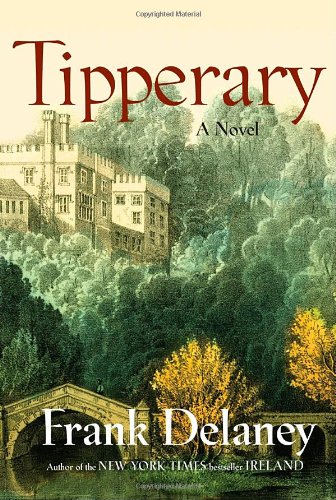



“My wooing began in passion, was defined by violence and circumscribed by land; all these elements molded my soul.” So writes Charles O’Brien, the unforgettable hero of bestselling author Frank Delaney’s extraordinary new novel–a sweeping epic of obsession, profound devotion, and compelling history involving a turbulent era that would shape modern Ireland. Born into a respected Irish-Anglo family in 1860, Charles loves his native land and its long-suffering but irrepressible people. As a healer, he travels the countryside dispensing traditional cures while soaking up stories and legends of bygone times–and witnessing the painful, often violent birth of land-reform measures destined to lead to Irish independence. At the age of forty, summoned to Paris to treat his dying countryman–the infamous Oscar Wilde–Charles experiences the fateful moment of his life. In a chance encounter with a beautiful and determined young Englishwoman, eighteen-year-old April Burke, he is instantly and passionately smitten–but callously rejected. Vowing to improve himself, Charles returns to Ireland, where he undertakes the preservation of the great and abandoned estate of Tipperary, in whose shadow he has lived his whole life–and which, he discovers, may belong to April and her father. As Charles pursues his obsession, he writes the “History” of his own life and country. While doing so, he meets the great figures of the day, including Charles Parnell, William Butler Yeats, and George Bernard Shaw. And he also falls victim to less well-known characters–who prove far more dangerous. Tipperary also features a second “historian:” a present-day commentator, a retired and obscure history teacher who suddenly discovers that he has much at stake in the telling of Charles’s story. In this gloriously absorbing and utterly satisfying novel, a man’s passion for the woman he loves is twinned with his country’s emergence as a nation. With storytelling as sweeping and dramatic as the land itself, myth, fact, and fiction are all woven together with the power of the great nineteenth-century novelists. Tipperary once again proves Frank Delaney’s unrivaled mastery at bringing Irish history to life. Praise for Frank Delaney’s TIPPERARY: “[T]he narrative moves swiftly and surely…A sort of Irish Gone With the Wind , marked by sly humor, historical awareness and plenty of staying power.” — Kirkus Reviews “[A]nother meticulously researched journey…Delaney’s careful scholarship and compelling storytelling bring it uniquely alive. Highly recommended.” — Library Journal (starred) “Sophisticated and creative.” — Booklist “Delaney’s confident storytelling and quirky characterizations enrich a fascinating and complex period of Irish history.” — Publishers Weekly “Read just a few sentences of Frank Delaney’s writing and you’ll see why National Public Radio called him ‘the world’s most eloquent man.’” — Kirkus Reviews , “Big Book Guide 2007” Frank Delaney is the author of the New York Times bestselling novel Ireland as well as Simple Courage: The Story of S.S.Flying Enterprise–and One of the Greatest Naval Rescues in History . A former judge for the Man Booker Prize, Delaney enjoyed a prominent career in BBC broadcasting before becoming a full-time writer. Born in Tipperary, Ireland, he now lives in New York City and Connecticut. Chapter 1 Be careful about me. Be careful about my country and my people and how we tell our history. We Irish prefer embroideries to plain cloth. If we are challenged about this tendency, we will deny it and say grimly: “We have much to remember.” “But,” you may argue, “isn’t memory at least unreliable? And often a downright liar?” Maybe. To us Irish, though, memory is a canvas—stretched, primed, and ready for painting on. We love the “story” part of the word “history,” and we love it trimmed out with color and drama, ribbons and bows. Listen to our tunes, observe a Celtic scroll: we always decorate our essence. This is not a matter of behavior; it is our national character. As a consequence of this ornamenting, we are accused of revising the past. People say that we reinvent the truth, especially when it comes to the history of our famous oppression by England, the victimhood that has become our great good fortune. And do we? Do we embellish that seven hundred years since the Norman barons sailed to our southeast shores? Do we magnify those men in silver armor, though they stood only five feet six inches tall? Do we make epic those little local wars, often fought across rivers no more than some few feet wide? Do we render monumental the tiny revolutions fought on cabbage patches by no more than dozens of men with pitchforks and slings? Perhaps we do. And why should we not? After all, what is history but one man’s cloak cut from the beautiful cloth of Time? Customarily, history is written by the victors; in Ireland the vanquished wrote it too and wrote it more powerfully. That is why I say, “Be c