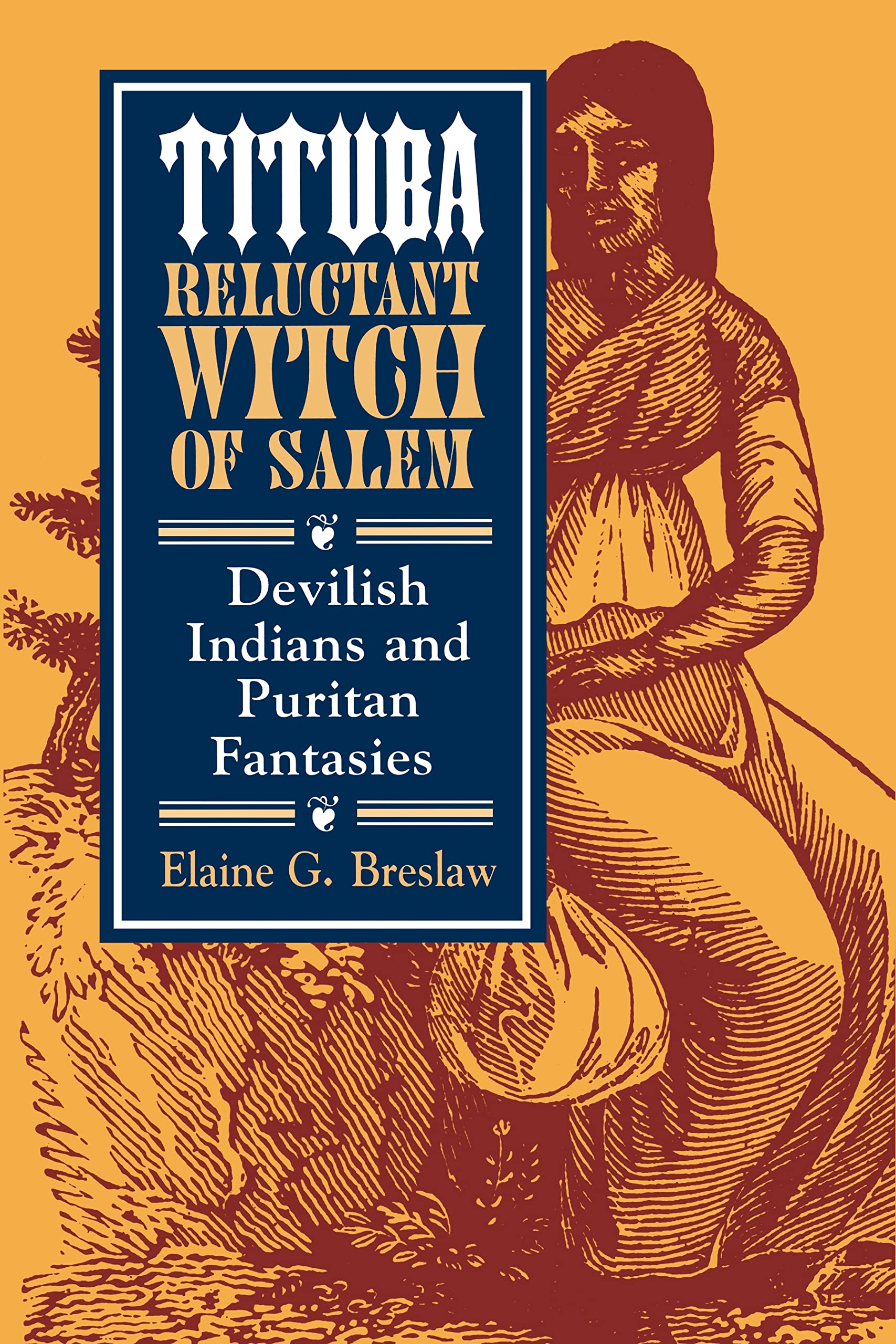
Tituba, Reluctant Witch of Salem: Devilish Indians and Puritan Fantasies (The American Social Experience, 19)
$36.95
by Elaine G. Breslaw



A landmark contribution to women's history that sheds new light on the Salem witch trials and one of its most crucial participants, Tituba of The Crucible In this important book, Elaine Breslaw claims to have rediscovered Tituba, the elusive, mysterious, and often mythologized Indian woman accused of witchcraft in Salem in 1692 and immortalized in Arthur Miller's The Crucible . Reconstructing the life of the slave woman at the center of the notorious Salem witch trials, the book follows Tituba from her likely origins in South America to Barbados, forcefully dispelling the commonly-held belief that Tituba was African. The uniquely multicultural nature of life on a seventeenth-century Barbadan sugar plantation―defined by a mixture of English, American Indian, and African ways and folklore―indelibly shaped the young Tituba's world and the mental images she brought with her to Massachusetts. Breslaw divides Tituba’s story into two parts. The first focuses on Tituba's roots in Barbados, the second on her life in the New World. The author emphasizes the inextricably linked worlds of the Caribbean and the North American colonies, illustrating how the Puritan worldview was influenced by its perception of possessed Indians. Breslaw argues that Tituba’s confession to practicing witchcraft clearly reveals her savvy and determined efforts to protect herself by actively manipulating Puritan fears. This confession, perceived as evidence of a diabolical conspiracy, was the central agent in the cataclysmic series of events that saw 19 people executed and over 150 imprisoned, including a young girl of 5. A landmark contribution to women's history and early American history, Tituba, Reluctant Witch of Salem sheds new light on one of the most painful episodes in American history, through the eyes of its most crucial participant. Breslaw (history, Univ. of Tennessee) provides a fascinating account of Tituba, an American Indian slave woman whose confession inspired much of the 1692 Salem witch trials. Breslaw reveals Tituba as a South American (not an African, as 19th- and 20th-century writers supposed) who was sold into slavery in Barbados and came to Salem with the Reverend Samuel Parris, her owner. Tituba skillfully used her knowledge and storytelling ability to save her own life and to express defiance of her master both in her confession and in her subsequent recantation. Highly recommended for scholars in American history and literature as well as general readers. Carolyn M. Craft, Longwood Coll., Farmville, Va. Copyright 1995 Reed Business Information, Inc. "A fine example of readable scholarship." ― Baltimore Sun "An imaginative reconstruction of what might have been Tituba's past." ― Times Literary Supplement "A fascinating theory about the origins of the witch hunt that is sure to influence future historians. . . . a valuable probe of how myths can feed hysteria" ― The Washington Post Book World With this important book, Elaine G. Breslaw has "found" Tituba, the elusive, mysterious, and often mythologized Indian woman accused of witchcraft in Salem in 1692 and immortalized in Arthur Miller's The Crucible. Reconstructing the life of the slave woman at the center of the notorious Salem witch trials, the book traces Tituba from her likely origins in South America to Barbados, forcefully dispelling the commonly held belief that Tituba was African. The uniquely multicultural nature of life on a seventeenth-century Barbadan sugar plantation - defined by a mixture of English, American Indian, and African ways and folklore - indelibly shaped the young Tituba's world and the mental images she brought with her to Massachusetts. By dividing her biography into two parts, one focusing on Tituba's roots in Barbados, the other on her life in Massachusetts, Breslaw emphasizes the inextricably linked worlds of the Caribbean and the North American colonies, illustrating how the Puritan worldview was influenced by its perception of possessed Indians. Tituba's confession, Breslaw argues, clearly reveals Tituba's savvy and determined efforts to protect herself by actively manipulating Puritan fears. This confession, perceived as evidence of a diabolical conspiracy, was the central agent in the cataclysmic series of events that saw nineteen people executed and over 150 imprisoned, including a young girl of five. Elaine G. Breslaw retired as Professor of History from Morgan State University in Baltimore after 29 years and has taught on an adjunct basis at Johns Hopkins University, Goucher College, and the University of Tennessee, Knoxville. She is the author of Tituba, Reluctant Witch of Salem: Devilish Indians and Puritan Fantasies (NYU Press, 1995), Witches of the Atlantic World: An Historical Reader and Primary Sourcebook (NYU Press, 2000), and Dr. Alexander Hamilton and Provincial America: Expanding the Orbit of Scottish Culture. Used Book in Good Condition