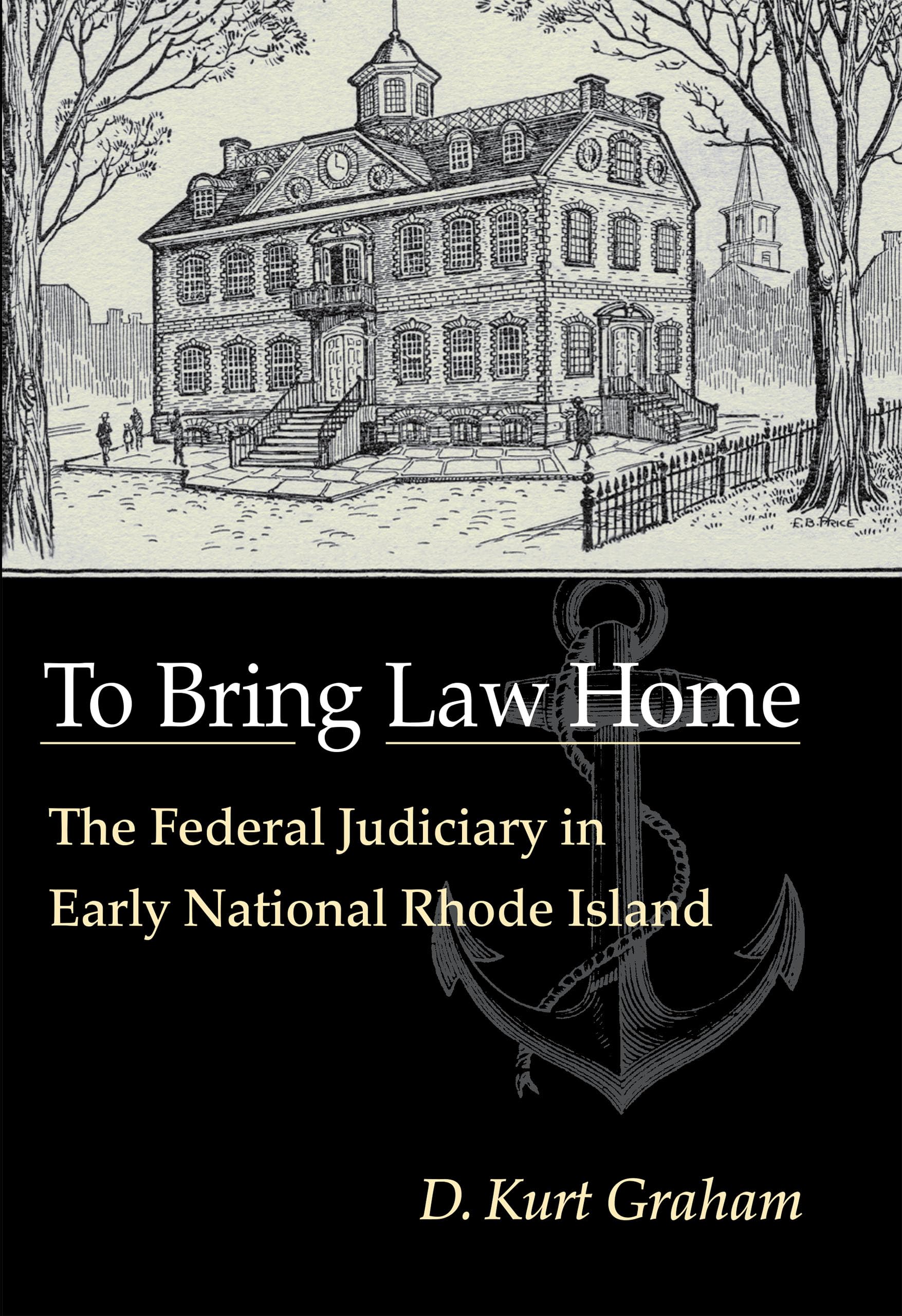
To Bring Law Home: The Federal Judiciary in Early National Rhode Island
$32.00
by D. Kurt Graham



In this original study, Kurt Graham sheds light on both an understudied institution and an underappreciated period in our nation's judicial history with an examination of the federal judiciary―the district and circuit courts―during the early national period. Using Rhode Island as a case study, Graham argues that the federal judicial system exerted a significant nationalizing influence on the citizens and states of the new American nation. Graham illustrates how the federal judiciary brought a federal presence and national authority to bear in Rhode Island, a state that had resisted federal union longer than any other. Rhode Island represents an ideal example: in part because of its initial resistance to federal union―a condition that made the national presence more conspicuous―and in part because of its heavy involvement in commerce. The national government's income came from customs duties, which gave Rhode Island and the federal courts there a significance they otherwise might not have had. The federal courts in Rhode Island highlight both the localized nature of national authority and the relative strength of the national government from its inception. The district and circuit courts have lived in the shadow of the U.S. Supreme Court and have been considered "inferior" courts in every sense. Beginning with Charles Warren's groundbreaking 1922 work, The Supreme Court in United States History , legal historians have focused on the significance of the Supreme Court, its decisions, and its justices. Because of this focus, the role of the lower courts―which is where most of the federal judicial activity took place in the early republic―has gone virtually unexplored. Graham contends that the lower federal courts were instrumental in establishing and maintaining national supremacy and in steadily enhancing the power of the national government. Legal historians and scholars of the early republic will appreciate this insightful book that opens a window onto an often overlooked aspect of U.S. history. A fascinating book describing how the federal judiciary (looked upon by many during the debate over the ratification of the Constitution as a potential engine of despotism) was readily, easily, and overwhelmingly accepted in Rhode Island. Graham writes in an easily understood prose and avoids jargon. -- John Kaminski, University of Wisconsin-Madison A superb, well-written, and much needed study of the early federal judiciary. It is a model of historical scholarship. -- Gordon S. Wood, Brown University, author of Empire of Liberty Does much more than fill a major gap in the scholarship of the Early Republic. By showing how a state that rejected ratification of the Constitution quickly came to accept national authority and to favor federal courts over its own state courts, To Bring Law Home expands our understanding of law and the legal profession at a formative point in our history. -- David T. Konig, Washington University in St. Louis D. Kurt Graham is the Housel Director of the McCracken Research Library and Co-Director of the Cody Institute for Western American Studies, both at the Buffalo Bill Historical Center in Cody, Wyoming. He holds a Ph.D. in American history from Brown University. Used Book in Good Condition