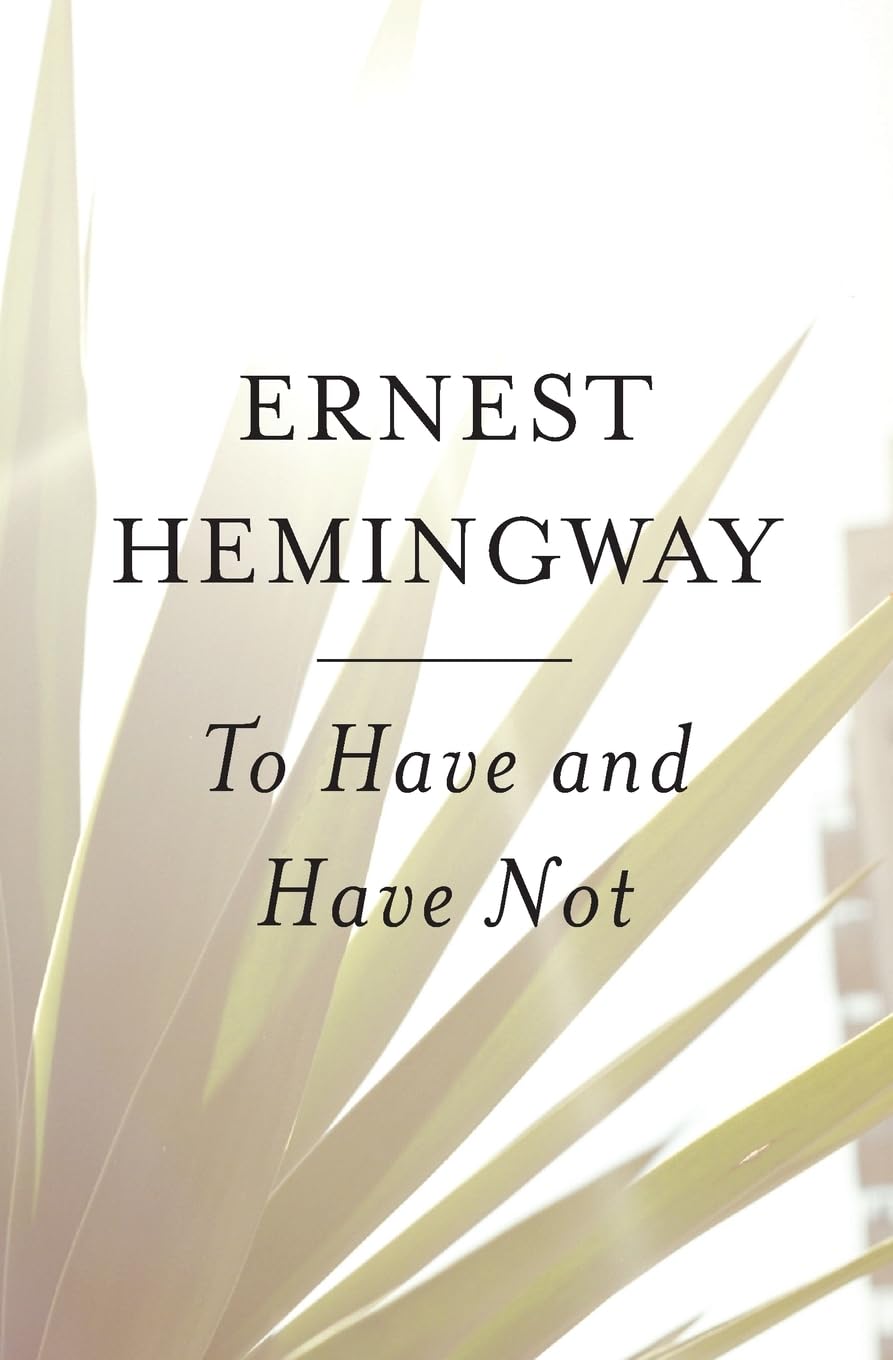



From one of the best writers in American literature, a classic novel about smuggling, intrigue, and love. To Have and Have Not is the dramatic story of Harry Morgan, an honest man who is forced into running contraband between Cuba and Key West as a means of keeping his crumbling family financially afloat. His adventures lead him into the world of the wealthy and dissipated yachtsmen who throng the region and involve him in a strange and unlikely love affair. In this harshly realistic, yet oddly tender and wise novel, Hemingway perceptively delineates the personal struggles of both the "haves" and the "have nots" and creates one of the most subtle and moving portraits of a love affair in his oeuvre. By turns funny and tragic, lively and poetic, remarkable in its emotional impact, To Have and Have Not is literary high adventure at its finest. First things first: readers coming to To Have and Have Not after seeing the Bogart/Bacall film should be forewarned that about the only thing the two have in common is the title. The movie concerns a brave fishing-boat captain in World War II-era Martinique who aids the French Resistance, battles the Nazis, and gets the girl in the end. The novel concerns a broke fishing-boat captain who agrees to carry contraband between Cuba and Florida in order to feed his wife and daughters. Of the two, the novel is by far the darker, more complex work. The first time we meet Harry Morgan, he is sitting in a Havana bar watching a gun battle raging out in the street. After seeing a Cuban get his head blown off with a Luger, Morgan reacts with typical Hemingway understatement: "I took a quick one out of the first bottle I saw open and I couldn't tell you yet what it was. The whole thing made me feel pretty bad." Still feeling bad, Harry heads out in his boat on a charter fishing expedition for which he is later stiffed by the client. With not even enough money to fill his gas tanks, he is forced to agree to smuggle some illegal Chinese for the mysterious Mr. Sing. From there it's just a small step to carrying liquor--a disastrous run that ends when Harry loses an arm and his boat. Once Harry gets mixed up in the brewing Cuban revolution, however, even those losses seem small compared to what's at stake now: his very life. Hemingway tells most of this story in the third person, but, significantly, he brackets the whole with a section at the beginning told from Harry's perspective and a short, heart-wrenching chapter at the end narrated by his wife, Marie. In between there is adventure, danger, betrayal, and death, but this novel begins and ends with the tough and tender portrait of a man who plays the cards that are dealt him with courage and dignity, long after hope is gone. --Alix Wilber Ernest Hemingway did more to change the style of English prose than any other writer of his time. Publication of The Sun Also Rises and A Farewell to Arms immediately established Hemingway as one of the greatest literary lights of the twentieth century. His classic novel The Old Man and the Sea won the Pulitzer Prize in 1953. Hemingway was awarded the Nobel Prize for Literature in 1954. His life and accomplishments are explored in-depth in the PBS documentary film from Ken Burns and Lynn Novick, Hemingway . Known for his larger-than-life personality and his passions for bullfighting, fishing, and big-game hunting, he died in Ketchum, Idaho on July 2, 1961. Chapter 1 You know how it is there early in the morning in Havana with the bums still asleep against the walls of the buildings; before even the ice wagons come by with ice for the bars? Well, we came across the square from the dock to the Pearl of San Francisco Café to get coffee and there was only one beggar awake in the square and he was getting a drink out of the fountain. But when we got inside the café and sat down, there were the three of them waiting for us. We sat down and one of them came over. "Well," he said. "I can't do it," I told him. "I'd like to do it as a favor. But I told you last night I couldn't." "You can name your own price." "It isn't that. I can't do it. That's all." The two others had come over and they stood there looking sad. They were nice-looking fellows all right and I would have liked to have done them the favor. "A thousand apiece," said the one who spoke good English. "Don't make me feel bad," I told him. "I tell you true I can't do it." "Afterwards, when things are changed, it would mean a good deal to you." "I know it. I'm all for you. But I can't do it." "Why not?" "I make my living with the boat. If I lose her I lose my living." "With the money you buy another boat." "Not in jail." They must have thought I just needed to be argued into it because the one kept on. "You would have three thousand dollars and it could mean a great deal to you later. All this will not last, you know." "Listen," I said. "I don't care who is president here. But I don't carry anything to the sta