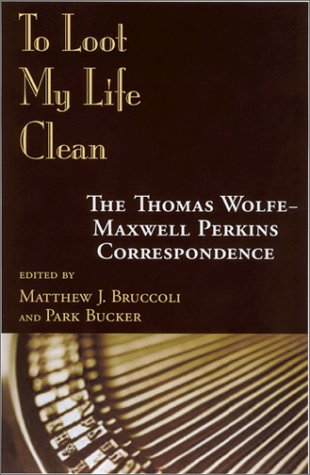
To Loot My Life Clean : The Thomas Wolfe-Maxwell Perkins Correspondence
$55.55
by Thomas Wolfe



Establishes the famed rapport between a distinguished author and his publisher The relationship between Thomas Wolfe and his legendary editor, Maxwell Perkins, has been the subject of guesswork and anecdote for seventy years. Beginning with the 1929 publication of Look Homeward, Angel, literary scholars have debated the writer's dependence on his editor and the degree to which Perkins participated in Wolfe's work. Now, with this volume of 251 letters between Wolfe and the House of Scribner (two-thirds of which have never been published), the mythologized friendship between the author and the editor is clarified, and the record can be set straight. Celebrated for his close literary relationships with F. Scott Fitzgerald, Ernest Hemingway, and other literary giants of the early twentieth century, Maxwell Perkins was both mentor and father figure to Thomas Wolfe. According to the introduction, "The letters published here document Wolfe's artistic and professional problems, and demonstrate how Perkins, serving as both editor and friend, aided Wolfe in solving them. Only by considering all of the author/editor/publisher correspondence can Wolfe's literary career and his complex relationship with Charles Scribner's Sons be properly assessed." The successes and pains of both Wolfe's career and his friendship with Perkins are revealed in letters between the two as well as through Wolfe's correspondence with other Scribner employees. Documenting an important era in American literary history, the letters of To Loot My Life Clean span the Wolfe-Perkins friendship, from their meeting in 1929, through the novelist's break with his editor and the House of Scribner, until Wolfe's death in 1938. "Wolfe emerges as driven, intensely committed, locked in a torturous, exhausting struggle with his talent and material that verges on madness―a writer reliant on his editor's judgment but also possessing a clear artistic vision. High- strung, hypersensitive to criticism and in need of constant reassurance, he is difficult, demanding and 'crammed to the lips with living"― Publishers Weekly Matthew J. Bruccoli (1931–2008) was the Emily Brown Jefferies Distinguished Professor Emeritus of English at the University of South Carolina and the leading authority on the House of Scribner and its authors. He was the editorial director of the Dictionary of Literary Biography and the author or editor of some one hundred books. Park Bucker earned his Ph.D. in American literature from the University of South Carolina in Columbia. He is the editor of The Catalogue of the Matthew J. and Arlyn Bruccoli Collection of F. Scott Fitzgerald. Bucker's volume on social fiction is forthcoming. Excerpt The Letters Late March 1928 TS, 4pp., PUL NOTE FOR THE PUBLISHER'S READER This book, by my estimate, is from 250,000 to 280,000 words long. A bookof this length from an unknown writer no doubt is rashly experimental, and showshis ignorance of the mechanics of publishing. That is true: this is my first book. But I believe it would be unfair to assume that because this is a very long bookit is too long a book. A revision would, I think, shorten it somewhat. But I do notbelieve any amount of revision would make it a short book. It could be shortenedby scenes, by pages, by thousands of words. But it could not be shortened by half,or a third, or a quarter. There are some pages here which were compelled by a need for fullness ofexpression, and which had importance when the book was written not because theymade part of its essential substance, but because, by setting them forth, the mindwas released for its basic work of creation. These pages have done their work ofcatharsis, and may now be excised. But their excision would not make a short book. It does not seem to me that the book is overwritten. Whatever comes out of itmust come out block by block and not sentence by sentence. Generally, I do notbelieve the writing to be wordy, prolix, or redundant. And separate scenes are toldwith as much brevity and economy as possible. But the book covers the life of alarge family intensively for a period of twenty years, and in rapid summary for fiftyyears. And the book tries to describe not only the visible outer lives of all these people,but even more their buried lives. The book may be lacking in plot but it is not lacking in plan. The plan is rigidand densely woven. There are two essential movements?one outward and onedownward. The outward movement describes the effort of a child, a boy, and ayouth for release, freedom, and loneliness in new lands. The movement of experienceis duplicated by a series of widening concentric circles, three of which are representedby the three parts of the book. The downward movement is represented bya constant excavation into the buried life of a group of people, and describes thecyclic curve of a family's life-genesis, union, decay, and dissolution. To me, who was joined so passionately with the